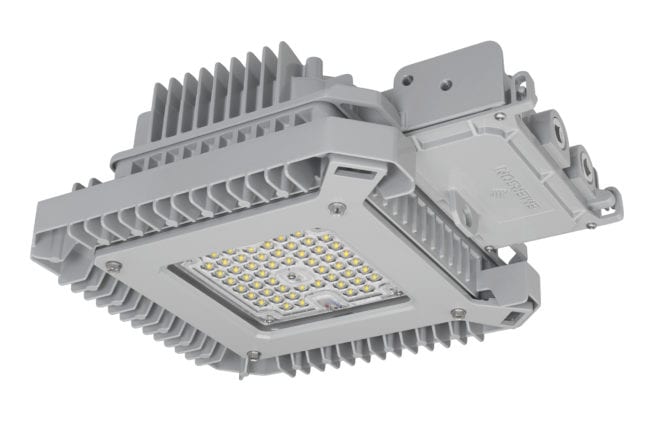
The Baymaster is not a product that will ever appear on the shelves of a home center, and it will never be reviewed by the consumer electronics press. It is an industrial tool, designed for industrial environments, sold through industrial distribution channels, and specified by engineers who understand the difference between a light that works in a clean, air‑conditioned office and a light that must function reliably in a refinery where the ambient temperature swings from minus‑40 degrees Fahrenheit to 149 degrees, where flammable gases may be present, where saltwater spray and corrosive chemicals are part of the daily environment, and where a failed light is not an annoyance but a safety incident waiting to happen. The Baymaster is built for these environments, and the engineering that went into it reflects a deep understanding of what industrial lighting actually requires—which is, it turns out, something very different from what a consumer or even a commercial lighting product provides. It is a luminaire designed to be installed once, to operate for decades, and to survive whatever the environment throws at it, all while producing a consistent, high‑quality light that meets the specific needs of the application, whether that application is illuminating a narrow aisle in a warehouse, flooding a wide bay in a manufacturing plant, or providing precise, glare‑free illumination in a chemical processing facility where color accuracy and shadow elimination are critical to safety and productivity.
The Quick‑Mount Pendant System: One Electrician, One Ladder, One Motion
The installation of a traditional high bay light is a multi‑person operation. The fixture itself is heavy—a typical HID high bay can weigh forty pounds or more, with a separate ballast assembly adding additional weight and complexity. It must be lifted to the mounting height, which is typically twenty to forty feet above the floor, and held in position while the electrical connections are made and the mounting hardware is secured. This requires at least two people: one to support the weight of the fixture, and one to make the connections. If a lift is used, the process is slightly easier but still requires coordinating the lift, the fixture, and the electrical work, often in a confined space with limited maneuverability. The entire installation can take an hour or more per fixture, and in a facility with dozens or hundreds of lights, the labor cost alone can be staggering. Emerson addressed this problem with a patented Quick‑Mount pendant system that fundamentally changes the installation process. The system consists of two components: a mounting hood that is pre‑wired to the building's electrical system, and the luminaire itself, which mates to the hood via a simple, intuitive alignment mechanism. The electrician first installs the mounting hood—a relatively lightweight component that can be handled by one person—and makes the electrical connections at ground level or from a ladder, without having to support the weight of the full fixture. The hood is secured to the existing conduit or pendant mount, and the wiring is completed and tested. Then the luminaire is lifted to the hood, aligned using clearly marked arrows, and locked into place with a simple twisting motion. The electrical connection is made automatically as the luminaire engages the hood, through a set of robust, self‑aligning contacts. No separate wiring step is required at the luminaire; no wire nuts, no terminal blocks, no taping. The luminaire simply plugs into the hood. The entire process—from lifting the luminaire to locking it in place—takes approximately one minute, and it can be performed safely and comfortably by a single electrician. The Quick‑Mount system reduces the labor required for installation by at least half, and because the electrical connections are made at the pre‑wired hood, the risk of wiring errors—reversed polarity, loose connections, improper grounding—is dramatically reduced. The system also makes future maintenance significantly easier. If a luminaire ever needs to be replaced or upgraded, the electrician simply unlocks it from the hood, lowers it to the ground, and lifts a new one into place. The hood remains in place, its wiring undisturbed. The swap takes minutes rather than hours, and it can be performed during a brief maintenance window rather than a scheduled shutdown. The Quick‑Mount system is not a gimmick. It is a genuine innovation that addresses the single largest cost driver in industrial lighting—labor—and it is one of the features that makes the Baymaster a compelling choice for facilities that are planning a large‑scale retrofit.
Secondary Optics: Tailoring the Light to the Space
One of the inherent limitations of traditional HID and fluorescent high bay fixtures is that their light distribution is largely fixed. The reflector and the lamp produce a specific beam pattern, and if that pattern is not ideal for the space—if it leaves dark spots in the aisles, creates glare on the work surfaces, or throws light where it is not needed—there is little that can be done to correct it short of replacing the entire fixture. The Baymaster addresses this with a system of secondary optics—interchangeable lenses and reflectors that shape the light output of the LED array into specific beam patterns optimized for different applications. Emerson offers four beam spreads: Aisle, Narrow, Medium, and Wide. An aisle beam is elongated, throwing light forward and backward along the length of the aisle while minimizing spill to the sides—ideal for warehouse racking, library stacks, or any long, narrow space where light is needed along the path but not on the shelves themselves. A narrow beam concentrates the light into a tight, focused pattern that reaches the floor from high mounting heights with minimal dispersion—ideal for very high bay applications, such as the ceiling of a power plant turbine hall, where the light must travel sixty feet or more before it reaches the work surface. A medium beam provides a balanced distribution that works well in most standard industrial bays. A wide beam floods the area with light, minimizing shadows and providing uniform illumination across a broad floor area—ideal for assembly lines, maintenance bays, and open manufacturing floors. The secondary optics also serve to eliminate the dark spots and glare that are characteristic of poorly designed LED fixtures. The optics shape the light so that it is evenly distributed across the target area, with no bright hot spots directly under the fixture and no dim zones between fixtures. The result is a lighting environment that is comfortable for workers, that does not create harsh shadows that could hide hazards, and that meets or exceeds the illumination levels required by OSHA and other regulatory bodies. The optics are a critical component of the Baymaster's overall performance, and they are one of the features that distinguish it from the many generic LED high bay fixtures that have flooded the market in recent years. Those generic fixtures often use simple, unshaped LEDs that produce a harsh, uneven light with significant glare—a light that is adequate for a parking garage but unacceptable for a precision manufacturing environment where workers must be able to see fine details clearly and comfortably for hours at a time. The Baymaster's optics ensure that the light is not merely bright, but good—comfortable, even, and appropriate for the task at hand.
Lumen Output, Color Temperature, and Energy Efficiency
The Baymaster is available in six lumen output levels, ranging from 9,500 lumens to 38,000 lumens, allowing the specifier to match the light output to the specific requirements of the space. A low‑bay application with a 15‑foot mounting height might require only the lowest output level, while a high‑bay application with a 40‑foot mounting height might require the highest. The availability of multiple output levels means that the facility is not forced to over‑light a space in order to achieve adequate illumination at the work surface—a common problem with single‑output HID fixtures, which are often installed with more wattage than necessary because the next size down would be insufficient. By matching the output to the application, the Baymaster reduces energy consumption and eliminates the waste of over‑illumination. The luminaire offers two color temperature options: 5000K cool white and 3000K CCT warm white. The cool white option provides a bright, neutral light that closely approximates the color of midday sunlight and that is ideal for environments where color accuracy and visual acuity are important—manufacturing, inspection, assembly, and quality control. The warm white option provides a softer, more yellow light that is often preferred in environments where a less clinical, more comfortable atmosphere is desired—employee break areas, some retail or commercial spaces, and areas where the cooler light of 5000K might feel harsh or institutional. The color rendering index (CRI) of the LEDs, while not specifically published by Emerson, is typical of high‑quality industrial LED products in this class—generally in the 80+ range, which is sufficient for all but the most demanding color‑critical applications. For industries where precise color discrimination is essential—textiles, printing, paint mixing—supplementary task lighting with a higher CRI may be necessary, but for the vast majority of industrial applications, the Baymaster's color quality is excellent. The energy efficiency of the Baymaster is one of its primary selling points. Emerson claims a reduction in energy consumption of approximately 65% when compared to traditional HID high bay fixtures producing equivalent illumination. This figure is consistent with the known efficiency improvements of LED technology over HID technology, and it is supported by the specific wattage and output figures for the Baymaster models. A facility that replaces 100 HID fixtures with Baymaster LEDs can expect to see a reduction in lighting energy consumption of roughly two‑thirds, which, depending on the local cost of electricity and the number of operating hours per year, can translate into tens of thousands of dollars in annual savings. The reduced energy consumption also reduces the load on the facility's HVAC system, because the heat generated by the lights—which, in the case of HID fixtures, is substantial—is no longer being dumped into the conditioned space. This secondary energy savings, while smaller than the direct lighting energy savings, is a meaningful bonus in facilities that are air‑conditioned.
Durability, Environmental Resistance, and Hazardous Location Ratings
The Baymaster is built to survive in environments that would destroy a conventional light fixture. The housing is constructed from copper‑free aluminum—an alloy that contains less than 0.4% copper, which makes it highly resistant to corrosion in marine and chemical environments. Copper is a common alloying element in aluminum, and it improves strength and machinability, but it also makes the aluminum susceptible to galvanic corrosion when exposed to saltwater or certain chemicals. By using a copper‑free alloy, Emerson has ensured that the Baymaster will not corrode, pit, or weaken when installed in coastal facilities, offshore platforms, chemical plants, or any other environment where salt or corrosive chemicals are present. The exterior finish is an electrostatically applied, baked epoxy‑clad coating that provides an additional layer of corrosion protection. The coating is applied as a dry powder, which is electrostatically attracted to the aluminum surface and then baked in an oven to form a hard, uniform, chemically resistant skin. Unlike wet paint, which can run, sag, or leave thin spots, the powder coat process produces a consistent, durable finish that will not chip, peel, or fade over the life of the luminaire. The exterior hardware—screws, bolts, hinges, latches—is made from stainless steel, which resists corrosion in even the most aggressive environments. The gaskets that seal the housing against moisture and contaminants are made from silicone rubber, a material that remains flexible and resilient over a wide temperature range and that resists degradation from ultraviolet light, ozone, and common industrial chemicals. The gaskets are designed to maintain their seal for the life of the luminaire, without requiring replacement or re‑tightening. The lens is made from high‑impact, UV‑stabilized polycarbonate, which is significantly more resistant to breakage than glass and which does not yellow or become brittle over time. The luminaire carries an IP66/67 rating, which means it is completely dust‑tight (the "6" rating) and protected against powerful water jets (the "6" in the second digit) and temporary immersion in water (the "7" in the optional second rating). In practical terms, this means the Baymaster can be hosed down during facility cleaning, can operate in heavy rain or snow when installed outdoors, and can survive temporary flooding without damage to the internal electronics. The luminaire is also rated for wet locations and carries Type 3R, 4, and 4X ratings for weather resistance. It is certified for marine outside type (saltwater) applications for the USA, making it suitable for docks, piers, shipyards, and offshore platforms. Most significantly, the Baymaster is available in configurations rated for use in hazardous locations—environments where flammable gases, vapors, or dusts may be present. The enclosed and gasketed design prevents the hot internal components of the luminaire from coming into contact with the external atmosphere, eliminating the risk of ignition. This makes the Baymaster suitable for use in chemical plants, refineries, grain elevators, and other facilities where a standard light fixture could pose a fire or explosion hazard. The Baymaster's instant‑on capability is another feature that distinguishes it from HID fixtures. HID lamps require a warm‑up period of several minutes before they reach full brightness, and if they are switched off, they must cool down before they can be restarted. The Baymaster, like all LED fixtures, turns on instantly to full brightness, with no warm‑up and no restrike delay. This is a significant safety advantage in environments where a momentary power interruption could plunge the facility into darkness, because the Baymaster will restore full illumination the instant power is restored. It also means that the lights can be switched on and off as needed, without the penalty of long warm‑up times, which encourages energy‑saving practices like turning off lights in unoccupied areas.
Lifespan, Warranty, and the 10‑Year Extension
The Baymaster's LED array is rated for a nominal luminaire life of 84,000 hours, which, at 24/7 operation, equates to approximately 9.6 years of continuous use. In a typical industrial facility operating two shifts per day, five days per week, the luminaire will last for decades before the light output depreciates below the level where replacement is recommended. The actual lifespan can exceed 200,000 hours depending on ambient temperature, because LEDs degrade more slowly at lower temperatures. The Baymaster's robust aluminum housing and efficient thermal management—the LED heat is conducted into the large aluminum body and dissipated into the surrounding air—ensure that the LEDs operate at a relatively low junction temperature, which extends their life and maintains their brightness over time. The luminaire is backed by a standard 5‑year warranty, which covers defects in materials and workmanship. This warranty can be extended to 10 years when the luminaire is equipped with secondary optics and 10kV surge protection—an option that Emerson recommends for all installations, and which adds a modest increment to the upfront cost. The 10‑year warranty is a statement of confidence in the product's durability, and it provides the facility owner with a guaranteed performance window during which any failure will be repaired or replaced at no cost. For a facility that is investing hundreds of thousands of dollars in a lighting retrofit, the extended warranty provides peace of mind and eliminates the risk of unexpected maintenance costs during the critical payback period. The warranty, combined with the energy savings, the reduced maintenance costs, and the utility rebates that are often available for LED retrofit projects, makes the Baymaster a financially attractive proposition for most industrial facilities, with a typical payback period of two to four years depending on the specific application and the local cost of electricity.
Appleton Baymaster LED High Bay Specifications
| Specification | Detail |
|---|---|
| Lumen Output Range | 9,500 to 38,000 lumens |
| Color Temperature Options | 5000K cool white, 3000K warm white |
| Beam Spread Options | Aisle, Narrow, Medium, Wide |
| Housing Material | Copper‑free aluminum |
| Finish | Electrostatically applied baked epoxy‑clad |
| Hardware | Stainless steel |
| Gaskets | Silicone rubber |
| Lens | High‑impact UV‑stabilized polycarbonate |
| IP Rating | IP66/67 |
| Ambient Temperature Range | ‑40°C to 65°C (‑40°F to 149°F) |
| Rated Luminaire Life | 84,000 hours (can exceed 200,000 depending on ambient temperature) |
| Mounting | Quick‑Mount pendant system |
| Input Voltage Options | 120‑277 Vac 50/60 Hz, 170‑300 Vdc, or 347‑480 Vac 50/60 Hz |
| Warranty | 5 years standard; 10 years with secondary optics and 10kV surge protection |
Conclusion: The High Bay Light That Industrial Facilities Deserve
The Appleton Baymaster LED High Bay luminaire is not a product that will generate excitement outside of the niche world of industrial lighting specification. It will not be reviewed on YouTube, it will not be the subject of breathless blog posts, and it will not appear in anyone's holiday gift guide. But for the facility manager, the electrical engineer, or the maintenance supervisor who is responsible for keeping a factory, a refinery, a wastewater treatment plant, or a chemical processing facility lit—safely, reliably, and cost‑effectively—the Baymaster represents a significant advance in the state of the art. It is designed to be installed quickly and safely, to operate for decades without maintenance, to survive in environments that would destroy conventional fixtures, and to produce a high‑quality, tailored light that improves safety and productivity. The energy savings—approximately 65% compared to HID—are substantial, and the reduced maintenance burden is, for many facilities, even more valuable than the energy savings. The available hazardous‑location ratings, the saltwater certification, and the wide ambient temperature range make the Baymaster suitable for the most demanding applications, and the optional 10‑year warranty provides assurance that the investment will be protected. The Baymaster is not the cheapest LED high bay on the market, and it is not intended to be. It is a premium industrial luminaire, designed and built to a premium standard, for applications where failure is not an option and where the long‑term cost of ownership matters far more than the upfront purchase price. For those applications, it is not merely a good choice. It is the right choice.
Comments 0
Leave a Comment