This review is the honest account of someone who went through the full assembly process, encountered the real-world imperfections that don't show up in product photos, and ultimately made a practical decision about whether this cart earns its place in a working shop. The short answer is: yes, with caveats. The longer answer is what follows.
Why a Mobile Lumber Cart?
Before getting into the specifics of the Grizzly T34006, it's worth understanding why a mobile lumber cart matters in the first place. For hobbyists and professionals alike, lumber management is one of those unglamorous but genuinely important aspects of shop organization. Poorly stored lumber warps. Improperly stacked boards create trip hazards. Material that's hard to access slows down every project it's needed for.A well-designed mobile lumber cart solves all of these problems simultaneously. It keeps boards organized by size or species, makes them easy to retrieve without disturbing everything else, and - critically - allows you to move your entire lumber inventory when your shop layout needs to change. That mobility is more valuable than it might initially seem.
I had been considering building a custom solution using 80/20 extrusions - a modular aluminum framing system that offers exceptional flexibility and a genuinely premium result. The custom route would have produced exactly what I wanted, sized precisely for my space and workflow. But custom builds take time, and I had an immediate need. The Grizzly T34006, available and ready to ship, became the practical choice over the ideal one.
Specifications: What You're Getting on Paper
The Grizzly T34006 is a substantial piece of equipment, and the numbers reflect that. The cart's footprint measures 60-1/2 inches by 30 inches - large enough to handle full-length dimensional lumber without overhang issues. At 58-1/2 inches tall, it keeps material at a comfortable working height without requiring you to bend down to floor level for retrieval.The weight capacity is genuinely impressive: 1,100 pounds distributed across four tiers. That's enough to hold a meaningful inventory of dimensional lumber, sheet goods cut-offs, and specialty boards without approaching the structural limits of the cart. For a shop that processes significant material volume, this capacity matters.
Mobility comes from eight casters - four fixed and four swivel - positioned to provide both stability when stationary and maneuverability when you need to reposition. The combination of fixed and swivel casters is a thoughtful design choice: pure swivel casters can make a loaded cart difficult to steer in a straight line, while the fixed casters provide directional control.
On paper, this is a well-conceived product. The dimensions are practical, the capacity is generous, and the mobility solution is sensible. The real-world execution is where the story gets more complicated.
Assembly: Where the Challenges Begin
Let me be straightforward about the assembly experience: it was more frustrating than it needed to be. Not impossibly difficult, not project-ending, but persistently annoying in ways that suggest quality control at the manufacturing level could be better.The first issue I encountered was with the caster plates. Proper alignment of caster plates is fundamental to how a cart rolls - misaligned plates mean uneven load distribution, irregular movement, and accelerated wear on the casters themselves. On my unit, the alignment was off enough to be immediately noticeable. This isn't the kind of imperfection you can talk yourself out of; it's visible, measurable, and requires attention during assembly rather than simply bolting things together as designed.
The second issue involved weld quality. Welds on fabricated steel products are always something worth inspecting, and the Grizzly T34006 showed inconsistency across the frame. Some welds were clean and solid. Others were noticeably uneven - not structurally catastrophic, but not the standard you'd hope for at this price point from a brand with Grizzly's reputation.
The Upright Support Problem
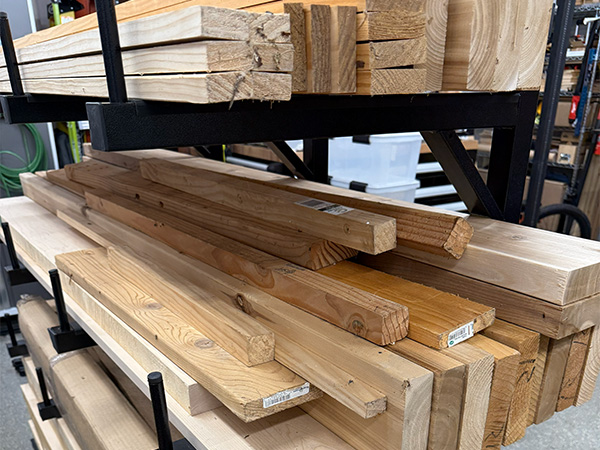
The most functionally significant issue I encountered involved the top arms of the upright supports. These arms are what longer boards rest against, and their evenness is directly related to how stable that material will be in storage. On my unit, the top arms were measurably uneven - one side sitting higher than the other.For shorter boards, this unevenness is manageable. For longer dimensional lumber - 8-foot or 10-foot boards that span the full width of the cart - it's a genuine concern. An uneven support surface means longer boards will tend to slide toward the lower side, potentially shifting the load distribution in ways that compromise the stability of the entire stack.
This is the kind of issue that requires shimming or adjustment during assembly rather than simply accepting the cart as it arrives. It's fixable, but it adds time and effort to a process that should be more straightforward.
The Top Shelf Gap Issue
Related to the dimensional inconsistencies throughout the frame, I also observed gaps on the top shelf that required shimming to ensure proper support for material stored there. Again - fixable, but not ideal. A shelf with gaps doesn't provide consistent support across its surface, which matters when you're storing material that can shift under its own weight.The shimming process itself isn't technically complex. But it's the kind of remediation work that shouldn't be necessary on a product that arrives as a finished, purchasable item. Every minute spent compensating for manufacturing inconsistencies is a minute not spent doing actual shop work.
Functionality: Where the Cart Earns Back Ground
After working through the assembly challenges and addressing the issues that required correction, something worth acknowledging emerged: the cart works. Despite the fit and finish concerns, despite the alignment issues and the uneven supports, the Grizzly T34006 does what a mobile lumber cart is supposed to do.The four-tier organization system makes it genuinely easy to sort and access material by size or type. The 1,100-pound capacity handles real-world lumber inventory without straining. The eight-caster mobility system, once properly aligned, allows the loaded cart to move reasonably well across a flat shop floor. And the overall footprint makes efficient use of shop space while keeping material accessible.
For managing lumber inventory - particularly in a shop that processes moderate to high material volume - the T34006 provides a viable short-term solution that meaningfully improves organization compared to leaning boards against walls or stacking them on the floor.
The 80/20 Comparison: What You Give Up and What You Gain
Throughout this process, I kept returning mentally to the 80/20 extrusion alternative I had initially considered. It's worth addressing that comparison directly, because it illuminates what the Grizzly T34006 is and isn't.An 80/20-based custom lumber cart would offer superior fit and finish, precise dimensions, complete customizability, and a result that's exactly tailored to your specific space and needs. The modular aluminum system produces tight tolerances, clean connections, and a genuinely premium result. There would be no misaligned caster plates, no uneven welds, no shimming required.
What it would require is time - design time, sourcing time, and build time. For someone with an immediate need and a pressing project schedule, that time investment isn't always available. The Grizzly T34006's primary advantage isn't quality - it's availability and speed. You order it, it arrives, you assemble it, you use it. The custom alternative requires weeks of planning and fabrication.
Knowing this going in changes how you evaluate the product. If you're expecting a premium, precision-engineered solution, the T34006 will disappoint. If you're looking for a functional, quickly-deployable lumber management system that you can modify or replace later, it becomes much more defensible.
Long-Term Outlook and Potential Modifications
I approached the Grizzly T34006 from the beginning with the understanding that it was a temporary solution - something to address an immediate need while leaving open the possibility of a more refined replacement down the road. That framing has proven useful.The cart's steel construction makes it relatively amenable to modification. The uneven upright arms could be addressed with fabricated shims welded in place. The caster alignment could be corrected with appropriate adjustments during assembly. The top shelf gaps could be filled with added material. None of these modifications are complex, and all of them would meaningfully improve the long-term functionality of the cart.
Whether those modifications are worth the investment depends entirely on your situation. If you're planning to replace the cart within a year or two with something better, extensive modification may not make sense. If you're looking for a longer-term solution that you're willing to invest in improving, the T34006 provides a reasonable foundation to work from.
Final Verdict
The Grizzly T34006 mobile lumber cart is a product of genuine utility and genuine frustration in roughly equal measure. Its capacity, footprint, and mobility solution are well-conceived. Its fit, finish, and dimensional consistency fall short of what the price point should deliver.For shops that need a functional lumber management solution quickly, without the time investment of a custom build, it does the job. For buyers expecting precision engineering and premium quality control, it will disappoint.
Go in with realistic expectations, plan for some remediation work during assembly, and treat it as what it is - a practical, imperfect tool for a specific organizational problem - and the T34006 delivers reasonable value. Expect more than that, and you'll find reasons to be frustrated at nearly every stage of the process.
The lumber is organized. The shop is cleaner. The cart rolls. For now, that's enough.
Comments 0
Leave a Comment