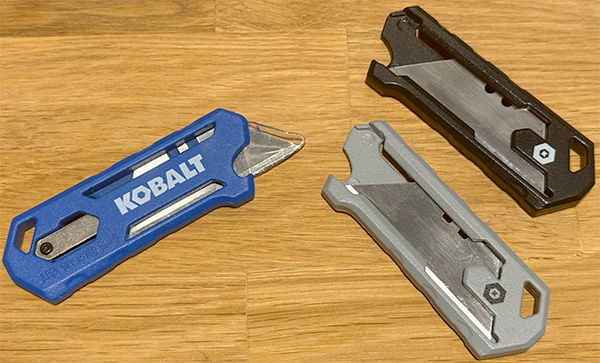
This past holiday season, that itch led me straight to Lowe's, where a new wave of utility knives had quietly made its debut: the Kobalt EDC-style mini knife set, a collaboration with Gil-Tek, inspired by the beloved RUK model.
At first glance, everything looked promising. The packaging was clean, the branding was familiar, and the price - $9.98 for a set of three - was the kind of number that makes you reach for your wallet without thinking twice.
I placed the order online, conveniently bundling it with other purchases to hit that $35 threshold for free shipping. A few days later, the package arrived. I tore it open with the kind of quiet excitement that only fellow tool enthusiasts truly understand.
What followed was a lesson I've learned before, but apparently needed to learn again: price alone is never the whole story.
First Impressions : Promising on the Surface
Let's give credit where it's due. Out of the box, the Kobalt EDC mini knives looked decent enough. The construction appeared adequate - nothing extraordinary, but nothing that immediately screamed cheap either.The form factor was compact and pocketable, staying true to the EDC (Every Day Carry) philosophy that has made tools like the Gil-Tek RUK so popular among tradespeople, hobbyists, and everyday users alike.
The concept behind the EDC utility knife is simple but brilliant: take the functionality of a standard utility knife and shrink it down into something you can comfortably carry in your pocket.
No bulky housing. No unnecessary weight. Just a clean, functional cutting tool that's there when you need it.
The Kobalt version appeared, at least visually, to be a worthy entry into this category. But appearances, as they say, can be deceiving.
The Operation Problem : Frustrating and Potentially Unsafe
Here's where things started to unravel. The Kobalt EDC mini requires a specific sliding motion to operate - a mechanism that, in theory, should feel intuitive and smooth.In practice, it was anything but.
The motion felt awkward, requiring a deliberate and somewhat unnatural hand position to execute correctly. For a tool that's supposed to be deployed quickly and effortlessly, this is a major drawback.
But awkward isn't the worst word here - potentially unsafe is more accurate.
When working with a blade, you need confidence in your grip and control. Any hesitation introduces risk. The Kobalt's mechanism created exactly those moments.
A utility knife should feel like an extension of your hand. This one felt like a puzzle.
The Oiled Blade Problem : A Slippery Slope
If the operation was frustrating, the oiled blades made things worse. While oil is common for rust prevention, in this case it created unnecessary difficulty.The slippery surface made blade removal genuinely difficult. Two knives were manageable with effort. The third? Completely stuck.
A brand-new tool, never used, already failing at its most basic function.
This isn't a minor inconvenience - it's a clear quality control issue.
Comparing to the Gil-Tek RUK : Night and Day
To understand the gap, you have to look at what it's trying to imitate. The Gil-Tek RUK is a precision-machined aluminum utility knife, built with tight tolerances and smooth operation.It has earned its reputation through consistent, real-world performance.
The Kobalt version, by contrast, appears to use cast aluminum - a cheaper process that results in less precision and a rougher finish.
The difference is noticeable both visually and in hand: machined aluminum feels precise; cast aluminum feels approximate.
At $3.33 per knife, the price is appealing. But in a tool you rely on daily, that difference becomes a matter of safety-not just preference.
The Return : An Easy Decision
After testing all three knives, the decision to return them was easy. Lowe's return process was simple, and within days, the set was on its way back.To be fair, not every tool needs to be premium. For occasional, light use, this set might be sufficient.
But for daily users - contractors, electricians, warehouse workers - this is not a tool I can recommend.
What This Experience Teaches Us About Buying EDC Tools
- - Ergonomics matter more than aesthetics. A tool can look great, but if it doesn't feel right in your hand, it will fail you.
- - Price per unit can be misleading. Cheap upfront doesn't always mean good value over time.
- - Safety is non-negotiable. Any hesitation while using a blade is a red flag.
- - Collaborations don't guarantee quality. A brand name alone doesn't ensure execution.
The Bottom Line
The Kobalt EDC mini knife set had the right idea-but failed in execution.If your budget allows, invest in the Gil-Tek RUK. It's more expensive, but delivers reliability, confidence, and long-term value.
If budget is tight, consider mid-range options instead. There are better choices in the $10–$20 range.
Look beyond the price tag. Understand the mechanism. And whenever possible, get the tool in your hand before buying.
Your safety - and your sanity - will thank you.
Comments 0
Leave a Comment