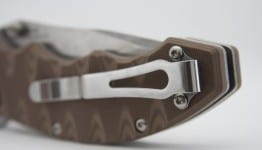
The 300SN is not Benchmade's most celebrated model. It does not possess the sleek, organic lines of the 940 Osborne or the intimidating presence of the Adamas. What it offers instead is a carefully considered synthesis of work‑ready features wrapped in a handle that accommodates gloved hands, a blade that balances slicing efficiency with tip strength, and the legendary AXIS lock mechanism that has defined Benchmade's reputation for over two decades. Over the past several weeks, I have carried the 300SN through days of yard work, garage reorganization, and volunteer construction projects, often while wearing heavy leather gloves. I have cut rope, cardboard, plastic sheeting, rubber hose, and the occasional stray branch. Through it all, the 300SN has performed with the quiet competence of a tool that knows exactly what it is and does not feel compelled to apologize for its intentional lack of frivolity.
First Principles: The 154CM Blade and Drop‑Point Geometry
The heart of any knife is its blade, and the 300SN is built around a 3.22‑inch drop‑point blade forged from Crucible 154CM stainless steel. 154CM is an American‑made alloy that has been a staple of premium production knives for decades, and for good reason. It contains roughly 1.05% carbon, 14% chromium, 4% molybdenum, and a small amount of vanadium, yielding a steel that offers excellent edge retention, good corrosion resistance, and sufficient toughness to resist chipping under hard use. It is not the newest or most exotic steel on the market—S30V, S35VN, and M390 have nudged it aside in the spec‑sheet wars—but 154CM remains a thoroughly competent performer that sharpens more readily than many of its powder‑metallurgy successors while holding an edge far longer than budget steels like AUS‑8 or 8Cr13MoV.
The blade on the 300SN is ground with a swedge—a shallow, unsharpened bevel along the spine that begins near the pivot and runs two‑thirds of the way to the tip. The swedge serves no cutting function; it is purely aesthetic, but it dramatically refines the profile of the blade. It gives the 300SN a sleek, almost aerodynamic silhouette that suggests speed and precision. More importantly, the swedge reduces weight toward the tip without sacrificing the robust point that a drop‑point design provides. The tip is acute enough for piercing tasks—opening clamshell packaging, starting a hole in drywall, marking a precise point in wood—but thick enough behind the swedge to survive lateral pressure that would snap a more needle‑like profile. The primary edge is a full flat grind, meaning the blade tapers continuously from spine to cutting bevel. This geometry minimizes drag through material and makes the 300SN an exceptionally efficient slicer. When cutting through double‑wall cardboard, the knife glides with noticeably less resistance than a saber‑grind blade of similar stock thickness.
Out of the box, the factory edge is serviceable but not exemplary. It will slice printer paper and shave arm hair with some effort, but it does not possess that hair‑whittling, push‑cutting sharpness that knife enthusiasts obsess over. This is typical of Benchmade's production edges, which are applied by machine and tend to be slightly toothy. A few minutes on a Spyderco Sharpmaker or a leather strop loaded with diamond compound transforms the edge into something far keener. The 154CM responds well to sharpening; it does not fight the stone the way some high‑vanadium steels do, and it takes a polished edge with minimal effort. Once dialed in, the edge retention is impressive. After breaking down a week's worth of shipping boxes—roughly thirty mixed‑size cartons—the blade was still cleanly slicing receipt paper with no perceptible dulling. Only after adding several dozen cuts through heavy nylon rope and plastic strapping did the edge begin to show the first signs of wear, and even then a quick stropping restored it to near‑peak sharpness.
The AXIS Lock: Benchmade's Signature Mechanism and Why It Matters
No discussion of a Benchmade knife is complete without examining the AXIS lock, the ambidextrous mechanism that has become synonymous with the brand. Invented by Bill McHenry and Jason Williams and licensed exclusively to Benchmade, the AXIS lock operates on an elegantly simple principle: a spring‑loaded steel bar slides back and forth in a channel milled into both steel liners. When the blade opens, the bar moves forward into a notch in the blade tang, physically blocking the blade from closing. To release the lock, the user pulls the bar rearward with thumb and forefinger, freeing the tang and allowing the blade to pivot closed. There is no liner to push aside, no frame lock to press against; the motion is symmetrical and intuitive for both right‑ and left‑handed users.
The advantages of the AXIS lock are numerous. It is exceptionally strong—Benchmade rates it to withstand hundreds of pounds of static force, far beyond what a folding knife would encounter in normal use. It is completely ambidextrous, with no favoritism toward either hand. It allows the blade to swing freely once the lock is disengaged, enabling one‑handed closing without placing any fingers in the path of the edge. And because the lock bar is a substantial piece of steel rather than a thin leaf, it resists wear and deformation over thousands of cycles. The AXIS lock on the 300SN operates with the smooth, hydraulic feel that Benchmade has perfected over the years. There is no gritty drag, no sticky engagement, no tendency to jam. The bar slides rearward with light pressure, the blade drops to approximately 90 degrees, and a flick of the wrist sends it home. It is a mechanism that rewards familiarity, and once you have used an AXIS lock for a week, returning to a liner lock or frame lock can feel like a step backward.
Deployment: The Flipper That Requires a Flick, and Why That Is a Feature, Not a Bug
The 300SN is a manual flipper, not an assisted opener. This is an intentional design choice that aligns with Benchmade's philosophy of offering knives that are legal in jurisdictions where assisted‑opening mechanisms are restricted and that do not rely on a torsion spring that can fatigue over time. The flipper tab protrudes from the spine when the blade is closed, shaped with a flat, textured face that provides excellent purchase for the index finger. To deploy the blade, the user presses rearward on the flipper while simultaneously giving the wrist a gentle flick. The combination of flipper pressure and wrist momentum drives the blade through its arc and locks it securely open. The action is not the fall‑shut, bearing‑smooth glide of some high‑end manual knives; it requires a deliberate, intentional flick. This is not a deficiency. It is a characteristic that results from the deliberately strong detent and the weight of the blade, which is not heavy enough to carry itself through the full arc without some assistance from momentum.
The flipper tab doubles as a finger guard when the blade is open. It extends downward from the tang, creating a substantial barrier that prevents the index finger from sliding forward onto the cutting edge during a thrust. This is a critical safety feature for a work knife that will be used forcefully and in awkward orientations. The tab is large enough to catch the finger even when wearing heavy work gloves, and its textured surface remains grippy when wet. The thumb studs, which are present on both sides of the blade, are smaller and less aggressively textured. They can be used to deploy the blade with a slow, deliberate roll of the thumb, but they are clearly secondary actuators. The flipper is the primary interface, and the knife is designed around it.
Ergonomics and the Desert Sand G10 Handle: Grip, Comfort, and Glove Compatibility
The handle of the 300SN is constructed from desert sand G10 scales mounted over full stainless steel liners. G10 is a glass‑reinforced epoxy laminate that is prized in the knife industry for its exceptional strength‑to‑weight ratio, its resistance to moisture and chemicals, and its ability to accept aggressive three‑dimensional texturing without sacrificing structural integrity. The desert sand color is a warm, earthy tan that contrasts attractively with the satin blade finish and avoids the tactical black‑on‑black aesthetic that some users find off‑putting in mixed company. It is a color that says “tool” rather than “weapon,” and that subtle distinction matters in environments where pulling out a knife attracts attention.
The G10 scales on the 300SN are textured with a pattern that Benchmade describes as “tiger stripe” grooves—deep, machined channels that run diagonally across the handle in alternating directions. These grooves are not merely decorative. They provide significant mechanical grip, channeling sweat, water, and oil away from the palm and providing edges for the skin or glove to bite into. The texture is aggressive enough to prevent slipping during heavy cutting tasks, but not so rough that it abrades bare skin during prolonged use. For gloved hands, the grooves are transformative. The handle locks into the palm of a leather work glove with the kind of positive engagement that allows the user to focus entirely on the cutting task without worrying about the knife shifting or rotating. This is a knife that was clearly designed with gloved use in mind, and it excels in that environment.
The handle profile is generously sized, filling the hand with a full four‑finger grip in a standard hammer hold. The spine of the handle is gently arched, following the natural contour of the palm. The forward choil—formed by the flipper tab and a deep index‑finger notch—provides a secure purchase for choking up on the blade for detail work. The rear of the handle is rounded, with no sharp corners that could dig into the palm during extended use. At 0.59 inches thick, the handle is substantial enough to provide a comfortable grip without feeling blocky or cumbersome. The balance point is slightly forward of the pivot, giving the blade a livelier feel in the hand than the handle‑heavy balance of some other work knives.
The Deep‑Carry Clip: Low‑Rider Concealment and All‑Day Comfort
One of the most thoughtful features of the 300SN is its pocket clip. Benchmade designed this clip to position the knife deep in the pocket, with only a small portion of the handle visible above the pocket seam. This “low‑rider” carry style offers several advantages. First, it improves concealment; the knife does not advertise its presence, which is valuable in settings where discretion is appreciated. Second, it enhances comfort; a knife that rides high in the pocket can jab into the hip when seated, but the deep‑carry design keeps the handle parallel to the thigh and eliminates pressure points. Third, it reduces the risk of the knife being dislodged during activity; the deeper the knife sits, the less likely it is to catch on a seat belt, a ladder rung, or a protruding object.
The clip is reversible for tip‑up carry on either the left or right side, accommodating both right‑ and left‑handed users. It is not, however, a four‑position clip. Tip‑down carry is not an option, which may disappoint users who prefer to have the blade oriented for a quick overhead deployment. For most everyday carry applications, tip‑up is the standard preference, as it positions the blade against the rear seam of the pocket where it is protected from accidental opening. The clip tension is firm, holding the knife securely even during vigorous activity, but not so tight that it is difficult to slide onto a pocket. After weeks of daily use, the clip has shown no signs of bending or loosening.
Real‑World Testing: From Cardboard to Rope, the 300SN Absorbs Abuse
I tested the 300SN across a range of materials and tasks that approximate the kind of work a professional builder or weekend warrior might encounter. The knife was used to break down a mountain of cardboard shipping boxes—single‑wall, double‑wall, some reinforced with fiber tape. The full flat grind and acute edge made this work efficient; the blade sliced through corrugation with minimal resistance, and the handle remained secure in my hand even when my palm grew damp with sweat. After more than fifty boxes, the edge was still cutting cleanly, though the initial hair‑popping sharpness had faded to a working edge. A few passes on a ceramic rod restored it.
Next, I cut through three separate lengths of 1/4‑inch manila rope, each requiring multiple heavy‑pressure draw cuts. The blade bit deeply and tracked smoothly, with no tendency to bind or skate. The choil and flipper guard kept my index finger firmly in position, and the G10 texture prevented any hint of the knife rotating in my hand. Following the rope, I sliced through several layers of heavy rubber floor mat, the kind found in commercial gyms. The 154CM steel handled the abrasive material without chipping or rolling, and the edge remained serviceable. Only after cutting through a dozen heavy‑duty zip ties did I notice a subtle decline in sharpness, and that was restored in minutes.
Throughout all this testing, the AXIS lock never failed. The blade never wobbled, never drifted, never gave the slightest indication that it might close unintentionally. The flipper action became progressively smoother as the pivot wore in, though it never achieved the glass‑like glide of a well‑tuned bearing pivot. It remained a deliberate, mechanical action—more like cocking a well‑made bolt‑action rifle than flipping a switch on a spring‑assisted knife. For those who appreciate the tactile feedback of a manual mechanism, it is deeply satisfying. For those accustomed to the instant snap of a SpeedSafe or S.A.T. system, it may feel sluggish by comparison. But speed is not the point of this knife; control and reliability are.
What Is G10? A Brief Material Science Interlude
Because G10 is mentioned so frequently in knife reviews without explanation, a brief clarification may be helpful. G10 is a high‑pressure fiberglass laminate originally developed for the electronics industry as a substrate for printed circuit boards. It is manufactured by stacking layers of woven glass cloth soaked in epoxy resin, then compressing the stack under heat and pressure until the resin cures. The resulting material is dense, rigid, and exceptionally strong. It is impervious to water, resistant to most chemicals, and does not shrink, swell, or warp with changes in humidity or temperature. For knife handles, G10 offers a combination of strength, lightness, and grip that is difficult to match with metal or natural materials. It can be machined, textured, and colored in virtually any way the designer desires. The desert sand G10 on the 300SN is an excellent example of the material used to its full potential: attractive, functional, and durable enough to last multiple lifetimes.
Benchmade 300SN AXIS Flipper Specifications
| Specification | Detail |
|---|---|
| Blade Steel | 154CM Stainless |
| Blade Length | 3.22 inches |
| Blade Thickness | 0.12 inches |
| Handle Material | Desert Sand G10 over stainless liners |
| Lock | AXIS |
| Clip | Reversible deep‑carry (tip‑up, left/right) |
| Closed Length | 4.59 inches |
| Overall Length | 7.81 inches |
| Weight | 4.1 ounces |
| Country of Origin | USA |
Conclusion: A Work‑First EDC That Rewards Those Who Give It Time
The Benchmade 300SN AXIS Flipper is not a knife that seduces with curves or dazzles with exotic materials. It is a knife that earns respect through performance, the kind of tool that grows on you the more you use it. The 154CM blade, with its swedge‑refined drop‑point profile, cuts efficiently and holds an edge long enough for a full workday of demanding tasks. The desert sand G10 handle, with its deeply grooved texture, provides an exceptionally secure grip for bare hands and an even more confident purchase for gloved hands. The AXIS lock operates with the smooth, ambidextrous reliability that has made it an industry benchmark. The deep‑carry clip keeps the knife discreet and comfortable, and the flipper‑and‑thumb‑stud combination offers flexibility in deployment.
This is a knife that works best when you stop comparing it to other categories and accept it on its own terms. It is a manual flipper with a strong detent, not a spring‑assisted rocket. It is a heavy‑duty work knife with a compact enough footprint to serve as an everyday carry, not a lightweight gent's folder. It is a tool that asks you to learn its nuances—the precise flick of the wrist that deploys the blade reliably, the thumb position that avoids pressing against the AXIS bar during opening, the slight forward balance that makes cutting strokes feel more authoritative. If you are willing to invest that time, the 300SN will reward you with years of faithful service and a tactile experience that feels like shaking hands with an old friend every time you pull it from your pocket.
Comments 0
Leave a Comment