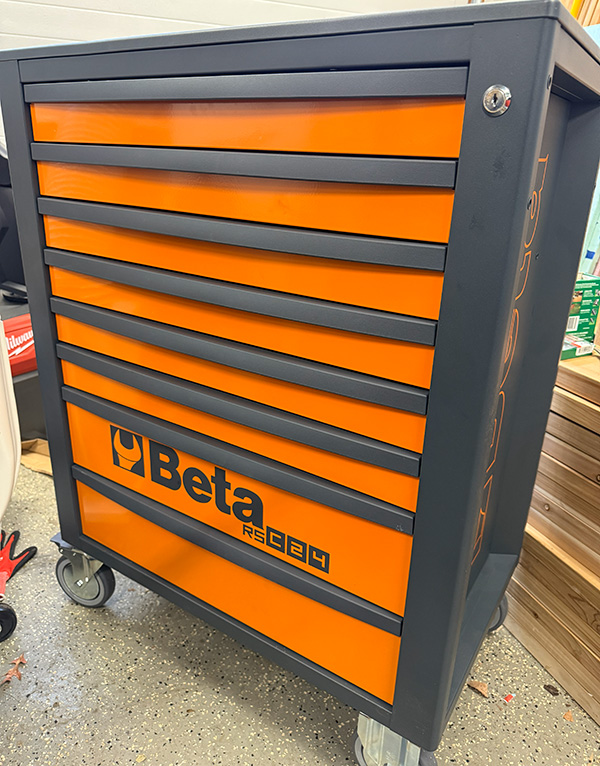
This isn't a review written in anger. It's a candid account of what happened when a product with a strong reputation, a premium price point, and years of anticipation behind it failed to deliver - and what that failure reveals about quality control, customer support, and the gap between brand heritage and actual product execution.
Years of Anticipation, Then a Complicated Start
I had been watching the Beta RSC24 for several years before finally deciding to purchase. Beta Tools carries a reputation built on Italian manufacturing heritage, professional-grade construction, and the kind of fit and finish that justifies a significant investment. For a serious tool user, that reputation matters. You're not just buying storage - you're buying into a standard of quality that's supposed to outlast the tools it holds.When I finally placed orders for two units, what followed was immediately frustrating. Through a series of miscommunications and logistical complications, I attempted to cancel the orders - only to have both cabinets arrive anyway. Resolving the situation required a costly settlement with Zoro, the retailer involved, that left me holding two cabinets I had tried to return before they ever shipped.
The total cost for each cabinet, including shipping, exceeded $1,000. At that price point, expectations are not just reasonable - they're non-negotiable. A $1,000 tool cabinet needs to be excellent. What I received was considerably less than that.
First Impressions: What Initially Appealed
To be fair to the Beta RSC24, there are genuine design choices worth acknowledging. The shallow drawer configuration was a significant part of what drew me to this cabinet in the first place. Shallow drawers force better organization - tools stored in shallow drawers are visible and accessible in ways that deep drawers simply don't allow. For someone who values workflow efficiency, a cabinet designed around shallow storage makes a meaningful practical difference.The overall aesthetic also delivered on the promise of Italian design sensibility. The RSC24 looks like a premium product. The lines are clean, the proportions are considered, and the visual impression on first encounter is positive. For a brief window before the closer inspection began, the cabinet appeared to justify the investment.
That window closed quickly.
The Documentation Problem: A Surprising Failure
The first concrete indication that something was off came before I had even begun using the cabinets: the near-total absence of documentation. No installation guide. No customer support contact information. No clear point of contact for questions, warranty claims, or product issues.For a product at this price point, the lack of documentation isn't just an inconvenience - it's a signal. Well-supported premium products come with comprehensive documentation because the manufacturers behind them expect to stand behind their products. The absence of that documentation suggests either that Beta didn't anticipate needing to support the RSC24 post-sale, or that the support infrastructure simply wasn't in place for the North American market.
Either explanation is problematic. Both reflect poorly on the overall ownership experience.
Installation: Simple, But Not Without Issues
The physical installation of the RSC24 was, to its credit, relatively straightforward. The assembly process didn't require specialized tools or technical expertise, and the basic structure came together without significant difficulty.The exception was the fixed caster bolts. Accessing these bolts during installation proved unnecessarily challenging - a design detail that suggests the cabinet was engineered without full consideration of the assembly experience. On a product where you're paying for precision and thoughtfulness, that kind of oversight stands out.
It's a minor issue in isolation. In the context of everything else that followed, it was an early indicator of a broader pattern.
The Handle Failure: Small Problem, Large Implications
Shortly after installation, the handle detached from one of the cabinets. On its own, a detached handle is a minor mechanical failure - the kind of thing that happens occasionally with any product and that a competent customer support operation resolves quickly. You contact support, describe the issue, receive a replacement part, and move on.Except there was no readily accessible support to contact. Remember the missing documentation? This is where that absence becomes genuinely consequential. A minor hardware failure became a significant frustration because the pathway to resolution simply wasn't clear. I was left holding a $1,000+ cabinet with a detached handle and no obvious way to get it addressed.
The handle failure, in isolation, was a small problem. The support vacuum surrounding it transformed it into a meaningful indictment of the ownership experience.
Quality Control Issues: A Pattern Emerges
The handle was only the beginning. Closer inspection of both cabinets revealed a constellation of quality control issues that, taken together, painted a concerning picture of manufacturing standards.The most immediately noticeable issue was drawer scraping - drawers that didn't slide smoothly and cleanly, but instead caught and dragged in ways that suggested misalignment or dimensional inconsistency in the drawer slides. On a cabinet positioned as a professional-grade product, smooth drawer operation is a fundamental expectation, not a premium feature.
More puzzling was the appearance of an unexplained dark powder residue inside the drawers. The source of this residue wasn't immediately apparent, which raised questions about the internal finishing process and what, exactly, the residue consisted of. For a cabinet designed to store precision tools, contamination of any kind is a concern worth taking seriously.
The back panel presented perhaps the most structurally significant issue: a wobbly panel secured with non-welded tabs rather than proper welds. On a steel cabinet designed to hold significant weight and withstand the regular movement and vibration of a working shop environment, non-welded connections are a legitimate durability concern. Welding exists for good reasons - it's stronger, more permanent, and more appropriate for load-bearing structural connections. Tabs are a shortcut.
Drawer Performance: Inconsistent Across the Same Product
Of all the quality control issues encountered, the inconsistency in drawer performance was perhaps the most revealing. One drawer, upon inspection, performed satisfactorily - smooth operation, acceptable fit, nothing worth noting. The drawer beside it, in the same cabinet, required correction before it would function properly.This inconsistency within a single unit is the clearest possible evidence of quality control failures at the manufacturing level. It's not that the RSC24 is universally poorly made - it's that the manufacturing process lacks the consistency to ensure that every component meets the same standard. On a premium product, that inconsistency is unacceptable. You're paying for reliability, and reliability requires consistency.
The Soft Wheels: Final Insult
The scratched soft wheels were, in the grand scheme of things, the least significant issue with the RSC24. They're a cosmetic concern rather than a functional one. But they matter because they speak to the care - or lack thereof - applied to the product between manufacturing and delivery.Soft wheels scratch when they're handled carelessly during packaging or shipping. Scratched wheels on a premium product suggest that the premium experience was never fully considered beyond the manufacturing floor. For a buyer who has invested $1,000+ in a cabinet, discovering cosmetic damage on components that should have been protected communicates that the brand doesn't value the purchase as much as the buyer does.
Italian Heritage vs. Real-World Execution
Beta Tools' Italian manufacturing heritage is central to its brand identity and, to a significant degree, to its pricing. "Made in Italy" carries associations with craftsmanship, precision, and quality standards that command and justify premium pricing in many product categories. The RSC24 is positioned as a beneficiary of that heritage.The experience of actually owning and using the RSC24 raises uncomfortable questions about the gap between that heritage and current product execution. Heritage is historical - it describes what a brand has been. Execution is present - it describes what a product actually delivers today. When those two things diverge significantly, heritage becomes marketing rather than meaningful quality assurance.
I'm not in a position to assess whether the issues I encountered are representative of all RSC24 units, or whether my experience reflects a particularly unfortunate production run. What I can say is that at $1,000+ per cabinet, any level of quality inconsistency is difficult to defend.
The Bottom Line: Does the RSC24 Justify the Investment?
Based on my experience, the honest answer is: no, not for most users.The shallow drawer design remains genuinely appealing, and the visual presentation of the cabinet delivers on its premium positioning. But the quality control failures - the scraping drawers, the dark powder residue, the non-welded back panel, the detached handle, the scratched wheels - represent a pattern of manufacturing inconsistency that undermines the case for the RSC24 at its current price point.
The complete absence of accessible customer support compounds every individual issue. A premium product with strong support infrastructure can recover from manufacturing imperfections. A premium product with no clear support pathway cannot. When something goes wrong - and with the RSC24, something will go wrong - you're largely on your own.
There are tool storage options at similar and lower price points that deliver more consistent quality, better documented support processes, and a more reliable ownership experience. Until Beta Tools demonstrates a meaningful commitment to quality control consistency and accessible customer support for the North American market, it's difficult to recommend the RSC24 as a worthwhile investment for serious tool users.
The anticipation was years in the making. The disappointment took considerably less time to arrive.
Comments 0
Leave a Comment