This is the full story of that evolution - from hesitation to recommendation - and why the journey took longer than it should have.
First Impressions : The Hesitation Was Real
When the BDST3IN1CTFF arrived, my early observations were mixed. The 3-in-1 concept is appealing in theory - one piece of equipment replacing three specialized tools, storing in the space of one, converting between configurations as your task demands. But multi-function products have a well-earned reputation for compromising on each individual function in service of the flexibility promise. A cart that does three things adequately is often less useful than a specialized cart that does one thing exceptionally well.That concern kept me from committing to a final assessment for longer than it should have. I wanted to conduct a thorough evaluation before drawing conclusions, and that caution - while professionally defensible - delayed getting this review in front of the people who could benefit from it. That delay, in retrospect, was a mistake. The cart earned a clearer verdict sooner than I gave it credit for.
The Three Configurations : What You're Actually Getting
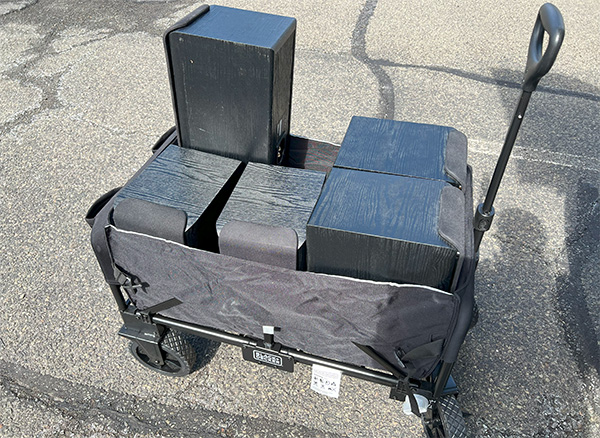
Before getting into performance, it's worth understanding what the three configurations actually look like in practice, because the marketing description doesn't fully convey how the transitions work or how different each mode feels in use.The traditional wagon configuration is the default mode - four wheels, upright sides, the familiar form factor that most people associate with a utility wagon. Black & Decker includes an optional fabric liner for this mode, which transforms the hard-sided frame into something more appropriate for carrying irregularly shaped items or anything you don't want sliding around on a metal surface. The liner is a thoughtful addition, and it's the kind of detail that suggests the product was designed by people who thought about actual use cases rather than just the engineering challenge.
Remove the liner, lower the sides, and the wagon converts into a compact flat wagon - a low-profile flatbed configuration suited for larger, flatter items that don't need containment. This mode gets less attention in most reviews, partly because it's less visually dramatic than the hand truck conversion, but it's genuinely useful for moving sheet goods, large boxes, or anything that needs a stable flat platform rather than a contained cargo area.
The hand truck mode is the most dramatic conversion and the one that makes the BDST3IN1CTFF genuinely distinctive in its category. Tipping the cart upright and deploying the hand truck configuration gives you a two-wheel upright dolly with a 150-pound load capacity - functional for stair navigation, tight hallways, and the kind of vertical transport that a four-wheel wagon simply can't handle.
The 150-Pound Capacity : More Useful Than It Sounds
A 150-pound load capacity sounds modest until you start thinking about what actually needs to be moved in real-world applications. The average large cardboard box packed for a move weighs somewhere between 30 and 50 pounds. A full load of charitable donations - the application that ultimately became my most substantive test of this cart - can easily reach 80 to 100 pounds without feeling excessive. Stack two substantial loads together and you're approaching the capacity limit in ways that test the structure meaningfully.The BDST3IN1CTFF handled these loads without the structural complaints - the flexing, the wobbling, the sense that the equipment is struggling - that characterize lesser transport equipment. The construction felt genuinely robust under load, not just adequate. That distinction matters more than it might seem. Equipment that performs confidently under load encourages you to use it for tasks you'd otherwise approach with uncertainty. Equipment that feels marginal under load gets avoided for anything serious, which defeats the purpose of having it.
The Rummage Sale Test : Real-World Validation
The most practically illuminating test came from an entirely unglamorous task : transporting donations to a local church rummage sale. This is exactly the kind of application that reveals whether a piece of transport equipment is genuinely useful or merely theoretically capable - irregular loads of varying sizes and weights, repeated loading and unloading cycles, navigation across parking lots and through doorways, and the cumulative physical demand of a task that continues until everything is moved.The BDST3IN1CTFF handled the rummage sale task with a straightforwardness that, in retrospect, is the best possible endorsement. It didn't require careful loading strategy to remain stable. It navigated across uneven pavement without drama. It converted between configurations when the situation called for it without requiring tools or significant effort. And - perhaps most valuably - it eliminated the back strain that would have accumulated across the same number of trips with manual carrying.
That last point deserves emphasis. The ergonomic benefit of proper transport equipment isn't just comfort - it's sustained capability. Manual carrying over multiple trips creates fatigue that compounds with each load. Equipment that handles the weight mechanically preserves your physical capacity for the rest of the day's work. For anyone managing a task that involves significant material volume - a rummage sale, a move, a job site cleanout - that preservation of physical capacity has real practical value.
Large Boxes and Bulky Items : Reducing Trip Count
Beyond the rummage sale, the BDST3IN1CTFF proved its utility across a broader range of applications involving large boxes and bulky items. The specific value here was trip reduction - the ability to consolidate what would have been multiple manual carries into a single cart load.Trip reduction sounds simple, but its practical impact is significant. Every unnecessary trip across a job site, parking lot, or storage facility costs time and physical energy. Equipment that consolidates loads effectively doesn't just save individual trips - it changes the economics of the entire task. A move that would take three hours with manual carrying might take ninety minutes with effective transport equipment. That difference is meaningful in ways that extend well beyond convenience.
The BDST3IN1CTFF's wagon configuration proved particularly effective for this application. The contained cargo area prevented items from shifting during transport, the 150-pound capacity accommodated consolidated loads without complaint, and the wheel configuration tracked smoothly across flat surfaces without the steering instability that affects some wagon designs under heavy loads.
The Durability Question : Addressed Directly
My previous experience with transport equipment in this category - collapsible carts, folding wagons, multi-function dollies - had established a baseline expectation of limited durability. The category has a well-documented problem : products that perform adequately in light use but reveal structural weaknesses under the kind of sustained, real-world loading that represents actual utility.The BDST3IN1CTFF's construction challenged that expectation. A year of use across varied applications - including loads that approached the 150-pound capacity limit - revealed no structural degradation, no joint loosening, no wheel bearing failure, and no conversion mechanism wear that affected the transitions between modes. The cart looks and performs today essentially as it did when it arrived.
That durability consistency across a year of real use is worth more than any initial impression. Products reveal their actual quality over time and under load, not in controlled first-use conditions. The BDST3IN1CTFF's durability record over the review period earned it a level of confidence that short-term testing couldn't have provided.
The Folding Storage Advantage
Storage footprint matters more than product reviews typically acknowledge. Workshop and garage space is finite, and transport equipment that doesn't earn its storage allocation - either through frequent use or through the confidence that it will perform when called upon - eventually gets displaced by equipment that does.The BDST3IN1CTFF folds to a compact footprint that genuinely minimizes its storage impact. This isn't a case where "folds flat" means something technically accurate but practically insufficient - the collapsed dimensions are small enough to slide behind a workbench, hang on a wall, or stack in a storage area without meaningfully displacing other equipment.
That storage efficiency has a secondary benefit : it makes the cart accessible. Equipment stored in inconvenient locations doesn't get used for tasks it could handle, because the friction of retrieval makes manual alternatives seem easier. Equipment stored accessibly gets used regularly, which means its value is realized rather than theoretical.
The $190 Price Point : Is It Justified ?
At $190 on Amazon, the BDST3IN1CTFF sits in a price range that requires genuine justification. This isn't an impulse purchase - it's a deliberate investment in a tool that needs to earn its cost through actual utility.The justification case rests on three pillars. First, the replacement cost : a dedicated wagon, a flatbed cart, and a hand truck purchased separately would cost considerably more than $190 in total, even at budget price points for each. The 3-in-1 functionality represents genuine consolidation value, not just marketing positioning.
Second, the durability factor : a year of real-world use with no structural degradation suggests a product that will deliver value over multiple years rather than requiring replacement after a single season of heavy use. Amortized across its useful life, $190 becomes a significantly smaller number per year of reliable service.
Third, the ergonomic value : back strain from manual carrying isn't just uncomfortable - it has real consequences for productivity and long-term physical health. Equipment that eliminates unnecessary physical strain has value that doesn't appear in a product specification sheet but manifests clearly in the quality of your workdays.
A Note on Black & Decker's Positioning
Black & Decker occupies an interesting position in the tool market - a brand with genuine heritage and broad recognition that sometimes struggles to be taken seriously by professional users who associate it primarily with entry-level equipment. That perception isn't entirely unfair, but it creates a tendency to underestimate the brand's capability in categories where it has invested meaningfully in product development.The BDST3IN1CTFF is a case where that underestimation would be a mistake. This is a thoughtfully designed, durably constructed, practically useful piece of equipment that delivers on its promises across a range of real-world applications. It rekindled my appreciation for what Black & Decker can produce when the product development process is oriented around genuine utility rather than price-point competition.
Final Verdict
The Black & Decker BDST3IN1CTFF 3-in-1 collapsible cart earns a straightforward recommendation for anyone seeking flexible, reliable transport equipment for home, garage, or light commercial use. The 3-in-1 versatility is genuine rather than gimmicky. The 150-pound capacity handles real-world loads without structural complaint. The durability has been validated across a year of actual use. And the folding storage configuration makes it practical to keep accessible rather than stored out of the way.At $190, it represents a worthwhile investment for anyone who regularly moves bulky items, manages charitable donations or small moves, or simply wants to reduce the physical toll of tasks that equipment should be handling. The skepticism I brought to this review a year ago has been fully replaced by confidence in the recommendation.
Sometimes the right tool for the job comes from a brand you weren't expecting to impress you. This is one of those times.
Comments 0
Leave a Comment