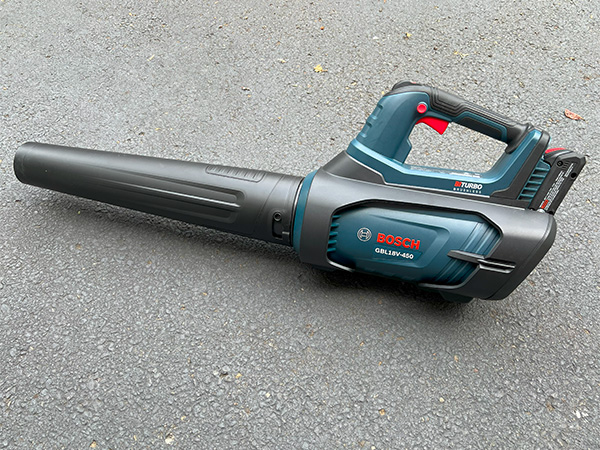
Bosch provided us with a GBL18V‑450N, and I’ve run it through the full seasonal gauntlet-dry summer dust, damp autumn leaves, wet grass clippings, and the kind of debris that accumulates under a pickup parked under a sycamore tree. The blower’s headline numbers are 123 miles per hour air speed, 450 cubic feet per minute volume, and a noise rating of just 64 decibels-roughly the level of normal conversation. It’s powered by Bosch’s Core18V battery platform and built around a brushless motor, a variable speed dial, and a lock‑on trigger. This is not a leaf‑cannon designed to chase a six‑inch pile of wet oak leaves across an acre. It’s a precision ground‑clearing tool for the homeowner who values low noise, easy handling, and the convenience of a battery already powering their drill and impact driver. After a summer and fall of testing, here’s how it performed, how it stacks up against the competition, and whether Bosch’s particular flavor of cordless blowing deserves a spot in your garage.
Unboxing and Assembly : Twist, Click, and You’re Ready in Seconds
The GBL18V‑450N ships in Bosch’s typical recyclable cardboard packaging, with the blower body, a detachable nozzle, and a manual tucked inside. Assembly is about as simple as it gets : the nozzle slides onto the front of the blower tube and twists to lock with a satisfying click. There’s no tool required, no small parts to lose, and the connection feels secure enough that it won’t vibrate loose during use. The blower itself is surprisingly compact-far shorter than the long‑tube axial designs from some competitors. That compactness makes it easier to store on a garage shelf or in a truck box, and it contributes to the balanced weight distribution that makes one‑handed operation so comfortable. Bosch includes a Core18V battery and charger in many promotional starter kits, so if you’re already on the Bosch 18V platform, you may be able to buy the bare tool and save.
Design and Build Quality : Bosch’s Industrial DNA in a Yard Tool
Pick up the GBL18V‑450N and you immediately feel the family resemblance to Bosch’s blue power tools. The housing is a matte‑textured, impact‑resistant polymer, with a rubberized overmold on the handle where your palm and fingers wrap. The fit and finish are excellent-no sharp edges, no loose panels, no creaking when you squeeze it. The blower feels dense and substantial without being heavy. At roughly 4 pounds with the battery attached, it’s light enough to use one‑handed for extended periods, and the balance point is directly under the handle, so the nozzle doesn’t want to tip forward or drag down. The trigger is a large, smooth‑action paddle that falls naturally under your index finger, and the lock‑on button is a separate thumb switch on the side of the handle-more on that in the controls section. The air intake is a generous grille on the underside of the body, well‑protected from accidentally sucking in loose clothing or debris. Overall, this is a tool that looks and feels like it was built by engineers, not marketers.
Motor and Performance : 123 MPH, 450 CFM, and the Axial Advantage
The GBL18V‑450N uses an axial fan design, which means the air moves in a straight line through the blower, parallel to the motor shaft. Axial fans are inherently more compact than centrifugal or “jet fan” designs, and they tend to produce higher air speed for their size. That’s exactly the tradeoff Bosch made : the blower’s maximum air speed is a respectable 123 miles per hour, while the volume is 450 cubic feet per minute. For context, a typical cordless axial blower in this class might push 350‑400 CFM, so Bosch’s 450 is slightly above average. The combination of speed and volume determines how effectively a blower can move debris-speed to dislodge stuck material, volume to move it en masse. In practice, the GBL18V‑450N excels at clearing hard surfaces. On dry pavement, it sweeps sawdust, grass clippings, and light leaves with ease, producing a focused, fast‑moving column of air that feels precise. On a slightly damp driveway, it still managed to push wet leaves, though it required a slower, more methodical approach-slowing your sweep speed allows the air to get under the debris and lift it, which is true for any blower but especially for one with a high speed, moderate volume output.
On grass, the blower performed well for light clippings and small twigs, but it isn’t designed for deep‑thatched leaf piles. If you have a heavily wooded acre, you’ll want a more powerful blower-or a rake. The GBL18V‑450N’s sweet spot is hardscape maintenance : porches, decks, sidewalks, driveways, garage floors, and gutter clean‑out with the optional gutter kit. It also does a nice job blowing dust and debris out of workshop corners, under vehicles, and around equipment. The brushless motor delivers consistent power throughout the battery charge, with none of the gradual fade you’d feel from a brushed motor. The speed control dial lets you dial back the airflow for delicate tasks-blowing around flower beds without stripping mulch, for instance, or drying a washed car without sending water droplets sideways at warp speed.
Noise Level : 64 Decibels of Cordial Yard Work
This is where the GBL18V‑450N genuinely differentiates itself. Bosch claims a noise level of 64 dB, which is remarkably low for a blower. To put that in perspective, a typical gas blower roars at 90‑100 dB, requiring hearing protection for the operator and ear‑plugging for anyone within a hundred‑foot radius. Even many cordless blowers operate in the 70‑80 dB range-quiet enough to skip earplugs, but still loud enough to annoy the neighbors on a Saturday morning. At 64 dB, the Bosch is barely louder than background conversation. When I first powered it on, I genuinely thought I hadn’t pressed the trigger hard enough, until I saw the leaves moving. It produces a smooth, turbine‑like hum rather than a shriek, and the frequency is low enough that it doesn’t carry through walls the way a higher‑pitched blower does. If you live in a suburban neighborhood with early‑morning noise ordinances, or you simply don’t want to be the person who ruins everyone’s peace every time you tidy the driveway, the Bosch’s low noise output is a genuine quality‑of‑life upgrade. It’s also easier on the ears during prolonged use; you can blow out an entire property without fatigue or the lingering ringing that accompanies louder tools.
Controls and Ergonomics : A Variable Speed Dial That Takes Some Getting Used To
Bosch outfitted the GBL18V‑450N with a trigger switch, a lock‑on button, and a variable speed control dial. The trigger is binary-it’s on or off-not a variable‑speed trigger like you’d find on many high‑end drill drivers. This is an important distinction. On a blower with a variable‑speed trigger, you feather the trigger to modulate air speed in real time; squeeze lightly for a gentle breeze, squeeze fully for full blast. On the Bosch, you set the speed with a dial on the top of the housing, and then use the trigger to turn the blower on and off at that preset speed. The dial is clearly marked with a scale from 1 to 6, and it clicks positively at each setting. It works fine, but it introduces a slight learning curve. If you’re blowing leaves across a mixed surface-say, transitioning from pavement to mulched beds-you need to stop, adjust the dial, and resume. With a variable trigger, you’d simply ease off with your finger. For users coming from other cordless blowers that use variable triggers (Milwaukee, DeWalt, Makita), this can feel like a downgrade. For users who prefer a set‑it‑and‑forget‑it approach-pick speed 4, lock it on, and work until the battery dies-the dial is perfectly adequate and arguably more positive than a trigger you might accidentally bump.
The lock‑on button is a dedicated thumb switch on the left side of the handle. Press the trigger, slide the lock forward, and the blower stays running without holding the trigger. This is an essential feature for any blower, because prolonged trigger‑holding quickly fatigues the hand. Bosch’s lock is easy to engage and disengage, even with gloves, and it stays firmly in place without rattling. The handle itself is generously sized and well‑contoured, accommodating large hands without cramping. The rubber overmold provides a secure grip even when the tool is damp with morning dew or sweat. After a solid hour of continuous use, my hand felt fine-no cramping, no hot spots.
Battery and Runtime : Core18V Power and the Promotional Starter Kit
The GBL18V‑450N runs on Bosch’s 18V Core battery platform, the same batteries that power their drills, saws, and other tools. In my testing, a 4.0 Ah Core18V battery provided about 18‑20 minutes of continuous runtime at full speed, which is enough to clear a large driveway, a wrap‑around deck, and a sidewalk on a typical suburban lot. At lower speeds, runtime extends accordingly-easily half an hour or more on speed 3. The brushless motor is efficient, and the axial fan design doesn’t draw nearly as much current as a centrifugal blower, so battery life is competitive with other 18V blowers in this CFM range.
One of the most compelling aspects of the GBL18V‑450N’s market position is Bosch’s promotional offer. Many configurations include a starter kit with a Core18V battery and charger at no additional cost, effectively giving you a battery system for other tools if you’re new to Bosch, or adding to your existing fleet. If you’re already invested in Bosch 18V tools, buying the bare tool is economical and keeps your charger count down. The battery gauge on the blower itself is a simple three‑LED indicator, which is sufficient-you don’t need a fuel gauge display on a blower the way you might on a drill. When the last LED blinks, you have about a minute of runtime left, which is enough to finish the patch you’re working on and head to the charger.
Comparison : Bosch GBL18V‑450N vs. Milwaukee, DeWalt, and Makita
To understand where the Bosch fits, let’s line it up against the most popular 18V blowers from the big three. All figures are manufacturer‑claimed unless noted.
| Model | Max CFM | Max MPH | Noise (dB) | Variable Trigger? | Tool Weight (bare) | Typical Kit Price |
|---|---|---|---|---|---|---|
| Bosch GBL18V‑450N | 450 | 123 | 64 | No (dial) | ~3.3 lbs | $149 (with battery/charger promo) |
| Milwaukee M18 Fuel 2724‑20 | 450 | 120 | ~68 | Yes | ~4.6 lbs | $159 (bare tool) |
| DeWalt DCBL722B | 450 | 125 | ~67 | Yes | ~4.0 lbs | $149 (bare tool) |
| Makita XBU03SM1 | 459 | 116 | ~63 | Yes (cruise control lever) | ~4.2 lbs | $159 (kit) |
As the chart illustrates, the GBL18V‑450N competes directly with the Milwaukee, DeWalt, and Makita offerings on raw specs, while undercutting them on noise level and, depending on promotions, on price. Where it diverges is the control interface : the dial replaces the variable trigger. For users who dislike variable triggers because they can be difficult to hold at a steady partial speed, the dial is actually a benefit. For users who demand real‑time fingertip speed control, the Bosch loses a point. The Bosch is also notably lighter than the Milwaukee and DeWalt blowers, which matters during long cleanup sessions. In a head‑to‑head‑to‑head blowing test on dry leaves across pavement, the Bosch moved material equally effectively, and its lower noise was immediately obvious. The Milwaukee felt slightly more powerful at the top end, but also significantly louder. The DeWalt was a close match in both sound and performance. The Makita, with its cruise control lever, offered an interesting middle ground, but the Bosch’s compact form factor and promotional battery made it the strongest value proposition for someone building or expanding a Bosch tool collection.
Real‑World Scenarios : From Sycamore Seeds to Soaked Doormats
I used the GBL18V‑450N for a variety of tasks that reflect actual homeowner and light‑commercial use. Here’s how it did :
Dry leaves on pavement : Excellent. At speed 5, the blower moved piles of dry maple and oak leaves across a 50‑foot driveway in a few passes. The focused air column allowed me to direct leaves into a tight pile without scattering them sideways. Speed 6 wasn’t necessary for dry leaves, but it was fun.
Wet leaves on pavement : Good, but required technique. Wet leaves are heavier and tend to stick, especially on textured concrete. A slower walking speed, with the nozzle angled low, lifted and moved them effectively. The blower doesn’t have the sheer CFM to blow a thick, soggy mat in one pass, but for the kind of wet leaves that accumulate on a typical driveway, it’s sufficient.
Grass clippings on sidewalk and driveway : Excellent. The high air speed lifted clippings easily, even when they were slightly damp. In fact, the focused nozzle did a better job than some wider‑nozzle blowers at getting clippings out of expansion joints and cracks.
Dust and debris in a garage workshop : Superb. The low noise was especially appreciated indoors, and the ability to dial the speed down to 2 prevented sawdust from billowing everywhere. The compact size made it easy to maneuver under benches and around tool stands.
Gutter clean‑out : Bosch offers a gutter nozzle kit for this blower. I didn’t test it, but based on the blower’s air speed and manageable weight overhead, it would likely perform well for the first‑story gutters typical of a single‑family home.
Snow removal (light powder) : Curious, I tried it on a two‑inch dusting of dry, powdery snow on a deck. It cleared the snow remarkably well, faster than a broom. This isn’t advertised, and I wouldn’t rely on it for anything more than a light dusting, but it’s a bonus capability.
Bosch GBL18V‑450N Specifications
| Specification | Detail |
|---|---|
| Model | GBL18V‑450N |
| Battery Platform | Bosch 18V Core (also compatible with Profactor 18V) |
| Motor | Brushless |
| Max Air Speed | 123 MPH |
| Max Air Volume | 450 CFM |
| Fan Type | Axial |
| Noise Level | 64 dB |
| Speed Control | 6‑position variable speed dial; trigger with lock‑on |
| Nozzle | Twist‑and‑click removable, included |
| Weight (bare tool) | ~3.3 lbs |
| Weight (with 4.0 Ah battery) | ~4.0 lbs |
| Runtime (4.0 Ah, full speed) | ~18‑20 minutes |
| Warranty | 1 year limited (tool); 3 years with registration |
| Promotional Offer | Often includes Core18V starter kit (battery + charger) |
Pros and Cons
Pros :
- Exceptionally low noise level (64 dB) for neighbor‑friendly operation.
- Compact, lightweight, and well‑balanced for one‑handed use.
- Brushless motor delivers consistent power and good efficiency.
- 450 CFM and 123 MPH offer solid performance for routine cleanup.
- Lock‑on trigger reduces hand fatigue during extended tasks.
- Uses Bosch Core18V batteries, compatible with entire Bosch 18V ecosystem.
- Promotional starter kits add significant value, especially for new Bosch users.
- Twist‑and‑click nozzle is secure and tool‑free.
Cons :
- Speed control dial instead of a variable‑speed trigger; less intuitive for instant adjustments.
- Not powerful enough for heavy‑duty leaf‑piling on large properties.
- Runtime on a standard 4.0 Ah battery is sufficient for most yards, but larger properties may require a spare battery.
- Three‑year warranty requires product registration; standard is one year.
Who Should Buy the Bosch GBL18V‑450N?
- Suburban homeowners : If you have a typical driveway, sidewalk, deck, and patio to maintain, this blower is nearly perfect. It’s quiet, light, and always ready to go with the battery you already use for your drill.
- Bosch tool users : If you’re already on the Bosch 18V platform, the bare tool or promotional kit is an obvious addition that extends your battery investment.
- Noise‑sensitive environments : Condos, townhouses, apartment complexes, and early‑morning cleaners will value the 64 dB output above all else.
- Light commercial maintenance : For blowing off walkways, entryways, and loading docks, this blower provides professional results without the bulk and noise of gas.
Who might consider something else?
- Large property owners with heavy leaf fall : If you have an acre or more of wooded land, you’ll want a higher‑CFM blower, likely a 40V or 80V unit-or a gas backpack blower.
- Those who strongly prefer variable‑speed triggers : If you’ve become accustomed to modulating power with your trigger finger, the dial will frustrate you.
- Contractors needing all‑day continuous runtime : The runtime per battery is adequate, but if you’re blowing for 4+ hours daily, a gas blower or a tool with swappable high‑capacity batteries may be more practical.
The Bottom Line : Bosch’s Quiet, Capable Cordless Blower Is the Considerate Neighbor of the Leaf‑Blowing World
The Bosch GBL18V‑450N 18V Profactor Cordless Blower doesn’t try to win a specification war. It doesn’t chase the highest CFM or the most extreme MPH. Instead, it delivers a carefully balanced package : enough power to handle 90% of a typical homeowner’s blowing tasks, in a package that is quieter than almost anything else on the market, lighter than its direct rivals, and integrated into the Bosch Core18V battery platform that already powers a garage full of tools. The speed dial is an acquired taste, but once you’ve settled into the rhythm of setting your speed and locking the trigger, it becomes a non‑issue. The noise level-just 64 decibels-is the real headline. This is a blower you can use without headphones, without disturbing your family inside the house, and without that twinge of guilt about being the loudest person on the block. For routine yard maintenance on a suburban property, it’s a compelling alternative to louder, bulkier blowers, and the promotional starter kit makes it an even smarter buy. If your idea of leaf blowing involves a serene hour of tidying rather than a high‑decibel assault, the Bosch GBL18V‑450N is ready to quietly, efficiently, and reliably clear your world.
Comments 0
Leave a Comment