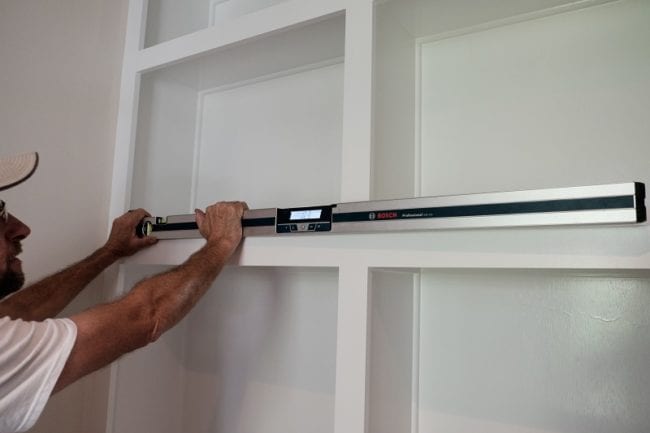
Bosch looked at that workflow and decided the level itself should be the digital angle finder. The Bosch GIM 120 48‑Inch Digital Level is a 4‑foot aluminum box beam that houses not only high‑contrast bubble vials but a precision inclinometer that resolves angles to one‑twentieth of a degree. Its backlit, auto‑rotating digital display shows measurements in degrees, percent slope, or inches per foot. An audible tone signals when you’ve hit level (0°) or plumb (90°), freeing your eyes to focus on the workpiece. A hold/copy button locks a reading so you can transfer it across the shop. Alignment arrows point you toward the adjustment direction. And the whole system is field‑calibratable, meaning you’re never at the mercy of a factory setting that drifted during shipping. At $199.99, it occupies the upper tier of production levels, competing with premium lasers and digital inclinometers on price, but offering a unique combination of traditional leveling interface and modern sensor precision.
We handed the GIM 120 to Matt Kent of Kent Made, LLC, an architectural woodworking and finish carpentry shop in Lakeland, Florida, known for built‑ins, stairs, and interior trim. Matt put the level through its paces on handrails, vaulted ceiling beams, and built‑in countertops. His verdict was nuanced : the GIM 120 is a game‑changer for angled applications, but its hyper‑accurate tolerancing and slight audible tone delay can frustrate on standard plumb‑and‑level tasks. That duality defines this tool. It’s not a replacement for every level on the truck, but it might be the best level you can buy for work that involves angles, slopes, and precision beyond what a bubble can deliver. Let’s break down every feature, every quirk, and every use case so you can decide whether the GIM 120 deserves a spot in your trailer.
What the GIM 120 Brings That a Traditional 48‑Inch Level Can’t
The first thing you notice about the Bosch GIM 120 is the digital module integrated into the center of the aluminum frame. It’s not an add‑on; it’s a flush‑mounted, sealed unit with a large backlit LCD that orients itself automatically. Tilt the level vertically, and the display rotates 90 degrees so the numbers remain right‑side up whether you’re checking level or plumb. Work above your head, and the angled display surface remains legible because the screen is positioned at roughly the same angle you’d naturally view it when looking up. This might seem like a small ergonomic detail, but anyone who’s ever held a digital inclinometer upside‑down on a ladder knows exactly how annoying a fixed‑orientation screen can be. The auto‑rotate feature means you never have to twist your neck or spin the tool to read a number.
The display shows four key pieces of information simultaneously : the current angle (in degrees, percent slope, or inches/foot), alignment arrows, a hold indicator, and a battery status icon. The alignment arrows are particularly clever—they point left or right, up or down, indicating which way you need to tilt the level to reach zero. Instead of watching a bubble and mentally translating its position into an adjustment direction, you just follow the arrows until the display reads 0.0° and the audible tone sounds. For quick, repetitive work—like checking the plumb of every stud in a row—this speeds things up dramatically because you’re not interpreting, you’re reacting.
The audible tone is a double‑edged sword, and we’ll discuss its delay later, but the concept is sound. You can set the GIM 120 to beep at level (0°) or plumb (90°). When it works as intended, you hear the beep, you stop adjusting, and you fasten. For a solo installer balancing a heavy cabinet on a ledger, being able to hear level confirmation without turning your head to look at a bubble is a safety and productivity win. The hold/copy button adds another layer of utility : find an angle on a staircase or a roof pitch, press hold, and the reading freezes on the display. You can then carry the level to your miter saw, refer to the frozen number, and set your bevel to match exactly. It’s a digital memory that doesn’t rely on your own.
Accuracy You Can Verify : ±0.05° and Field Calibration
The GIM 120’s accuracy specification is ±0.05° at 0° and 90°. That’s 1/20th of a degree. To put that into perspective, a traditional high‑end bubble level guarantees 0.0005 inches per inch, which over 48 inches equates to about 0.024 inches of deviation. The GIM 120’s angular tolerance translates to roughly 0.010 inches of vertical deviation across its 48‑inch length—less than half the potential error of a top‑tier bubble level. In practice, both accuracies are so tight that no human installer can reliably exceed them, but the digital readout gives you granularity that a bubble never will. You can see 0.1° increments, 0.1% slope increments, or 1/8‑inch‑per‑foot increments. That’s invaluable for ramps, stair stringers, and any application governed by code that specifies exact slopes.
Even more impressive is the field calibration feature. Traditional levels can’t be calibrated on site; if they’re out, they go back to the manufacturer or to the trash. The GIM 120 lets you perform a simple calibration procedure against a flat, level reference surface (like a granite countertop or a known‑good level). The process takes about a minute and resets the inclinometer’s zero reference. This means that if the level takes a hard drop and you suspect accuracy drift, you can verify and correct it right then, without job‑site downtime. For a tool that commands a $200 price tag, this feature alone can justify the premium over a fixed‑vial level, because it extends the useful life and ensures consistent accuracy.
Durability and Design : IP54 Protection in a Lightweight Aluminum Frame
Bosch built the GIM 120 around a rigid aluminum box beam that, at 48 inches and 1.5 pounds, feels substantial in the hand without inducing fatigue. The digital module is sealed into the frame with an IP54 rating, meaning it’s protected against dust that could interfere with the inclinometer and against splashing water from any direction. You can’t submerge it—don’t drop it in a foundation trench—but rain, conduit‑cutting coolant splatter, and jobsite grit won’t foul the electronics. The four AA batteries that power the display and inclinometer live in a weather‑sealed compartment, and the included protective carrying case cradles the level when it’s not in use, reducing the risk of storage‑induced damage.
The frame includes milled reference edges for scribing, and the end caps are impact‑resistant rubber that absorb shock from drops. The level’s light weight (1.5 pounds) partly results from the elimination of heavy glass vials; the digital inclinometer is a solid‑state sensor that weighs grams. The bubble vials that do exist are small secondary references, not the primary measurement method. For a carpenter accustomed to hoisting a 5‑pound steel level, the GIM 120 will feel almost too light, but that weight reduction is an ergonomic benefit on long days of up‑and‑down leveling.
In the Hands of a Pro : Matt Kent’s Real‑World Testing
We asked Matt Kent to integrate the GIM 120 into his daily finish‑carpentry workflow. His shop, Kent Made, specializes in high‑end built‑ins, staircases, and ceiling beam installations—exactly the kind of work that demands angle precision. His feedback was direct, practical, and free of marketing sugar‑coating.
Matt’s initial reaction to the build quality was positive. He appreciated the weight, calling it “substantial enough to feel solid but light enough to be a competitor in the 4‑foot level category.” That balance matters because a level that’s too light can feel insubstantial against a rough framing surface, while one that’s too heavy becomes a chore to lug up a staircase. The GIM 120 landed in his sweet spot.
The feature that won him over immediately was the digital angle readout. For a handrail installation on a staircase, he used the GIM 120 to measure the exact stair pitch directly from the treads. “We put the GIM 120 on the steps and it gives us the exact angle of the steps so we know exactly how to cut the handrail,” he explained. That single reading replaced the iterative process of guessing a miter angle, cutting a test piece, checking the fit, and adjusting. With the hold button, he locked the stair angle into the level’s memory, walked to the miter saw, and set the bevel to match—perfectly. The same workflow applied to ceiling beam installations in a vaulted ceiling, where matching the roof pitch exactly was critical for a seamless look. “We used all the features of the GIM 120. One particularly useful feature is the rake angle that was very helpful when installing the ceiling beams,” Matt reported.
The auto‑rotating display and alignment arrows also earned praise for overhead work. “The angled, illuminated display can be seen from many angles,” Matt noted, which mattered when holding the level against a ceiling while standing on scaffolding. The arrows pointed him toward the adjustment direction, reducing the back‑and‑forth of “a little higher, no, a little lower.” For a two‑person crew, this visual guidance kept communication clear.
The Audible Tone Delay : When Precision Slows You Down
The GIM 120’s most conspicuous flaw, according to Matt, is the audible level tone’s delay. “With the GIM 120, there’s an audible tone when it’s level, and although it’s nice that it tells you when it’s level, the tone is too delayed,” he explained. On a typical built‑in countertop installation, he would move a traditional level up and down until the bubble centered—a fluid, real‑time feedback loop. With the GIM 120, the digital readout would instruct him to move the cabinet up 0.1%, and when he did, there would be a pause before the beep confirmed level. Then, a second later, the reading might indicate it wasn’t level again, triggering another round of micro‑adjustments. “As you can imagine, this unnecessarily holds up workflow,” Matt said.
The root cause likely lies in the GIM 120’s extremely fine tolerance and the damping algorithm Bosch programmed into the sensor. The inclinometer resolves 0.1° increments—that’s so sensitive that any minor vibration, temperature drift, or even the settling of the cabinet on its ledger can cause the reading to flicker. The audible tone presumably requires the angle to stabilize within the ±0.05° window for a fraction of a second before it beeps. In a world where a carpenter can center a bubble in half a second and call it done, this digital deliberation feels glacial. The alignment arrows help, but the tone that’s supposed to confirm level can become an impediment. Fortunately, the tone can be turned off entirely, though that defeats its purpose. For Matt, this issue made the GIM 120 less appealing for standard plumb‑and‑level tasks like setting a built‑in cabinet top. For that work, he’d stick with a traditional bubble level. But for stairs and angles, the GIM 120’s benefits far outweighed the tone delay.
Rake Angle, Percent Slope, and Inches‑Per‑Foot : A Multilingual Digital Level
The GIM 120 can display measurements in three units : degrees, percent slope, and feet/inches (rise over run). Degrees are intuitive for miter saw bevels and joint layouts. Percent slope is the language of grading, concrete drainage, and ADA ramp compliance—a ramp must not exceed 8.33% slope (1:12 pitch), and the GIM 120 can check that directly. Inches per foot is the carpenter’s native tongue : 1/4 inch per foot, 1/8 inch per foot, etc. To set a shelf with a slight pitch for drainage, you can dial it in to 1/8 inch per foot and the display shows exactly when you’ve hit that. This multi‑unit capability makes the GIM 120 a true cross‑trade instrument.
The hold/copy function works in all units. On a staircase, for example, you measure the stair pitch in degrees, hold it, and then walk to the miter saw and set the bevel to that exact angle. But you can also measure the same stair pitch in percent slope to verify it meets local code, and in inches per foot to communicate to a framer who thinks in rough‑carpentry terms. The conversion is done inside the tool, eliminating the need for a separate calculator or phone app.
Comparing the Bosch GIM 120 to Traditional 48‑Inch Levels and Digital Inclinometers
At $199.99, the GIM 120 competes with both premium box beam levels (like Stabila Type 196, Empire True Blue e95, and Sola Big Red) and standalone digital inclinometers (like the Wixey WR365 or the Johnson Level 40‑6525). It essentially combines the two into one tool, but with tradeoffs in each direction. Here’s a feature comparison to illustrate where the GIM 120 fits:
| Feature | Bosch GIM 120 | Stabila Type 196 48″ (Bubble) | Wixey Digital Inclinometer (Standalone) |
|---|---|---|---|
| Length | 48 inches | 48 inches | N/A (pocket‑sized) |
| Accuracy | ±0.05° (digital) | 0.0005″/in (bubble) | ±0.1° (typical) |
| Units | Degrees, %, in/ft | Bubble only | Degrees, %, in/ft |
| Audible Level Tone | Yes | No | No |
| Field Calibration | Yes | No | Some models |
| Auto‑Rotating Display | Yes | No | No |
| Hold/Copy Function | Yes | No | Some models |
| IP Rating | IP54 | Not rated (typical) | Varies |
| Weight | 1.5 lbs | ~3‑4 lbs | <0.5 lbs |
| Price | $199.99 | $120‑$160 | $30‑$80 |
As the table shows, the GIM 120’s core advantage is its unique combination of a long, rigid reference plane and a high‑precision digital inclinometer in one tool. A standalone digital inclinometer is cheaper, but it can’t span a 48‑inch distance—it’s only as good as the straightedge you attach it to. A premium bubble level is cheaper and lighter on the brain for simple tasks, but it can’t give you an exact angle readout or an audible tone. The GIM 120’s value lies entirely in the versatility : it’s the level you want when you don’t know whether the next job will be a flat cabinet install or a complex angled staircase. If your work is 90% standard leveling and 10% angles, you might be better served by a good bubble level and a cheap digital inclinometer. But if angles, ramps, and pitches make up a significant portion of your work, the GIM 120 consolidates your toolkit and eliminates the “which device do I reach for?” decision fatigue.
Specifications at a Glance
| Specification | Detail |
|---|---|
| Model | Bosch GIM 120 |
| Length | 48 inches (122 cm) |
| Material | Aluminum frame |
| Weight | 1.5 lbs (0.68 kg) |
| Digital Accuracy (0°, 90°) | ±0.05° |
| Display Units | Degrees, percent slope, inches per foot |
| Display Features | Backlit, auto‑rotating, alignment arrows, hold/copy |
| Audible Tone | Configurable for 0° (level) or 90° (plumb) |
| Field Calibration | Yes |
| IP Rating | IP54 (dust‑protected, splash‑proof) |
| Vials | Secondary bubble vials for rough reference |
| Power Source | 4 × AA batteries (included) |
| Included | Protective carrying case, batteries, manual |
| Price | $199.99 (street price $189 approx.) |
Who Should Buy the Bosch GIM 120?
Based on Matt Kent’s field experience and our own analysis, the GIM 120’s ideal user is a professional who encounters angled work regularly and values precision angle transfer over the raw speed of a bubble level. Specific trades and applications include:
- Finish Carpenters and Stair Builders: If you’re cutting handrail miter joints, stair stringers, or rake walls, the digital angle readout eliminates the trial‑and‑error process of fitting angled components. The hold button lets you transfer the exact stair pitch to your saw. This alone can save hours per project and pay for the level within the first major staircase.
- Built‑In Cabinet Installers: In older homes where floors and walls are rarely true, the GIM 120 helps you measure the exact slope of a floor so you can shim a cabinet base to level. The percent slope display is directly usable for drainage on outdoor kitchen counters.
- Framers Working on Complex Roofs: Vaulted ceiling beams, hip roofs, and dormers all require exact angle measurements. The GIM 120 can read the roof pitch directly from a rafter, hold the value, and transfer it to a miter saw for cutting birdsmouths or ridge beams.
- Concrete and Hardscape Contractors: The percent‑slope mode is the language of grading and ADA compliance. Check a sidewalk slope, a driveway pitch, or a patio cross‑slope instantly, without a separate inclinometer.
- Flooring Installers: When working with large‑format tile or leveling subfloors, knowing the exact angular deviation across a room can help you plan a leveling compound pour.
Who Should Stick with a Traditional Bubble Level (For Now)
- Production Framers and Drywallers: If your day consists of plumbing up studs and leveling headers as fast as possible, the GIM 120’s audible tone delay and digital‑readout granularity will frustrate you. A high‑end bubble level like the Stabila Type 196 or Empire e95 will be faster for these repetitive “level or not” checks.
- Masons and Concrete Finishers: While the GIM 120’s slope modes are useful, the tool’s digital module may not survive prolonged exposure to wet mortar and abrasive concrete dust as well as a fully sealed, no‑electronics box beam level.
- Budget‑Conscious DIYers: At $200, the GIM 120 is a professional investment. A homeowner who hangs the occasional shelf can achieve excellent results with a $30 bubble level and a phone app for angle measurement.
The Verdict : A Specialist’s Tool That Excels When Angles Matter
The Bosch GIM 120 48‑Inch Digital Level is not a replacement for every level on your truck. It’s a precision angle‑measurement instrument that happens to also function as a spirit level. If you’re a carpenter who spends Mondays framing walls and Tuesdays building staircases, you’ll want both a traditional 48‑inch bubble level and the GIM 120 in your kit. The bubble level handles the plumb‑and‑level work with a fluidity that the digital tool, with its slight tone delay, can’t match. The GIM 120 takes over the moment a miter cut depends on an exact angle, a ramp pitch must meet ADA code, or a vaulted ceiling beam needs to follow the roof slope perfectly.
Matt Kent’s conclusion sums it up : “This is the level to use for any job that requires finding an angle – it’s a huge help. It’s very quick and accurate.” For those jobs, the GIM 120 doesn’t just improve the workflow—it transforms it, replacing calculation, guesswork, and test pieces with a single, repeatable digital measurement. The auto‑rotating display, the alignment arrows, and the hold/copy memory make the tool feel modern without feeling gimmicky. The field calibration ensures that your $200 investment remains accurate for years, not just out of the box.
The audible tone delay is a genuine drawback, but it’s a software problem that Bosch could address in a firmware update or a future hardware revision. It’s also a setting you can disable, and the visual arrows provide the same guidance silently. The GIM 120’s core value—precision angle measurement integrated into a long‑span level—remains undiminished by this quirk.
If your work involves stairs, vaulted ceilings, ADA ramps, or any scenario where the phrase “that’s close enough” isn’t in your vocabulary, the Bosch GIM 120 deserves a permanent spot in your trailer, right next to the bubble level you’ll still use for the quick stuff. At $199.99, it’s an investment in not just a level, but an angle‑finding system that can change how you approach angled carpentry from here on out.
Comments 0
Leave a Comment