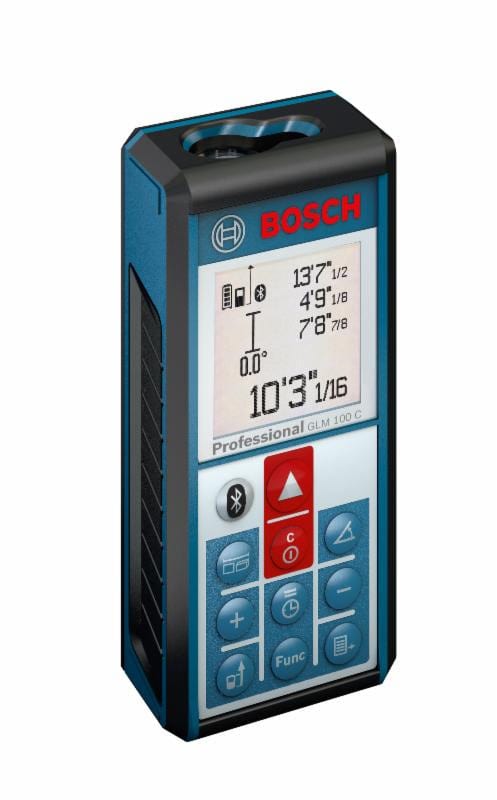
At its core, the GLM 100 C is a professional‑grade laser distance measurer capable of shooting targets up to 330 feet away with an accuracy of ±1/16 inch. That range and precision already put it in the upper tier of handheld lasers, but Bosch didn’t stop there. They gave it Bluetooth connectivity that pairs with the free Bosch Mobile Measurement App on smartphones and tablets. The app transforms the laser from a simple point‑and‑shoot device into a portable digital layout workstation. You can take a photo of the jobsite, sketch measurements directly onto it, perform area and volume calculations on the fly, and even operate the laser remotely—ideal for those awkward spots where the device itself is hard to reach but your phone is in your hand. The GLM 100 C stores up to 50 measurements internally, features a backlit display with tilt‑screen technology that auto‑rotates for easy reading, and runs on a rechargeable lithium‑ion battery good for a staggering 25,000 measurements per charge. At a street price hovering around $300, it’s not an impulse buy, but for the professional who measures more than they cut, it promises to eliminate enough paper scraps, math errors, and return trips to the saw to pay for itself in a matter of months. Let’s charge it up, pair it, and see just how far this little red beam can take us from the pencil‑and‑paper past.
The Number That Defines the Tool : 330 Feet at ±1/16 Inch
In the world of laser distance measures, two numbers dominate every comparison : maximum range and accuracy. The GLM 100 C delivers a maximum range of 330 feet, which is enough to measure the length of a basketball court, the footprint of a large custom home, or the span of a commercial parking lot from a single setup. Indoors, where reflective surfaces are abundant and ambient light is moderate, the laser reaches this maximum reliably. Outdoors under full sun, you’ll need the optional laser target plate to achieve the full 330 feet, because bright daylight can wash out the beam’s visibility and reduce the sensor’s ability to register the return signal. But even accounting for real‑world conditions, the GLM 100 C covers the vast majority of distances a contractor, remodeler, or estimator encounters daily without requiring a walk‑back to the truck for a longer tape or a surveyor’s transit.
Accuracy is specified at ±1/16 inch—identical to the tolerance of a premium tape measure over an 8‑foot span. But unlike a tape, which can sag, twist, or be read incorrectly due to parallax, the laser delivers a digital number that removes human interpretation from the equation. At 100 feet, a 1/16‑inch error is vanishingly small relative to the total distance, and for tasks like ordering countertops, cutting baseboard, or laying out a tile grid, it’s more than sufficient. Bosch’s laser uses a Class 2 red beam, which is eye‑safe under normal operation and bright enough to spot on a surface indoors up to about 150 feet without glasses. Beyond that, and in bright outdoor conditions, you rely on the digital readout rather than visual spot location, which is standard for this class of device.
Ten Measurement Modes : From Simple Length to Complex Indirect Height
A basic laser measure does one thing : it tells you how far away the wall is. The GLM 100 C does ten things, and each mode is a button press away. The standard modes include length (single distance), area (shoot length and width, multiply), volume (add height), and continuous measurement (real‑time tracking as you move the laser). But Bosch also incorporated indirect measurement capabilities that use the Pythagorean theorem to calculate distances you can’t shoot directly. Single indirect height requires two measurements to compute a vertical distance—useful for a building height when you can’t get a clear line to the peak. Combined indirect height uses three measurements for even greater accuracy. The multi‑surface mode lets you scan the laser across an irregular shape and calculate total surface area, a boon for estimating paint, stucco, or flooring on complex walls.
The angle mode measures the tilt of the device, which means you can use the GLM 100 C as a digital level for rough layout. It’s not a replacement for a 48‑inch box beam level, but for quick checks—is that drain pipe pitched correctly? Is that countertop sloping toward the wall?—the built‑in inclinometer adds utility without adding bulk. The min/max mode is invaluable for finding the shortest and longest distances in a room by simply panning the laser across the space; the device captures the extremes and displays them instantly. This is especially useful for checking wall flatness or floor levelness without a long straightedge.
Bluetooth and the Bosch App : The Magic That Ties It All Together
The GLM 100 C’s Bluetooth connectivity is what separates it from hundreds of other laser distance measurers in the $100‑$200 range. When paired with the free Bosch Mobile Measurement App (available for iOS and Android), the laser streams every measurement directly to your phone or tablet in real time. The app interface is clean and intuitive : you create a project, and each measurement you take is logged, timestamped, and available for manipulation. But the killer feature is the photo overlay. You can snap a picture of the work area—a wall, a room, a foundation trench—then drag your laser measurements directly onto the photo. The app automatically scales the measurement graphics to provide a visual record. Need to communicate to a client where the new window will go? Take a photo of the existing wall, measure the opening height and width with the GLM 100 C, and drop those dimensions onto the photo. Email it instantly. No ambiguity, no lost Post‑it notes, no “wait, which wall did we measure?” confusion.
The remote operation capability is another Bluetooth benefit that feels like a gimmick until you’re on a ladder, holding the laser against a ceiling corner where you can’t read the screen. You pair the device, prop it in position, climb down, and trigger the measurement from your phone. The result pops up on your phone, and you can save it without ever touching the laser. For solo operators who often work at height or in awkward orientations, this feature alone can prevent dangerous stretches and re‑positioning. The app also performs calculations directly on the captured data—area, volume, perimeter, and more—and can export the compiled measurements as a PDF or spreadsheet for estimating. It’s a workflow that replaces the classic “write it down, transfer it to a spreadsheet, hope you didn’t transpose anything” chain with a single, trackable digital process.
Rechargeable Lithium‑Ion Battery : 25,000 Measurements Per Charge
The bane of many digital tools is the constant need for AAA or 9V batteries, which always die when the hardware store is closed. Bosch engineered the GLM 100 C with an internal rechargeable lithium‑ion battery, the kind that powers modern smartphones and cordless tool packs. On a full charge, it’s rated for up to 25,000 individual measurements—enough for months of daily professional use. Charging is done via the included USB cable, which means you can top it off from a laptop, a job‑site radio with a USB port, a vehicle charger, or a standard wall adapter. The USB cable also serves a dual purpose : data transfer. When connected to a PC, you can pull stored measurements directly from the device without going through the app, giving you a backup path to your data.
The runtime is so generous that battery anxiety becomes a non‑issue for most users. Even if you take 500 measurements a day, a single charge lasts 50 working days—ten weeks. A full recharge cycle takes a few hours, so plugging it in overnight once a month becomes the maintenance routine, not the daily chore. Compared to lasers that burn through coin cells or AA batteries every few weeks, the GLM 100 C’s rechargeable design saves money and reduces landfill waste over the tool’s lifespan.
Tilt‑Screen and Backlit Display : Readable at Any Angle, in Any Light
The GLM 100 C’s onboard display is a high‑contrast, backlit LCD that auto‑rotates based on how you’re holding the device. Tilt the laser vertically to measure a ceiling, and the screen text flips to remain upright. Tilt it horizontally for a wall measurement, and it rotates again. This tilt‑screen technology means you never have to crane your neck to read a sideways number, which is a genuine ergonomic benefit when you’re in an awkward position—reaching into a cabinet, holding the laser above your head, or stretching across a bulkhead. The backlight is bright enough for dim basements and mechanical rooms, and it automatically turns off after a period of inactivity to conserve battery.
The display layout is clean, showing the primary measurement in large digits, with secondary information (mode, reference point, battery) smaller but still legible. The interface is controlled by a few well‑spaced buttons that are easy to press even with gloved hands. Bosch’s UI design prioritizes frequent functions : measure, add, subtract, and mode are one‑tap operations, while deeper settings are accessed through a menu that you won’t need daily but can navigate without a manual.
Build Quality and Kit Inclusions : What’s in the Box
Bosch packages the GLM 100 C as a complete ready‑to‑work kit. Inside the box, you’ll find the GLM 100 C laser measure itself, a USB data transfer and charging cable, a hand strap for secure carry, a soft belt pouch that protects the device when not in use, and the user manual. The hand strap attaches to a reinforced eyelet, letting you hang the laser from your belt or wrist when both hands are needed for other tasks. The belt pouch is made of durable nylon with a Velcro closure and a loop for belt attachment—it’s not a hard protective case, but it’s sufficient for keeping dust and minor scratches at bay when the laser is riding in a tool bag.
The build quality of the GLM 100 C feels solid and substantial. The housing is a rigid molded polymer with a soft‑touch overmold in the grip areas, providing decent impact resistance. The laser aperture and receiver lens are recessed to prevent scratching when the device is set face‑down. Bosch rates the GLM 100 C for indoor and outdoor use, and while it doesn’t carry an IP rating for water or dust ingress, the construction suggests it can handle typical jobsite dust and light moisture without immediate failure. Dropping it onto concrete from waist height is not recommended, but a short fall onto a subfloor or grass will likely leave only a cosmetic scuff. For the professional, a protective hard case may be a worthwhile secondary purchase, but the included pouch suffices for most transport needs.
Specifications at a Glance
| Specification | Detail |
|---|---|
| Model | Bosch GLM 100 C |
| Measurement Range | Up to 330 feet (100 meters) |
| Accuracy | ±1/16 inch (±1.5 mm) |
| Measurement Modes | Length, area, volume, angle, min/max, continuous, single indirect height, single indirect length, combined indirect height, multi‑surface |
| Internal Memory | Up to 50 measurements |
| Display | Backlit LCD with tilt‑screen technology (auto‑rotate) |
| Bluetooth Connectivity | Yes; pairs with Bosch Mobile Measurement App (iOS/Android) |
| App Features | Photo overlay with measurement graphics, remote laser operation, calculation, project management, PDF/spreadsheet export |
| Power Source | Internal rechargeable lithium‑ion battery (USB charging) |
| Battery Life | Up to 25,000 measurements per full charge |
| Charging/Data Transfer | Micro‑USB cable (included); also for data transfer to PC |
| Laser Class | Class 2, red beam |
| Weight | Approx. 0.3 lbs (135 g) |
| Included | GLM 100 C laser measure, USB cable, hand strap, belt pouch, user manual |
| Warranty | 1‑year limited; extendable by product registration |
| Street Price | Approx. $300 |
How the GLM 100 C Changes Daily Workflow Across Three Trades
Let’s put the GLM 100 C into the hands of real contractors and simulate how it affects their day.
The Remodeling Contractor: Arrives at a 1940s home to estimate a kitchen renovation. Floor plan in hand, but it’s outdated. She opens the Bosch app, creates a new project, and walks the room. With the GLM 100 C, she shoots room length, width, ceiling height, window opening sizes, and wall‑to‑wall cabinet spans. Each measurement populates instantly on her phone. She snaps a photo of the kitchen, drops the measurements onto the image, and shows the homeowner exactly where the new island will go and how much countertop space is needed. She saves the project, emails a PDF to her supplier for a quick cabinet quote, and leaves knowing her material order will be accurate—no second trip to remeasure.
The Flooring Installer: Tasked with laying luxury vinyl plank in an L‑shaped living area with multiple alcoves. He uses the continuous measurement mode to pan the laser around the room and capture the longest dimension. He switches to area mode to calculate the square footage of the main floor, then multi‑surface mode to add the alcoves. The GLM 100 C stores all measurements. He inputs the total into the app, adds 10% for waste, and orders the exact quantity of flooring needed. At the saw, he uses the GLM 100 C as a digital tape for cutting each row, switching to a physical tape only for final trim work around door jambs where the laser’s width can’t measure the tight offset.
The HVAC Installer: Needs to run ductwork across a basement ceiling with multiple obstacles. He uses the single indirect height mode to measure the clearance from the floor to the joists without climbing a ladder. He measures the length of the run in sections, each captured to the app. The app calculates total duct length, and he orders the spiral pipe and fittings from his truck before ever leaving the basement. The tilt‑screen display stays readable while he holds the laser above his head, and the Bluetooth remote function lets him shoot a tricky corner by wedging the laser into a tight spot and triggering the measurement from his phone.
The Learning Curve : What to Expect When You Switch from Tape to Laser
A laser measure is not a drop‑in replacement for a tape; it’s a different tool with different strengths. The learning curve for the GLM 100 C is gentle but real. The biggest adjustment is understanding what the laser can’t measure easily : distances shorter than about 8 inches (the minimum measurement range), distances where the target is reflective glass or a mirror (the beam can reflect away or give a false double reading), and distances where the target is a very dark, absorptive surface that doesn’t return enough light. In these situations, a physical tape or a laser target plate is necessary. The second adjustment is retraining your brain to trust a digital number rather than a visual tick mark. Many experienced carpenters double‑check their first few laser measurements out of habit; after a day, that habit fades as the laser’s repeatability becomes apparent.
The app has its own learning curve. The photo overlay feature, while powerful, requires a steady hand when framing the shot and a bit of practice to align the measurement graphics correctly. The initial Bluetooth pairing takes about 30 seconds and is straightforward; subsequent connections are automatic. The app occasionally disconnects if you wander out of range (~30 feet), but it reconnects quickly when you return. Overall, a competent smartphone user can be productive with the app within an hour, and the efficiency gains compound as you build projects and learn the shortcuts.
Comparing the Bosch GLM 100 C to Other Laser Measures and Traditional Layout Methods
At $300, the GLM 100 C lands in a competitive pack that includes the Leica Disto D2 ($150–$200, Bluetooth but fewer modes), the DeWalt 20‑foot Laser Distance Measurer ($60–$100, basic Bluetooth), and the classic 100‑foot tape measure ($20–$40). The GLM 100 C’s standout features—the app’s photo overlay, remote operation, and rechargeable battery—elevate it above the Leica and DeWalt in terms of software integration. Leica’s app is excellent, but the photo overlay with measurement graphics is a Bosch‑specific implementation that currently has few equals. The DeWalt models are more affordable but lack the indirect height modes and the comprehensive Bluetooth app of the GLM 100 C.
Against a traditional tape measure, the laser is faster for long spans, safer for high measurements (no ladder required for ceiling height), and eliminates the risk of misreading fractions. But a tape is still superior for tight spaces, scribing irregular profiles, and any scenario where the laser’s line‑of‑sight is obstructed. The two tools are complementary, not mutually exclusive. A pro who buys the GLM 100 C will still keep a 25‑foot tape on their belt for the close‑up work, but the laser will become the first‑choice tool for anything beyond arm’s reach.
Battery Life and Charging : The Rechargeable Advantage in Daily Use
The 25,000‑measurement battery life figure is one of those specs that sounds like marketing until you do the math. If you take 100 measurements per day—a busy day for estimating—you can go 250 working days, or roughly a year, between charges. In reality, the display backlight, Bluetooth transmission, and standby power consumption will reduce that slightly, but even accounting for those factors, a single charge easily lasts two to three months of typical professional use. The USB charging port is a micro‑USB, which is slightly dated compared to the now‑common USB‑C, but micro‑USB cables are ubiquitous and inexpensive to replace if lost. A full charge from empty takes roughly three to four hours, so plugging it in overnight once a month becomes a negligible routine. The lack of removable batteries eliminates the need to keep spares on hand, which is both a convenience and a mild risk : if you forget to charge it and it dies mid‑job, you can’t just pop in fresh AAs. A quick 15‑minute charge from a USB power bank will give you enough power for hundreds of measurements, so keeping a power bank on the truck mitigates this risk entirely.
Warranty and Support : Bosch’s 30‑Day Refund and 1‑Year Warranty
Bosch backs the GLM 100 C with a 30‑day money‑back or replacement guarantee, which gives you a risk‑free window to test the tool on your own jobs. The limited warranty covers defects in materials and workmanship for one year from purchase, and registering the product online within eight weeks extends the warranty. While a one‑year warranty is standard for electronic measuring tools, it’s shorter than the limited lifetime warranties common on manual tools. This reflects the reality that laser diodes, rechargeable batteries, and LCD screens have finite service lives, and Bosch’s warranty aligns with industry norms for this category. Customer support is available through Bosch’s professional tool service network, and the large installed base of GLM series lasers means replacement parts and service are generally accessible.
The Bottom Line : Bosch GLM 100 C Is the Digital Measuring Hub for the Connected Contractor
The Bosch GLM 100 C Laser Measure isn’t trying to kill the tape measure. It’s trying to relegate the tape measure to its proper role : a close‑quarters, high‑resolution tool for tasks under 8 feet. For everything beyond that—room dimensions, ceiling heights, foundation checks, estimating walkthroughs, material ordering—the GLM 100 C proposes a smarter, faster, and vastly more organized way of working. The Bluetooth app integration, with its photo overlay and project management, turns measurement data into a permanent, shareable digital asset instead of a fleeting number on a bent piece of paper. The rechargeable battery and 25,000‑measurement runtime make the tool essentially maintenance‑free for months at a stretch. And the ten measurement modes, combined with the tilt‑screen display, ensure that whatever odd angle or awkward corner you encounter, there’s a mode and a comfortable way to use it.
At $300, it’s an investment, but not an extravagant one when weighed against the cost of errors, callbacks, and wasted trips to the lumberyard. For the general contractor who estimates multiple jobs per week, the remodeler who needs to communicate layout with clients, or the tradesperson who works alone and values remote operation, the GLM 100 C quickly proves its worth. It’s a tool that gets better the more you use it, as your project library grows into a valuable reference archive. The future of jobsite measuring is digital, connected, and screen‑based—and with the GLM 100 C, Bosch has delivered one of the most polished and practical visions of that future yet. Clip it to your belt next to your tape, and discover how rarely you reach for the old hook after a week with the new beam.
Comments 0
Leave a Comment