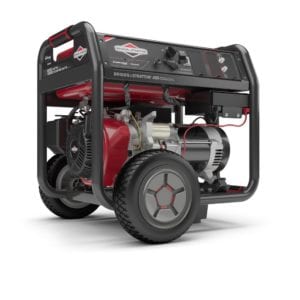
The StatStation app is the defining feature of the model 030679, and it represents Briggs & Stratton's response to consumer research that identified fuel anxiety as one of the primary pain points of portable generator ownership. Dan Roche, Director of Marketing for Briggs & Stratton Portable Power and Cleaning Systems, articulated the rationale: "The integration of Bluetooth technology was the result of customer research that told us consumers become frustrated by not knowing remaining fuel levels or the remaining capacity of a portable generator. StatStation Wireless featuring Bluetooth allows users to check the performance of the generator without having to brave the elements." The phrase "without having to brave the elements" captures the essential value proposition of the connected generator. A portable generator, by its nature, must be operated outdoors—away from windows, doors, and vents, to prevent carbon monoxide from entering the living space. This means that checking the generator's status requires the user to go outside, often in the very weather conditions that caused the power outage in the first place—a thunderstorm, a blizzard, a hurricane. With the StatStation app, the user can stay inside, warm and dry, and monitor the generator from the comfort of their living room. The app provides real‑time data on the generator's performance, and it can alert the user when the fuel level drops below a threshold, when the run time remaining falls to a specified limit, or when a maintenance task—an oil change, an air filter replacement—is due.
The app connects to the generator via Bluetooth, which means the range is limited—typically 30 to 50 feet in open air, somewhat less through walls. This is sufficient for a user who is inside their home while the generator is running on the patio, the deck, or just outside the garage door. It may not be sufficient for a user who is in a large building or whose generator is positioned at a significant distance from the living quarters. In those cases, the user will need to move closer to the generator—perhaps to a room with a window facing the generator—to establish a connection. The app is certified for use on iPhone 6 and above running iOS 9 or later, and on Samsung Galaxy S6 and above running Android 6.0.1 (Marshmallow) or later. In practice, the app will run on a wider range of devices, including many that are not specifically certified, as long as they meet the minimum operating system requirements. The app interface is clean and intuitive, with large, easy‑to‑read gauges for fuel level, run time, and wattage consumption. The generator itself sports all the hallmarks of a well‑built Briggs & Stratton machine: the Power Surge alternator, which is designed to handle the high starting currents demanded by motors and compressors without sagging the voltage; the electric start with remote choke, which eliminates the need for a pull cord and makes starting the generator as simple as turning a key or pressing a button; the multi‑featured control panel with circuit breaker protection, which provides multiple outlets—both 120‑volt and 240‑volt—for connecting loads, and which protects the generator and the connected equipment from overloads and short circuits; and the 12‑inch no‑flat wheels, which make the generator easy to move across grass, gravel, or pavement, even when the generator is full of fuel and oil and weighs in excess of 200 pounds. The 8,000‑watt rating (with a surge capacity that is typically somewhat higher, though Briggs & Stratton does not specify a separate surge figure in the product literature) places the 030679 in the category of mid‑sized portable generators, suitable for powering a refrigerator, a freezer, a furnace blower, a sump pump, a well pump, a collection of lights and electronics, and perhaps a window air conditioner—though not all of these simultaneously, unless the user is careful to manage the loads. The 9‑hour run time at 50 percent load, with a full tank of gasoline, is typical for a generator in this class, and it provides enough endurance to get through a typical overnight outage without refueling, provided that the load is managed to keep the generator running at or below half of its rated capacity.
The Bluetooth integration on the 030679 is, at the time of writing, limited to monitoring. The app can tell you what the generator is doing, but it cannot control the generator. You cannot start the generator from your phone. You cannot stop it. You cannot adjust the throttle, change the fuel mixture, or switch between 120‑volt and 240‑volt output. This limitation is deliberate—remote starting of a portable generator raises significant safety concerns, because a generator that starts unexpectedly could injure someone who is working on or near it, and because a generator that is started remotely might not have been properly ventilated or positioned. The Briggs & Stratton 030679 already has electric start, which eliminates the most physically demanding aspect of generator operation—the pull cord. The addition of Bluetooth starting would be a natural evolution of the platform, and it would allow the user to start and stop the generator from inside the house, without ever stepping outside. This capability already exists on some permanently installed standby generators, which can be started and stopped remotely via a smartphone app or a web portal. Extending it to a portable generator is a matter of engineering, regulation, and market demand, and it seems likely that future iterations of the StatStation platform will incorporate some form of remote control. In the meantime, the monitoring capability alone is a significant step forward in the user experience of portable generator ownership. The Briggs & Stratton 030679 is not a budget generator, and the Bluetooth connectivity adds a premium to the purchase price—the MSRP at launch was $1,199, which is several hundred dollars more than a comparable non‑connected generator from the same manufacturer. Whether that premium is justified depends on the value that the individual user places on the convenience and the peace of mind that the StatStation app provides. For the homeowner who uses the generator once or twice a year during brief power outages, the premium may not be justified. For the homeowner who lives in an area where extended outages are common—the hurricane‑prone Gulf Coast, the ice‑storm‑prone Northeast, the wildfire‑prone West—the ability to monitor the generator from inside the house, without having to venture out into the storm, may be worth the additional cost. For the contractor who uses the generator as a primary power source on remote job sites, the ability to monitor fuel consumption and run time from a distance—without interrupting the workflow—may translate into increased productivity and reduced downtime. Briggs & Stratton clearly envisions a future in which connectivity is a standard feature across the generator lineup, not a premium option on a single model, and the 030679 is an early step in that direction.
Briggs & Stratton Portable Bluetooth Generator Specifications
| Specification | Detail |
|---|---|
| Model Number | Briggs & Stratton 030679 |
| Rated Output | 8,000 watts |
| Run Time (50% Load) | ~9 hours |
| Starting Method | Electric start with remote choke |
| Connectivity | Bluetooth (StatStation app: iOS 9+, Android 6.0.1+) |
| App Features | Fuel gauge, remaining run time, percent load, total hours, maintenance reminders, dealer locator |
| Alternator | Power Surge |
| Wheels | 12‑inch no‑flat |
| Outlets | 120V and 240V, circuit breaker protected |
| Price (Launch MSRP) | $1,199 |
What the Bluetooth Generator Foreshadows About the Future of Portable Power
The Briggs & Stratton Portable Bluetooth Generator is not an isolated product. It is part of a broader trend toward connectivity in the outdoor power equipment and portable power industries, a trend that is being driven by the falling cost of Bluetooth and Wi‑Fi modules, the increasing comfort of consumers with smartphone apps as control interfaces, and the genuine utility that connectivity provides in managing machines that operate independently of their owners. Ryobi has introduced a Bluetooth‑enabled generator aimed at the tailgating and recreational market. Honda has incorporated Bluetooth into some of its inverter generators, allowing users to monitor performance and shut down the engine remotely. A growing number of portable power stations, from companies like Goal Zero, Jackery, and EcoFlow, offer Bluetooth or Wi‑Fi connectivity that allows users to monitor battery status, control outputs, and configure charging parameters from their phones. The trend is not limited to generators. It extends across the outdoor power equipment landscape: snow blowers, lawn mowers, pressure washers, and even portable heaters are beginning to incorporate connectivity features that allow users to monitor, control, and maintain their equipment remotely. The vision that underlies this trend is one in which the machines that power our lives become nodes in a network, communicating their status, their needs, and their availability to the people who depend on them. A generator that knows when it is low on fuel, that knows when its oil needs to be changed, that knows how many hours it has run and how many hours remain before its next service interval, and that can communicate all of that information to its owner without requiring the owner to walk outside and read a gauge—that generator is not merely more convenient than its unconnected counterpart. It is fundamentally more useful, because it removes the uncertainty and the anxiety that have always been part of the portable generator experience. The Briggs & Stratton 030679, with its StatStation Bluetooth connectivity, is an early implementation of that vision, and it points the way toward a future in which the portable generators that keep our lights on during an outage are as connected and as communicative as the smartphones we use to monitor them.
Comments 0
Leave a Comment