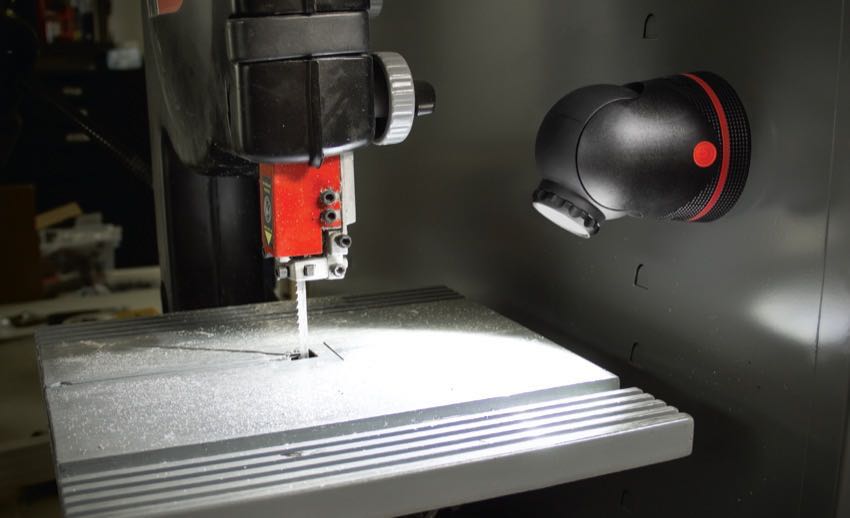
The Magnetic Base: Rubber‑Padded, Multi‑Angle, and Surprisingly Strong
The magnetic base is the PM500R's defining feature, the characteristic that differentiates it from a standard handheld flashlight or a work light that must be set on a flat surface or hung from a hook. The base is a substantial, flat, circular magnet encased in a rubber pad that serves two purposes. First, the rubber protects the painted or finished surface to which the light is attached. Slap the PM500R onto the fender of a car, the side of a painted steel cabinet, or the housing of a piece of equipment, and the rubber pad prevents scratches, scuffs, and that distinctive metallic clank that announces to everyone within earshot that you just stuck a magnet to something. Second, the rubber provides a slight amount of friction that prevents the light from sliding down a vertical surface under its own weight. The magnetic force alone is strong enough to hold the light securely, but the rubber adds a margin of grip that is particularly welcome on smooth, painted surfaces where a bare magnet might tend to creep. The magnet is powerful enough to hold the PM500R firmly in any orientation—horizontal, vertical, upside‑down—on any ferrous surface that is reasonably clean and flat. During testing, I attached it to the steel frame of an engine hoist, to the side of a metal junction box, to the underside of a steel workbench, and to the steel door of an electrical panel. In each case, the magnet held securely, with no tendency to slip, rotate, or fall, even when the light was bumped or when the attached surface was subjected to vibration. The rubber pad collected a modest amount of metal dust and shavings—an inevitable consequence of using a magnet in a workshop environment—but it wiped clean easily with a rag. The base is flat, which means the light can also be set on any horizontal surface and used as a stationary work light. It stands stably, with a low center of gravity that resists tipping. For the mechanic working under a vehicle, the tow truck driver loading a disabled car, the electrician working inside a steel panel, or the homeowner repairing a furnace in a dark basement, the magnetic base eliminates the most persistent frustration of portable lighting: the search for somewhere to set the light down where it will actually illuminate the work area. Just stick it to the nearest steel surface, rotate the bezel to aim the beam, and both hands are free for the task at hand. It is a simple feature, but it is executed with a level of thoughtfulness—the rubber pad, the strong magnet, the compact size—that transforms the PM500R from a flashlight into a hands‑free work light in under a second.
Pure‑Beam Focusing Optics: From a Broad Flood to a Tight Spot, and Why It Matters
Coast has built much of its reputation on its Pure‑Beam Focusing Optics, a lens system that allows the user to adjust the beam from a wide flood to a tight, long‑throw spot by twisting the head of the flashlight. The PM500R incorporates this system, and it is one of the light's most valuable features. In the flood position, the beam is broad and even, with no pronounced hot spot in the center and no dark rings or artifacts at the edges. It is ideal for illuminating a large work area at close range—the engine bay of a car, the interior of a panel, the surface of a workbench. The light is diffused enough that it does not create the harsh glare that can make it difficult to see fine details, and the color temperature is a neutral white that renders colors accurately. In the spot position, the beam tightens into a focused circle of light that can reach a considerable distance—672 feet on high, according to Coast's ANSI/FL1 testing, when using the lithium‑ion battery. This is the setting for when you need to see something at a distance, to search for a dropped fastener on a dark floor, or to illuminate a specific point on a large piece of equipment. The transition between flood and spot is smooth, with no intermediate positions that produce distracting artifacts, and the lens mechanism operates with a damped, quality feel that suggests precision engineering. The ability to focus the beam is not unique to Coast—many flashlights offer a similar feature—but the quality of the optics sets the PM500R apart. There are no halos, no hot spots, no color fringing at the edges of the beam. Coast guarantees this, and in my testing, the guarantee held true. The beam is clean, consistent, and useful across its entire range of focus. For the professional who needs to switch between broad area lighting and focused inspection light throughout the course of a job, the Pure‑Beam system eliminates the need to carry two separate lights, or to switch between a work light and a flashlight. One light does both, and the transition between modes takes less than a second.
Dual Power: The Best of Both Worlds, and the Freedom It Provides
The PM500R's dual‑power system is the feature that, more than any other, makes this light a standout in its category. The light comes with a rechargeable lithium‑polymer battery pack that provides the highest output—700 lumens on high, 200 lumens on low—and the longest throw. This battery pack is recharged via the included USB cable, which can be connected to the included AC wall adapter, the included DC vehicle adapter, or any standard USB port on a computer, a power bank, or a vehicle. The charging process is simple: plug in the cable, and an indicator light on the battery pack changes from red to green when charging is complete. The rechargeable battery provides the best performance and the lowest long‑term operating cost, and for most users, it will be the primary power source. But the PM500R also accepts three standard AAA alkaline batteries, which are loaded into a separate battery carrier that slides into the light in place of the rechargeable pack. The alkaline batteries produce slightly lower output—600 lumens on high—but they offer a critical advantage: they can be replaced anywhere, at any time, without access to electricity. For the professional who is working in a remote location, for the emergency responder who cannot afford to wait for a recharge, for the homeowner who realizes that the rechargeable battery is dead just as they are about to start a job, the AAA option is a lifeline. It means the PM500R is never truly out of commission as long as there is a convenience store or a drawer full of batteries somewhere nearby. The light also includes an 18‑foot USB cord—generously long—and both AC and DC adapters, so it can be run directly from a wall outlet or a vehicle 12V port without using any batteries at all. Plug it in, and the light operates indefinitely, drawing power from the grid or the vehicle's electrical system. This triple‑option power system—rechargeable, disposable, and direct‑wire—is the most versatile I have encountered on a work light of this size and price. It eliminates the anxiety of running out of power at a critical moment, and it ensures that the PM500R will always have a way to turn on, no matter the circumstances.
Rotation, Modes, and Build Quality
The light bezel on the PM500R rotates a full 180 degrees, allowing the beam to be aimed in any direction relative to the base. The rotation mechanism is smooth, with enough resistance to hold the bezel in position against gravity and vibration, but not so much that it is difficult to adjust. The detents are positive but not overly stiff. The light has two output modes—High (700 lumens with the rechargeable battery) and Low (200 lumens)—which are cycled by pressing the power button on the back of the light. The button is large, easy to locate by feel, and responsive. The light always starts in High mode, which is a minor inconvenience for users who prefer to start in Low, but this is consistent with most work lights in this class. The housing is constructed from a durable, impact‑resistant polymer with a textured surface that provides grip. It is not as rugged as an aluminum‑bodied light, but for the intended applications—magnetic mounting, handheld use, storage in a toolbox—the polymer is more than adequate. The light has been tested to ANSI/FL1 standards for impact resistance and carries an IPX4 rating, meaning it is protected against splashing water from any direction. It will survive rain, the splash of a puddle, or a brief dunk, but it is not submersible and should not be used underwater. The lens is recessed behind a protective bezel, which helps prevent scratches and impacts when the light is set face‑down or dropped. The overall build quality is consistent with Coast's reputation for producing reliable, well‑engineered lighting tools at accessible price points. The PM500R is not a premium, heirloom‑quality instrument; it is a working tool, designed to be used hard and replaced when necessary. Coast backs it with a lifetime warranty against defects in materials and workmanship, a guarantee that speaks to the company's confidence in their manufacturing quality.
Run Time, Brightness, and the Alkaline Trade‑Off
The PM500R's run times vary depending on the power source and the brightness setting. With the rechargeable lithium‑polymer battery, the light runs for approximately 2 hours and 15 minutes on High, and 5 hours and 15 minutes on Low. With AAA alkaline batteries, the run times are slightly different—and, interestingly, the high‑mode output is reduced to 600 lumens rather than the full 700. This is a consequence of the lower voltage and current delivery capability of alkaline cells compared to the lithium‑polymer pack. The lithium battery can sustain a higher discharge rate, which allows the LED to be driven harder for a brighter output. The alkaline cells, while capable of producing 600 lumens—still a very respectable figure—cannot quite match the lithium pack's peak performance. This is not a flaw; it is an inherent characteristic of the two battery chemistries, and it is a trade‑off that most users will happily accept in exchange for the flexibility of being able to use either power source. The 18‑foot USB cord and the included AC and DC adapters mean that the light can be operated on direct power for as long as needed, with no run‑time limitations at all. For a mechanic working in a shop with a nearby outlet, this is the ideal configuration. The light does not charge the lithium battery while operating on direct power; it simply runs the LED directly from the external power source. To charge the battery, the light must be turned off and connected to the USB cord. This is a minor inconvenience, but it is standard for lights in this class.
Who Needs the Coast PM500R? Everyone With a Dark Job and a Steel Surface
When we first considered who could use a rotating, dual‑power, magnetic work light, our immediate answer was... everyone. The PM500R is not a specialist tool; it is a generalist in the best sense of the word. The mechanic will use it stuck to the underside of a hood, to the frame of a lift, or to the inside of a wheel well. The electrician will use it stuck to a panel enclosure, to a junction box, or to a steel stud. The plumber will use it stuck to a cast‑iron pipe, to a water heater, or to a steel sink. The HVAC technician will use it stuck to a furnace cabinet, to a duct, or to a condensing unit. The tow truck driver will use it stuck to the bed, to the boom, or to the disabled vehicle itself. The first responder will use it at an accident scene, stuck to a vehicle, a guardrail, or a piece of equipment. The homeowner will use it in the garage, in the basement, in the attic, or under the kitchen sink. The camper, the angler, the hunter—anyone who ventures into the outdoors and needs reliable, versatile light—will find a use for the PM500R. The dual‑power system is the killer feature. Rechargeable lights are fantastic, but they are only as good as their last charge. A rechargeable light with a dead battery is a paperweight. The ability to fall back on three AAA batteries—available at any gas station, grocery store, or junk drawer—means that the PM500R will never be a paperweight. It will always turn on. That reliability, combined with the magnetic base, the rotating bezel, the focusing optics, and the direct‑power capability, makes the PM500R one of the most practical, versatile, and genuinely useful work lights on the market. At $99, it is not the cheapest work light, but it offers a combination of features that cheaper lights simply cannot match. It is a light that earns its keep every time it is used, and it is backed by a lifetime warranty that speaks to its quality. For anyone who works in the dark, on or around metal, the Coast PM500R Magnetic Worklight is not just a good choice—it is the right choice.
Comments 0
Leave a Comment