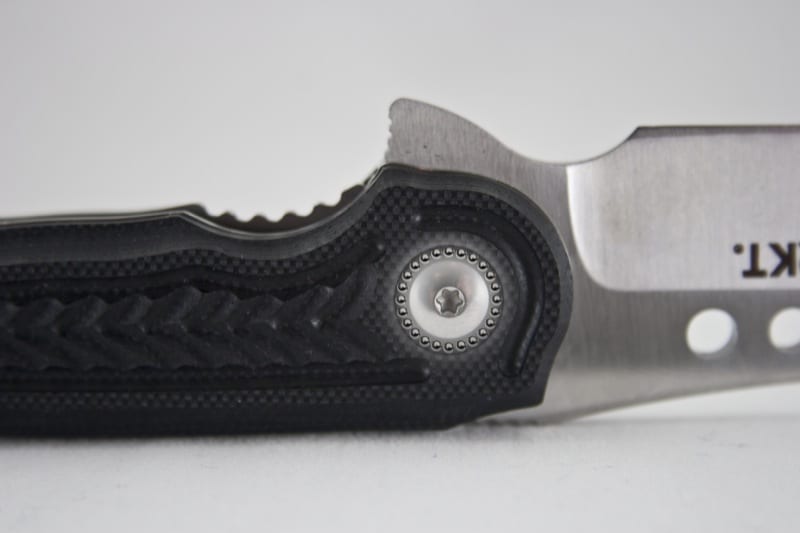
The Carajas is the brainchild of Brazilian knife designer Flavio Ikoma, a mechanical technician by training who has spent nearly two decades creating custom knives celebrated for their precision and elegance. Ikoma is not a household name in the casual knife community, but among aficionados, he is known for his innovative pivot systems—particularly the Ikoma Korth Bearing System (IKBS) that bears his name. The Carajas brings that custom‑grade pivot technology to a production folder priced well under $100, and it does so with a distinctive aesthetic that blends a broad, hollow‑ground blade with a surprisingly narrow, lightweight handle. The result is a knife that looks unconventional, carries with remarkable ease, and delivers a deployment experience that is fundamentally different from the spring‑assisted mechanisms that dominate its price bracket. It is a manual flipper that rewards aggression and technique, and once mastered, it offers a level of control that spring‑assisted knives cannot match.
The Ikoma Korth Bearing System: A Technical Deep Dive Into the Pivot That Changed the Game
Before we discuss the Carajas itself, it is worth understanding the IKBS system that makes it possible. Traditional folding knife pivots rely on either a simple bushing—a metal tube around which the blade rotates—or a set of ball bearings captured in a circular race, similar to a miniature version of a bicycle wheel hub. The race holds the bearings in fixed positions, ensuring they remain evenly spaced and do not wander. While effective, raced bearing systems add thickness to the pivot, require precision machining of the race itself, and can become contaminated with debris that is difficult to flush out without disassembly.
The IKBS, originally developed for balisong (butterfly) knives, takes a radically simpler approach. It eliminates the race entirely. Instead, the bearings—tiny, perfectly spherical steel balls—are placed directly into a circular channel machined into the titanium liners. The pivot pin serves as the inner race; the channel in the liner becomes the outer race. With no separate race component, the pivot can be made thinner, reducing overall handle thickness. The bearings are not confined to fixed positions, so they distribute load more evenly and self‑align as the blade rotates. Because there is no cage to trap debris, the system can be flushed clean with a spray of compressed air or solvent without disassembling the knife. Maintenance is simplified, and the smoothness of the action is limited only by the precision of the machining and the quality of the bearings.
The IKBS is not a spring‑assisted system. It relies entirely on the user's finger pressure to initiate the blade's travel. This is the key distinction that defines the Carajas experience. There is no torsion bar waiting to snap the blade open the moment you overcome a detent. There is only the smooth, progressive acceleration of precision bearings as they transfer your finger's input into blade rotation. The action feels different from a SpeedSafe or S.A.T. mechanism—less explosive, more controlled. It is the difference between firing a slingshot and throwing a baseball. Both achieve the same result, but the tactile experience is entirely different.
Blade Design: 12C27 Sandvik Steel, Hollow Grind, and the Shark‑Fin Aesthetic
The blade of the Carajas is forged from 12C27 Sandvik stainless steel, a Swedish alloy that has been a favorite of Scandinavian knife makers for generations. 12C27 is a fine‑grained steel with a relatively simple composition: roughly 0.6% carbon and 13.5% chromium. It lacks the high‑alloy complexity of S30V or the nitrogen‑enhanced corrosion resistance of 14C28N, but what it offers is an excellent balance of hardness, toughness, and ease of sharpening. The fine grain structure allows 12C27 to take an extremely keen edge with minimal effort, and it touches up quickly on a pocket stone or strop. The trade‑off is edge retention; 12C27 will not hold a working edge as long as the powder‑metallurgy super‑steels, but it is so easy to resharpen that this is rarely a practical concern for a daily‑use folder.
The blade profile is a drop point with a pronounced hollow grind—a grind that removes material from the flats of the blade using a large‑diameter wheel, leaving a distinctive concave surface. The hollow grind reduces drag when cutting through thick material and creates a thinner cross‑section behind the edge, which improves slicing efficiency. The blade features four circular cutouts above the tang stamp, an aesthetic touch that lightens the blade and adds visual interest without compromising structural integrity. The satin finish is clean and even, with longitudinal grind lines that catch the light attractively. The blade is not coated, so it will show scratches over time, but the satin finish hides them better than a mirror polish or a bead‑blast would.
The cutting edge is plain, without serrations, and the belly is generous enough to provide ample slicing surface for a 3.12‑inch blade. The tip is acute, suitable for piercing tasks, but backed by enough steel behind the hollow grind that it resists snapping under reasonable side loads. This is not a blade designed for prying—no folding knife should be used as a pry bar—but it is tough enough to handle the occasional accidental twisting cut without immediate failure. CRKT hardens the 12C27 to a range of 59‑61 HRC, which is on the harder side for this steel and speaks to a heat‑treatment protocol that prioritizes edge retention over maximum toughness. In practice, the edge holds up well through daily tasks like opening packages, cutting rope, and slicing cardboard, requiring a touch‑up roughly every week of moderate use. Sharpening is a pleasure; a few minutes on a fine diamond stone restores the edge to hair‑popping sharpness.
The Handle: Narrow G‑10, Light Weight, and the Calculated Curve
The Carajas handle is perhaps its most distinctive feature besides the blade. It is narrow—noticeably slimmer in width than most folding knives in its size class—and constructed from two slabs of textured G‑10 mounted over titanium liners. The narrow profile contributes directly to the knife's remarkable 3.0‑ounce weight. For a folder with a 3.12‑inch blade, this is nearly unheard of. The handle is so light that the knife, when closed, virtually disappears in a pocket. You forget you are carrying it until you need it, at which point it reappears in your hand almost telepathically.
The G‑10 scales are textured with a pattern of intersecting lines and ridges that provide substantial grip. When new, this texture can feel aggressive—almost sandpaper‑like—against the bare palm. This is the “broken‑in baseball glove” phenomenon I mentioned earlier. With use, the peaks of the texture wear down slightly, softening to a level that is still grippy but no longer abrasive. The handle also features a calculated curve along its spine, designed to match the natural contour of the palm. This curve, combined with the narrow width, creates a hold that feels secure and precise rather than clunky.
The knife carries tip‑up, right‑handed only, via a single‑position pocket clip. This is the one unequivocal limitation of the Carajas design for left‑handed users. The clip is not reversible, and there is no provision for left‑side carry. The clip is a standard stamped steel piece with decent tension, holding the knife securely without tearing the pocket fabric. The knife sits relatively high in the pocket—not a deep‑carry clip—so a portion of the handle is visible above the seam. This is often the preference of users who prioritize quick access over total concealment.
The Flipper: Where Aggression Meets Elegance
The flipper on the Carajas is the feature that demands the most user adaptation. As a manual IKBS knife, the flipper operates against the resistance of a detent—a small ball bearing that sits in a dimple in the blade tang, holding the blade closed. To deploy the blade, the user must apply enough pressure to the flipper tab to overcome the detent and then continue applying force to accelerate the blade through its full arc. This is not a knife that opens with a timid press of the finger. It demands a committed, deliberate motion—the kind of firm, authoritative push that says, “I am opening this knife, and I mean it.” Once you learn to apply the right amount of force and follow through smoothly, the blade swings open with a fluid, controlled grace that is entirely different from the abrupt snap of a spring‑assisted opener.
Some users, accustomed to the effortless deployment of SpeedSafe or S.A.T. knives, will initially find the Carajas stiff. They may think the knife is defective. It is not. It is simply built around a different philosophy—one that prioritizes smoothness, control, and the absence of spring‑fatigue over raw deployment speed. The IKBS bearings ensure that, once the detent is overcome, the blade travels with silky, frictionless ease. There is no gritty drag, no hesitation, no tendency to stop mid‑arc. It is a pure mechanical expression of your finger's energy, and mastering it is deeply satisfying.
The flipper tab itself is small but adequate, with a textured face that provides grip for the index finger. It is positioned far enough up the spine that it does not dig into the pocket when closed, and it doubles as a finger guard when the blade is open. The guard function is particularly effective on the Carajas because the narrow handle would otherwise leave the index finger somewhat exposed. The flipper creates a solid barrier that locks the finger in place behind the choil, providing the confidence needed for forceful cutting strokes.
Locking Mechanism: Titanium Liners and a Liner Lock That Inspires Confidence
The Carajas employs a liner lock, but not the kind of liner lock found on budget knives. The liners are titanium, a material that is lighter than steel, stronger than aluminum, and highly resistant to corrosion. Titanium liners engage the blade tang with a crisp, positive click, and the lock bar travels fully across the tang face, providing ample engagement surface. There is no blade play in any direction when the knife is locked open—no vertical movement, no lateral wiggle. The lock bar itself is adequately thick, and it is positioned such that disengaging it requires a deliberate press of the thumb. The lock has not shown any tendency to stick or become difficult to release, even after hundreds of cycles.
Who Should Carry the CRKT Ikoma Carajas?
The Carajas is an excellent choice for the knife enthusiast who appreciates mechanical novelty and is willing to invest time in learning a new system. The IKBS pivot is a genuine conversation starter and a pleasure to operate once mastered. The lightweight, narrow‑handled design makes it an ideal everyday carry for those who prioritize pocket comfort—you truly do forget it is there. The 12C27 blade takes a keen edge and sharpens easily, suiting users who prefer to maintain their own edges and who do not mind sharpening more frequently than they would with a premium steel. It is not a hard‑use work knife, despite the robust hollow grind and thick blade stock; the narrow handle would become fatiguing during prolonged heavy cutting, and the blade steel would require sharpening more often than a construction professional might like. It is better suited to the office worker, the weekend handyman, the knife collector who rotates through their collection and appreciates variety.
For left‑handed users, the Carajas presents an obstacle that may outweigh its virtues. The non‑reversible clip is a significant limitation, and while left‑handed flipper operation is possible, the knife is clearly optimized for right‑handed carry. For budget‑conscious buyers, the Carajas offers exceptional value, frequently available at street prices well below its MSRP. You are getting a custom‑inspired pivot system, titanium liners, and a distinctive design at a price that feels more like a mid‑range production knife than the high‑tech folder it actually is.
CRKT Ikoma Carajas Knife Specifications
| Specification | Detail |
|---|---|
| Open Length | 7.38 inches |
| Closed Length | 4.3 inches |
| Blade Length | 3.12 inches |
| Blade Thickness | 0.1 inches |
| Blade Steel | 12C27 Sandvik, satin drop point |
| Blade Hardness | 59‑61 HRC |
| Blade Grind | Hollow |
| Handle | G‑10 over titanium liners |
| Lock | Liner lock |
| Carry | 1‑position clip (right, tip‑up) |
| Weight | 3.0 ounces |
| Price | $69.99 |
Final Thoughts: The Knife That Ages Gracefully
The CRKT Ikoma Carajas is not a knife that seduces with instant gratification. It is a knife that reveals its virtues slowly, over weeks and months of daily carry. The flipper action, initially stiff, smooths out with use as the IKBS bearings polish their tracks in the titanium liners. The G‑10 texture, initially abrasive, softens under the hand as the peaks round off. The narrow handle, initially unfamiliar, becomes an old friend that you reach for automatically. This is a tool that evolves alongside its owner, accumulating the small signs of use that make a knife feel personal. The Brazilian designer who created it clearly understood that a knife is not just a collection of specifications; it is an instrument that must be learned, adjusted to, and ultimately trusted. Like that old baseball glove from my childhood, the Carajas becomes better over time—not despite its initial quirks, but because of them. It is a knife that earns its place in your pocket, and once it has done so, it is very hard to displace.
Comments 0
Leave a Comment