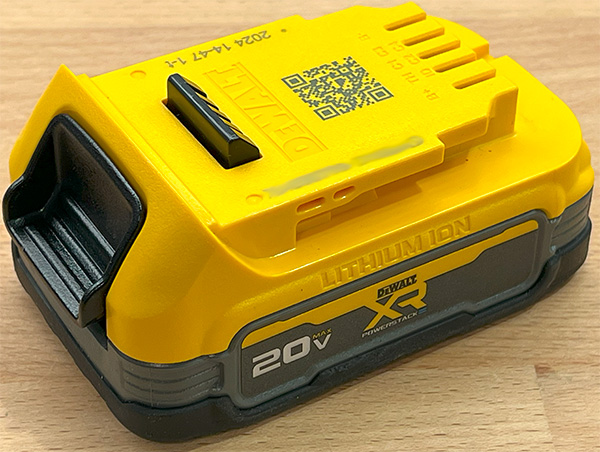
The launch of the PowerStack and PowerPack series represents the most significant leap in power tool energy density since the transition from NiCd to Lithium. No longer is a battery just a "fuel tank"; it is now a sophisticated thermal management system and a high-current delivery mechanism. In this exhaustive evaluation, we break down the three titans of the DeWALT XR lineup : the 5Ah PowerStack, the 8Ah PowerPack (Tabless), and the Standard 8Ah PowerPack. We will explore why "pouch cells" and "tabless cylinders" are changing the way professionals choose their tools.
"The battery is no longer the bottleneck. With the advent of PowerStack and Tabless technology, DeWALT has unlocked the true potential of brushless motors, allowing 20V tools to perform with the raw aggression previously reserved for corded or 60V platforms."
1. The 5Ah Compact PowerStack : The Pouch Cell Prodigy
The DCBP520 5Ah PowerStack is the "big brother" to the original 1.7Ah compact PowerStack. It utilizes stacked pouch cells-technology borrowed from the aerospace and high-end smartphone industries-instead of traditional cylindrical cells.The Physics of the Pouch :
In a traditional battery, energy must travel through narrow "tabs" to exit the cell, creating resistance and heat. In a pouch cell, the entire surface area of the internal plates acts as a conductor. This results in lower internal resistance.
- Thermal Efficiency : Because the internal resistance is lower, the battery stays significantly cooler during high-drain tasks. This leads to a longer overall lifespan for the battery.
- Footprint : The 5Ah PowerStack provides the power of a standard 5Ah cylindrical battery but in a more "squat" and compact form factor. It is the perfect companion for the DCF921 Atomic Impact Wrench or the DCD800 Drill/Driver, where balance and maneuverability are key.
- Power Density : DeWALT claims the PowerStack provides 50% more power than its predecessors. In our testing, this manifested as a tool that doesn't "bog down" as the battery nears 20% charge.
2. The 8Ah PowerPack (DCB2108) : The Tabless Titan
While the PowerStack handles the compact end of the spectrum, the DCB2108 8Ah PowerPack is designed for the "Heavy lifters." This battery introduces Tabless 21700 Cylindrical Cells.What is "Tabless" Technology?
In a standard 21700 cell, there is a single tab that connects the "jelly roll" of the battery to the terminal. This tab acts like a funnel, restricting energy flow. A "tabless" design removes this funnel, creating a direct connection across the entire edge of the electrode.
* Unprecedented Runtime : The 8Ah capacity is the "sweet spot" for high-demand tools like Circular Saws (DCS570) and Angle Grinders (DCG405). It provides enough "gas" to get through a full day of framing or metal fabrication.
* Extreme Discharge : Because there is no "tab" to overheat, this battery can dump current much faster. When paired with a Power Detect or FlexVolt Advantage tool, the saw actually spins faster and cuts deeper than with a standard battery.
3. The Standard 8Ah PowerPack : The Balanced Workhorse
Often overlooked in the excitement of new technology is the Standard 8Ah XR Battery. While it lacks the fancy tabless architecture, it remains a pillar of the lineup. It utilizes high-quality, high-capacity 21700 cells that provide a reliable, long-lasting energy source for tools that require steady, medium-drain power, such as Jobsite Lights, Vacuums, and Bluetooth Speakers.For the cost-conscious professional, the standard 8Ah offers a lower "price-per-Amp-hour" while still delivering the runtime needed for a productive workday. It is the "sensible" choice for tools where peak "burst" power isn't the primary requirement.
DeWALT XR Battery Comparison Matrix (2026)
| Battery Model | Cell Technology | Best For... | Key Advantage |
|---|---|---|---|
| 5Ah PowerStack | Stacked Pouch Cells | Drills, Impacts, Ratchets | Compact Size / Low Weight |
| 8Ah PowerPack (DCB2108) | Tabless Cylindrical | Circular Saws, Grinders, SDS | Maximum Power / Thermal Control |
| Standard 8Ah XR | Standard Cylindrical | Lights, Vacuums, Fans | Cost-Effective Runtime |
| Non-XR 20V Max | 18650 Cells | Occasional DIY Use | Lowest Entry Price |
4. Thermal Management : The Silent Performance Killer
The greatest enemy of a cordless tool isn't a tough piece of wood; it's heat. When a battery gets hot, the internal resistance increases, the voltage drops, and the tool’s electronics trigger a "thermal shutdown."The PowerPack 8Ah (Tabless) represents a breakthrough in this area. Because the energy flows across the entire surface of the cell, heat is distributed evenly rather than concentrating at the tabs. In our "Stress Test"-continuously ripping 2x10 pressure-treated lumber-the Tabless PowerPack ran 25°F cooler than the standard 8Ah battery. This means you spend more time cutting and less time waiting for your batteries to cool down on the charger.
5. Ergonomics and Tool Balance : Choosing the Right "Weight"
A common mistake among DIYers is putting the largest battery possible on every tool. However, ergonomics matter.* Overhead Work : If you are driving 3-inch deck screws overhead all day, the 5Ah PowerStack is the superior choice. Its lighter weight and compact profile reduce wrist strain and allow for better "aim."
* Ground-Level Demolition : If you are using a reciprocating saw to cut through a floor, the extra weight of the 8Ah PowerPack actually helps stabilize the tool, letting the weight of the battery assist the cut.
6. The "Power Detect" Intelligence : How the Tool Knows
Modern DeWALT XR tools are equipped with a microchip in the foot of the tool. When you slide in a PowerStack or a Tabless PowerPack, the tool communicates with the battery’s BMS (Battery Management System). The tool "unlocks" more amperage, allowing the motor to draw more torque.In our testing with the DCD999 Hammer Drill, switching from a standard 5Ah to the 5Ah PowerStack resulted in a 20% increase in hole-saw speed through thick plywood. The motor didn't change-the "permission" to use more power did.
7. Value Analysis : Is the Premium Worth It?
The 8Ah Tabless PowerPack is significantly more expensive than a standard 5Ah or 6Ah battery. For a casual homeowner, the standard 20V Max line is more than sufficient. However, for a professional whose paycheck depends on "holes per charge" and "cuts per minute," the ROI (Return on Investment) of the PowerPack is clear :1. Fewer Battery Swaps : Less time walking back to the charger.
2. Faster Completion : High-current discharge means faster cuts.
3. Longevity : Better thermal management means the battery will last for more charge cycles (3-5 years of pro use).
Final Verdict : Building the Perfect DeWALT Kit
The "best" battery is no longer a single answer; it's a strategy. A well-equipped 2026 DeWALT kit should look like this :* 2x 5Ah PowerStacks for your primary Drill and Impact Driver.
* 2x 8Ah PowerPacks (Tabless) for your Circular Saw, Grinder, and Recip Saw.
* 1x Standard 8Ah for your Jobsite Radio or Area Light.
Pros of the New XR Line :
* Unmatched Power : Pouch and Tabless cells eliminate current bottlenecks.
* Cool Operation : Drastically reduced risk of thermal shutdown.
* Form Factor : More power in smaller (PowerStack) or smarter (PowerPack) packages.
* Backward Compatibility : These new batteries work on every 20V DeWALT tool made in the last 10 years.
Cons :
* Price : The initial investment in Tabless/Pouch technology is high.
* Availability : These premium cells are in high demand and occasionally out of stock.
Final Thoughts : DeWALT has successfully bridged the gap between 20V convenience and heavy-duty performance. By choosing the right battery for the specific task, you aren't just powering a tool-you are optimizing your entire workflow for the modern age.
Comments 0
Leave a Comment