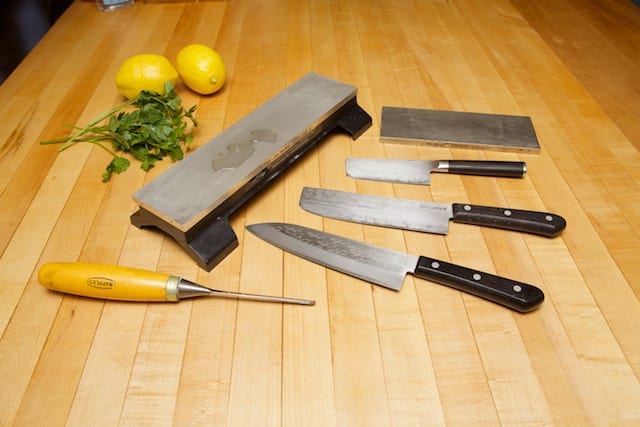
This is a sharpening system built around a 3‑inch by 12‑inch diamond plate—a generous expanse of real estate compared to the typical water stone—that is double‑sided. One face is Fine grit, roughly equivalent to a 1,000‑grit water stone. The reverse face is Extra Fine, approximating a 2,000 to 3,000‑grit water stone. The plate rests on a magnetic base with eight rubber feet that grip the work surface, holding the stone securely in place while you work. The timing of its arrival was fortuitous, for I could now sharpen at my bench, in the unheated shop, without making excuses about why I was spending so much time in the bathroom. I also had on hand one of DMT's 8,000‑grit polishing plates, which could also be mounted on the magnetic base, allowing me to progress from a really dull tool all the way to a polished, mirror‑finished edge without ever reaching for a water stone.
Why Diamond Plates Solve the Fundamental Problem of Water Stones
I must confess to having a Zen master's fondness for Japanese water stones. There is a meditative quality to the ritual: soaking the stone, building a slurry, feeling the subtle feedback as steel meets abrasive in a thin film of water. But there is also no denying that water stones are an enormous amount of rigmarole. The most problematic issue is flatness. Water stones wear unevenly, developing hollows and grooves that must be periodically lapped flat with a diamond plate or a dedicated flattening stone. If you neglect this maintenance—and most of us do, more often than we would admit—the stone becomes concave, and every tool you sharpen on it develops a slightly curved bevel. A curved bevel will never be as sharp as a flat one, and it will not register reliably in a honing guide. The DMT diamond plate, by contrast, is dead flat out of the box and will remain dead flat forever. The diamonds are bonded to a rigid steel substrate that does not wear, dish, or groove. You can sharpen a hundred chisels on it, and the surface will be as flat as the day you bought it.
Another advantage of diamond is speed. When you are reforming a really dull edge—say, a chisel that has been used to open paint cans or a plane iron that has encountered a hidden nail—nothing cuts faster than diamonds. The abrasive particles are sharp, hard, and aggressive. They remove steel quickly, establishing a new primary bevel in a fraction of the time it would take on a water stone. This is particularly valuable when sharpening very narrow tools, such as a 1/8‑inch‑wide bench chisel. On a water stone, a narrow chisel is prone to digging a trench into the surface, ruining the stone for subsequent use on wider blades. I do not let my students touch my water stones for precisely this reason; one moment of inattention, and a beautiful $80 stone is gouged beyond easy repair. A diamond plate laughs at such concerns. The surface is effectively indestructible under normal sharpening pressure, and I can now fearlessly hand it to anyone, from a novice to a seasoned woodworker, knowing it will emerge unscathed.
The MagnaBase System: A Magnetic Foundation That Holds Fast
The MagnaBase is a simple but brilliantly effective accessory. It is a flat, heavy platform with a magnetic top surface and eight rubber feet on the underside. The diamond plate, which has a steel substrate, adheres firmly to the magnet when placed on the base. The eight rubber feet grip the work surface, keeping the entire assembly stationary during sharpening. On my sharpening station, which has a plastic laminate top, the grip was excellent; the base did not slide, even under the fairly aggressive pressure I sometimes apply when re‑establishing a primary bevel. On my wood benchtop, the rubber feet were less effective, and I had to dog the base down or brace it against a bench stop to keep it from creeping. This is not a defect of the MagnaBase so much as a reflection of the fact that I probably apply more force during sharpening than most users. For a typical woodworker using controlled, moderate pressure, the rubber feet should be more than adequate on any reasonably textured surface.
The 3‑by‑12‑inch plate size is a significant upgrade over the smaller, pocket‑sized diamond stones that are common in the market. The extra length allows longer strokes, which means faster material removal and a more consistent bevel angle across the width of the tool. The extra width accommodates the full width of a standard bench chisel or plane iron without having to skew the tool diagonally. When you are sharpening a 2‑inch‑wide plane iron, having a 3‑inch‑wide stone means you can work the entire cutting edge in a single pass, rather than shifting the iron left and right to cover the full width. This is not merely a convenience; it translates directly into a more consistent edge, because every part of the bevel sees the same number of strokes on the same abrasive.
Grit Progression: Fine, Extra Fine, and the 8,000‑Grit Parting Glass
The Double‑Sided Dia‑Sharp plate is available in two grit combinations, but the one I tested is the Fine/Extra‑Fine pairing. The Fine side (approximately 1,000 grit) is the workhorse. It removes material quickly enough to raise a burr on even very dull edges, but leaves a surface that is already beginning to reflect light. The scratch pattern is uniform and shallow, the result of the consistent particle size and even distribution of diamonds on the plate surface. The Extra Fine side (approximately 2,000–3,000 grit) refines that edge further, polishing the bevel to a near‑mirror finish and reducing the burr to a fine wire that can be stropped off on a piece of leather or even a sheet of newspaper.
For tools that demand the highest possible sharpness—paring chisels, smoothing plane irons, carving gouges—I supplement the double‑sided plate with DMT's 8,000‑grit polishing plate, also mounted on the MagnaBase. This additional stone brings a really dull tool from rough grinding to a polished, light‑reflecting edge in a progression that is logical, repeatable, and fast. The 8,000‑grit diamond surface leaves a finish that rivals the best natural water stones, with none of the maintenance headaches. The entire system—double‑sided plate, MagnaBase, and optional 8,000‑grit plate—represents a sharpening solution that can handle anything from a badly damaged lawn mower blade to a delicate violin‑maker's knife, all while staying flat, staying clean, and staying precisely where you put it on the bench.
Wet vs. Dry: The Flexibility Advantage
DMT's instructions state that the plates can be used dry or with water. I prefer to use water, kept in a spray bottle to which I add a drop or two of dishwashing detergent to break the surface tension. The water serves two purposes: it floats the metal swarf away from the cutting surface, preventing it from loading up and reducing the stone's cutting efficiency, and it provides a small amount of lubrication that makes the sharpening stroke feel smoother. The diamond abrasive itself does not require lubrication; it cuts effectively regardless. But the water makes the experience more pleasant and extends the time between cleanings. When the plate does become loaded with swarf, a quick rinse under running water and a scrub with a nylon brush restore it to full cutting performance. There is no need for special cleaning fluids, no requirement to soak the stone before use, no waiting period. It is ready when you are, and it cleans up in seconds.
DMT Dia‑Sharp MagnaBase System Specifications
| Specification | Detail |
|---|---|
| Plate Size | 3 inches by 12 inches |
| Grit (Side 1) | Fine (~1,000 grit equivalent) |
| Grit (Side 2) | Extra Fine (~2,000–3,000 grit equivalent) |
| Base | Magnetic with 8 rubber feet |
| Use | Wet or dry |
| Model Numbers | D12CX‑WB (Coarse/Extra‑Coarse); D12EF‑WB (Extra‑Fine/Fine) |
| Price | ~$199 |
Who Should Invest in the DMT MagnaBase System?
At around $199, the MagnaBase System is being pitched as a premium sharpening solution, and its price reflects that positioning. It is not an impulse purchase for the casual woodworker who sharpens a chisel twice a year. But for the serious craftsman—the furniture maker, the luthier, the turner, the carpenter who maintains a full set of edge tools—the value proposition is clear. A single high‑quality Japanese water stone of comparable size can cost $60 to $100, and it will need to be flattened regularly, will need to be soaked before each use, and will eventually be consumed by the sharpening process. The DMT diamond plate will never wear out, never dish, never require flattening, and never need to be replaced under normal use. Over a career, the diamond plate is almost certainly the more economical choice, despite the higher initial outlay. It is also the more convenient choice. No soaking. No flattening. No bathroom storage. Just grab the plate, spray it with water, and sharpen. When you are done, rinse and put it away. The MagnaBase system removes the excuses we all make for working with dull tools, and in doing so, it makes us better craftsmen. That is an achievement worth far more than its price tag.
Conclusion: Flat, Fast, and Forever—The Last Sharpening System You Will Ever Need
The DMT Dia‑Sharp MagnaBase System is one of those rare tools that, once integrated into your workflow, makes you wonder why you spent so many years messing around with water stones. The diamond plates cut fast, stay flat, and require almost no maintenance. The magnetic base holds the stone securely and provides a stable platform for consistent, repeatable sharpening strokes. The double‑sided design puts two grits at your fingertips without flipping stones or changing setups. And the option to add an 8,000‑grit polishing plate extends the system's range to the finest edges. For the professional woodworker, the serious hobbyist, or anyone who maintains a collection of edge tools, the MagnaBase System is a long‑term investment in sharpness, efficiency, and the deeply satisfying pleasure of working with a tool that is perfectly, effortlessly sharp.
Comments 0
Leave a Comment