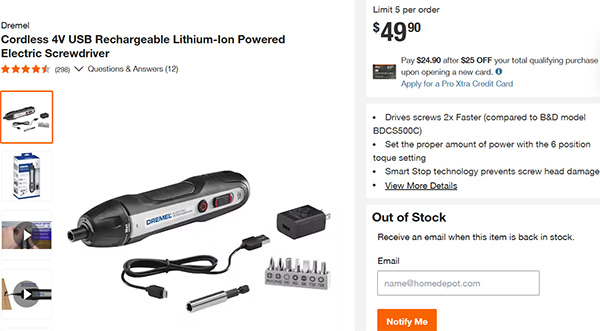
This isn't merely a case of a product reaching the end of its life cycle. Instead, the disappearance of the Dremel Go serves as a case study in the fragility of global supply chains and the massive impact of 2025-2026 trade regulation shifts. In this exhaustive analysis, we explore why this tool is no longer on the shelves of Home Depot or Amazon, the "De Minimis" policy change that killed its import viability, and what the future holds for those seeking a precision cordless driver.
"The Dremel Go didn't fail because of its motor; it failed because of the border. When the cost of importing a $40 tool exceeds the retail price of the tool itself, the consumer is the one who ultimately loses the choice."
1. The Disappearance : A Retailer Wipeout
As of early 2026, the Dremel GO-01 and HSES-01 models have been marked as "Discontinued" or "No Longer Available" across all major U.S. domestic retailers.- Home Depot & Lowe’s : Both giants cleared their remaining inventory in late 2025. Store SKUs that once held the 4V Max driver are now occupied by 12V alternatives from Milwaukee or Ryobi.
- Amazon US : While the product page exists, it is perpetually "Currently Unavailable."
- Dremel Official : The North American wing of Dremel has largely pivoted toward their traditional rotary tool lineup, leaving the "Home Solutions" screwdriver line in a state of indefinite hiatus.
2. The "De Minimis" Death Blow : Why the Border Closed
The primary driver of this disappearance is a major shift in U.S. trade policy. On August 29, 2025, the United States effectively removed the $800 de minimis threshold for commercial shipments.**What was the De Minimis Exemption?**
For years, international retailers (especially those in Europe and Asia) could ship individual tools directly to U.S. consumers duty-free, provided the value was under $800. This allowed specialized tools like the Bosch/Dremel Go series-often manufactured in overseas facilities-to be sold at a competitive $30–$45 price point.
**The New Reality in 2026 :**
With the exemption removed, every single commercial import now requires formal customs entry and the payment of applicable duties. For a low-cost tool like the Dremel Go, the processing fees and tariffs now represent a significant percentage of the tool's cost. This has made it economically impossible for European retailers to fulfill U.S. orders without charging upwards of $40–$50 in shipping and import fees alone.
3. The Bosch Go 3.0 : Available, But Only for the Determined
While the Dremel-branded version is gone, the Bosch Go (Generation 3) continues to thrive in European and Asian markets. This updated model features a brushless motor, an improved mechanical clutch, and USB-C charging.However, for an American buyer, acquiring one in 2026 feels like a black-market operation. You must use international marketplaces like eBay (via Malaysia or Italy) or specialty sites like Mister Worker.
| Factor | Dremel Go (Old US Stock) | Bosch Go 3.0 (International Import) |
|---|---|---|
| Price | ~$39.00 (Retail) | ~$45.00 + $40.00 Shipping/Fees |
| Charging | Micro-USB | USB-C |
| Motor | Brushed | Brushless |
| Availability | Extinct | Import Only |
4. The Search for Alternatives : Can Ryobi or DeWALT Fill the Void?
Disappointed users are flocking to other brands, but many report that the "Magic" of the Go's form factor is hard to replicate.* Ryobi 4V USB Lithium : While affordable, it lacks the "push-to-start" feature that many found essential for one-handed work.
* DeWALT Gyroscopic Screwdriver (DCF680) : This remains the most popular "high-end" alternative. It uses gyroscopic sensors to determine speed and direction, but it is significantly larger and twice the price of the Dremel Go.
* Worx WX240 : Often cited as the closest direct competitor, this pen-style driver offers similar maneuverability but lacks the refined mechanical clutch found in the Bosch/Dremel architecture.
5. The Logistics Crisis : European Retailers Retreat
Beyond tariffs, the global logistics crunch of 2026 has discouraged European tool giants from maintaining small-scale US exports. Increased customs documentation requirements mean that carriers face delays while systems are updated. For a retailer in the UK or Germany, the administrative "headache" of shipping a single screwdriver to New York is no longer worth the profit margin. This has led to a "Tool Isolationism" where high-quality European electronics are increasingly locked behind regional borders.6. Why the "Push-Start" Mechanism Still Matters
The reason users are so vocal about the loss of the Dremel Go is its Maneuverability and Precision. In tight spaces-such as inside a computer case or behind an electrical panel-fiddling with a trigger is difficult. The ability to simply press the tool into the fastener to activate it is a mechanical luxury that 12V "pistol-grip" drills cannot provide. Despite Bosch releasing newer 12V models, they are often too heavy for delicate tasks, risking the stripping of small screws in plastic housings.7. Final Verdict : A Future of Gray Markets?
The disappearance of the Dremel Go is a symptom of a larger trend : the end of the "easy import" era. While we may see a 12V "Americanized" version of this tool eventually, the compact 4V "pen" style remains a victim of 2026 trade realities.The Pros of the Go Series (Why it's missed) :
* Intuitive Control : Dual-activation (button or push).
* Form Factor : Fits in a pocket, charges via standard USB.
* Clutch Accuracy : Mechanical settings to prevent over-tightening.
The Cons of the Current Situation :
* Extreme Markup : Importing a Bosch Go now costs nearly $100 after fees.
* No Warranty : International imports rarely carry US-based support.
* Regulation Risk : Customs can still seize low-value imports under the new 2025 guidelines.
Conclusion : For the American DIYer, the Dremel Go has become a "Ghost Tool." If you still own one, cherish it. If you need one, prepare to pay double for a European import. The era of the $40 global precision tool is, for now, a thing of the past.
Comments 0
Leave a Comment