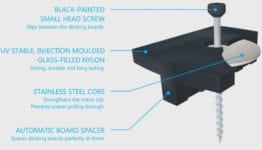
The Core Principle: Grooved Boards, Hidden Clips, and the Geometry of Concealment
The Eagle Claw Hidden Deck Fastening System, like most of its competitors, relies on a fundamental geometric trick: the fasteners that hold the boards down are not driven through the top face of the board but through a metal clip that is inserted into a groove machined into the side edge of the board. The clip spans the gap between two adjacent boards, with one leg engaging the groove of the board on the left and the other leg engaging the groove of the board on the right. A screw driven through the center of the clip and into the joist below secures both boards simultaneously. The screw head is buried in the gap between the boards, invisible from above unless one peers directly down into the crack. The result is a deck surface that is completely free of visible fastener heads—no screws, no nails, no plugs, just the uninterrupted expanse of wood or composite stretching from one end to the other. The trade‑off for this clean aesthetic is that the deck boards must be grooved. Every board that is installed using the Eagle Claw system—except for the first and last boards, which are fastened differently—requires a dado, or groove, cut into each of its long edges. These grooves accept the legs of the stainless‑steel clips. The carpenter can either purchase pre‑grooved deck boards from a lumber supplier—an option that is increasingly common as hidden fastening systems have gained popularity—or cut the grooves on‑site using a router equipped with a slot‑cutting bit. The latter approach requires an additional tool and an additional step in the installation process, but it allows the carpenter to use any deck board they choose, rather than being limited to the pre‑grooved options offered by a particular manufacturer. The grooves must be consistent in depth and width, and they must be positioned at the exact center of the board edge, because any deviation will cause the clip to seat improperly and the boards to gap or cup.
The installation process begins with the first board. The first board of the deck, typically the one that runs along the outer edge, cannot be secured with a hidden clip because there is no adjacent board to anchor the opposite leg of the clip. Instead, the first board is fastened in the traditional manner: screws driven through the face of the board near the outer edge, countersunk below the surface, and then concealed with wood plugs or color‑matched composite filler. For a hardwood deck like ipe or mahogany, the plugs can be cut from the same material as the decking, making them nearly invisible once sanded flush. For composite decking, color‑matched plugs are available from the manufacturer. Once the first board is securely fastened and its plugs are installed, the hidden clip process begins. The carpenter inserts the appropriate number of Eagle Claw clips into the groove on the inner edge of the first board, spacing them according to the manufacturer's specifications—typically one clip at every joist intersection. The clips slide into the groove and are held in place by friction. Then the next board is laid down, with its outer groove engaging the exposed legs of the clips. The carpenter uses the Eagle Claw deck clamp, a specialized tool that hooks onto the joist and presses against the face of the board, to pull the new board tightly against the clips and hold it in position while the screws are driven through the clips and into the joist. The clamp ensures that the gap between the boards is perfectly uniform, that the boards are properly aligned, and that the clip is fully seated in both grooves before the screw is tightened. Multiple boards can be clamped simultaneously, allowing the carpenter to work down the deck in sections rather than one board at a time. This speeds up the installation process and helps maintain consistent spacing across the entire deck surface. The final board of the deck—the one at the opposite edge—presents the same challenge as the first board, because there is no adjacent board to anchor the outer leg of a clip. It is fastened in the traditional manner, with face screws and plugs, just like the first board. The symmetrical fastener pattern at both edges of the deck provides a visual balance that contributes to the overall clean appearance. When the installation is complete, the deck presents an unbroken surface to the eye. The fasteners are there, hidden in the gaps, doing their work, but they are invisible from any normal viewing angle. It is a system that rewards careful, methodical installation with a result that looks significantly more refined than a face‑fastened deck.
The Stainless‑Steel Core: Why Eagle Claw Claims Longer Life
The single most important material choice that distinguishes the Eagle Claw system from many of its competitors is the use of a stainless‑steel core inside each clip. Most hidden deck clips on the market are made from either painted carbon steel or unfilled plastic. Painted steel clips are strong and relatively inexpensive, but they are vulnerable to corrosion. The paint or powder coating that protects the steel is easily scratched during installation—a screw driver bit slips, a clip is dragged across a joist, a board shifts slightly as it is being clamped—and once the coating is breached, the underlying steel is exposed to the moisture that inevitably accumulates in the gaps between deck boards. Over time, that moisture causes the steel to rust, and as it rusts, it loses strength. A clip that was once a robust, structural connection between board and joist can, after five or ten years of exposure to rain, snow, and humidity, become a corroded, weakened link that no longer holds the board securely. The boards begin to cup, to warp, to pull away from the joists. The deck, which was built to last, begins to fail from the inside out. Unfilled plastic clips avoid the corrosion problem but introduce a different vulnerability: they can become brittle over time, particularly when exposed to the ultraviolet radiation in sunlight. A plastic clip that sits in the gap between two boards, partially exposed to the sun that filters down through the crack, can gradually lose its flexibility and impact resistance. Under the repeated stress of foot traffic—the constant, rhythmic loading and unloading as people walk across the deck—a brittle clip can crack. Once cracked, it loses its grip on the board groove, and the board is no longer properly secured.
The Eagle Claw clip addresses both of these failure modes with a hybrid construction. The core of the clip is stainless steel—a material that, by its very nature, resists corrosion far better than painted carbon steel. Stainless steel contains a minimum of 10.5 percent chromium, which reacts with oxygen to form a thin, invisible, self‑healing layer of chromium oxide on the surface of the metal. That layer prevents the iron in the steel from rusting. Even if the surface is scratched—even if the protective oxide layer is mechanically breached—the chromium in the surrounding steel immediately forms a new oxide layer, effectively healing the scratch. This is why stainless steel does not rust in the way that carbon steel does. For a deck clip that lives its entire life in a damp, dark gap between two boards—an environment that is essentially a miniature humidity chamber—the corrosion resistance of stainless steel is a significant long‑term advantage. But Eagle Claw does not simply make the entire clip from stainless steel. They encase the stainless‑steel core in a housing of glass‑filled nylon, a high‑performance engineering plastic that is reinforced with short glass fibers. The glass fibers dramatically increase the plastic's strength, stiffness, and impact resistance compared to unfilled nylon, while the nylon provides the clip with the necessary flexibility to seat snugly in the board groove without cracking. The glass‑filled nylon housing also insulates the stainless‑steel core from direct contact with the deck board—particularly important with certain hardwood species like cedar and redwood, whose natural extractives can be corrosive to some metals. The combination of a corrosion‑resistant core and a strong, flexible, chemically resistant housing gives the Eagle Claw clip a theoretical service life that exceeds that of either a painted steel clip or an unfilled plastic clip. For the deck builder who is installing a premium hardwood or composite deck that is expected to last for twenty‑five years or more, the durability of the fastening system is not a secondary consideration—it is the primary consideration, because a deck that outlasts its fasteners is a deck that will eventually fail, regardless of how well the boards themselves hold up. The Eagle Claw system is designed to match the lifespan of the decking material, so that the builder can offer their client a deck that will remain secure and stable for decades, not just for the first few years after installation.
Comparison to Other Hidden Fastening Systems: Eagle Claw vs. Senco Mantis vs. Camo Edge Pro
The hidden deck fastening market is not a monopoly. Several well‑established systems compete for the attention—and the tool budget—of professional deck builders. The Senco Mantis system, which I have covered in detail elsewhere, uses a pneumatic tool to drive specialized screws through the edges of the deck boards at an angle, eliminating the need for clips altogether. The Mantis is fast—significantly faster than any clip‑based system—because the installer simply positions the tool, pulls the trigger, and moves on to the next fastener. There is no clip to insert, no clamp to position, no separate screw to drive. But the Mantis requires a substantial upfront investment in the pneumatic tool itself, and it requires access to compressed air—either from a job‑site compressor or a portable tank—which may not be practical on every job site. The Camo Edge Pro system, another clip‑free alternative, uses a specialized drill guide and proprietary screws to fasten boards through the edge rather than the face, achieving a hidden‑fastener look without the need for grooves or clips. The Camo system is less expensive than the Mantis but requires more manual effort, as each screw must be individually positioned and driven. Both the Mantis and the Camo systems have one feature in common that distinguishes them from clip‑based systems like Eagle Claw and Tiger Claw: they do not require pre‑grooved deck boards. The Mantis drives screws directly into the edge of the board; the Camo drives screws through the edge at an angle. Both rely on the integrity of the wood or composite material to hold the screw, rather than on a clip that engages a groove. This can be an advantage in terms of material flexibility—you can use any deck board you choose, without having to order grooved stock or spend time routing grooves—but it also means that the fastener is relying on the screw threads alone to resist withdrawal, rather than on the positive mechanical engagement of a clip in a groove. In a high‑wind environment, or on a deck that experiences significant thermal expansion and contraction, the clip‑based systems may offer superior resistance to board lift, because the clip physically locks into the groove and prevents the board from pulling upward. The Eagle Claw system shares the clip‑based approach with Tiger Claw, another well‑established brand, but differentiates itself with its stainless‑steel‑core construction. Tiger Claw clips are typically made from galvanized or stainless steel, but the specific alloy and the presence or absence of a nylon housing vary across their product line. The Eagle Claw system's hybrid construction—stainless steel inside, glass‑filled nylon outside—is a distinctive engineering approach that targets the specific failure modes of both metal and plastic fasteners. For the deck builder who prioritizes long‑term durability above all else, and who is willing to invest the time required to route grooves in their deck boards (or to order pre‑grooved stock), the Eagle Claw system offers a compelling combination of corrosion resistance, mechanical engagement, and installation efficiency.
Eagle Claw Hidden Deck Fastening System Key Features
- Stainless‑steel core encased in glass‑filled nylon housing for corrosion resistance, strength, and long‑term durability.
- Hidden clip design eliminates visible fasteners on the deck surface, providing a clean, uninterrupted appearance.
- Compatible with pre‑grooved deck boards or boards grooved on‑site with a router.
- Eagle Claw deck clamp pulls boards together for consistent spacing and secure clip engagement.
- Multiple boards can be clamped simultaneously for faster installation.
- End boards fastened with countersunk screws and plugs for a symmetrical, finished look at both edges of the deck.
- Suitable for both hardwood and composite decking materials.
Installation Considerations and Best Practices
Installing a deck with the Eagle Claw Hidden Deck Fastening System is not significantly more difficult than installing a deck with face‑fastened screws, but it does require a few additional steps and a commitment to precision that pays off in the final result. The most critical step is the routing of the grooves. If the carpenter is not using pre‑grooved boards, they must route a groove of precise depth and width into the edge of every board. The groove must be centered on the board edge, and it must be consistent from board to board. A groove that is too shallow will not fully engage the clip leg, reducing the clip's holding power. A groove that is too deep will weaken the board edge and may cause splitting. A groove that is not centered will cause the clip to seat at an angle, which will affect the alignment of the boards. The best practice is to use a router table with a fence and a slot‑cutting bit of the correct diameter, and to run every board through the same setup without adjusting the fence or the bit height. This ensures that every groove is identical. If a handheld router is used, a guide bushing or an edge guide is essential to maintain a consistent distance from the board face. The second critical step is the clamping. The Eagle Claw deck clamp is not an optional accessory; it is an essential part of the system. Attempting to pull the boards together by hand and hold them in position while driving screws is an exercise in frustration and will result in inconsistent gaps, misaligned boards, and clips that are not fully seated. The clamp hooks onto the joist and presses against the face of the board, applying controlled, even pressure that brings the board into perfect alignment with its neighbor. The screw can then be driven through the clip and into the joist without the board shifting. The clamp also serves as a spacer, setting the gap between the boards at a consistent width that allows for drainage, ventilation, and thermal expansion. After the screw is driven, the clamp is released, and the process repeats for the next clip. With practice, a skilled carpenter can move down a board, clamping and fastening clip after clip, in a rhythm that is almost as fast as face‑fastening. The final critical step is the treatment of the end boards. The first and last boards of the deck will have visible fasteners, because they are fastened from the face rather than through hidden clips. The carpenter should take the time to countersink these fasteners deeply enough to accept a plug, and to choose plugs that match the deck material as closely as possible. On a hardwood deck, plugs cut from the same material, with the grain aligned to match the board, will be nearly invisible after sanding. On a composite deck, the manufacturer's color‑matched plugs are the best option. The plugs should be glued in place with a waterproof exterior adhesive, and they should be sanded flush with the surrounding surface after the glue has cured. The result, when the job is complete, is a deck that appears to have no fasteners at all—just the clean, uninterrupted sweep of the boards, the uniform gaps between them, and the quiet confidence of a system that is doing its work invisibly, beneath the surface.
Conclusion: A Fastening System Built for the Long Haul
The Eagle Claw Hidden Deck Fastening System does not try to be the fastest system on the market. It does not try to be the cheapest. What it tries to be—and what, based on its materials and construction, it appears to achieve—is one of the most durable. The stainless‑steel core, encased in a glass‑filled nylon housing, addresses the two primary failure modes of deck fasteners: corrosion and embrittlement. For the professional deck builder who is installing premium materials and who wants the fastening system to match the lifespan of the deck itself, the Eagle Claw system offers a compelling argument. The installation process, while slightly more involved than a face‑fastened deck or a pneumatic edge‑fastening system like the Senco Mantis, is straightforward and becomes efficient with practice. The result is a deck surface that is free of visible fasteners, that allows for thermal expansion and contraction through the sliding engagement of the clips in the grooves, and that will resist the lifting, cupping, and warping that plague decks built with less robust fastening methods. At the end of the day, a deck is a long‑term investment, and the fasteners that hold it together should be every bit as durable as the boards they secure. Eagle Claw has built a system around that principle, and for the deck builder who shares it, the Eagle Claw Hidden Deck Fastening System is worth serious consideration.
Comments 0
Leave a Comment