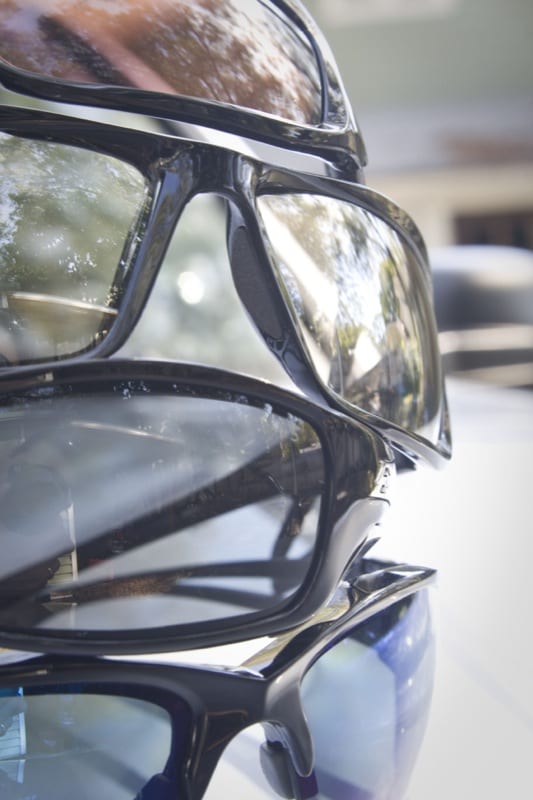
The KHOR Series With Polarized Aqua Precision Blue Mirror Lens (TSDKAP218): A Half‑Frame Masterpiece That Blocks Red and Infrared Light
The Edge KHOR Series glasses with the Polarized Aqua Precision Blue Mirror lens are beautiful to look at, and even better to wear. They are a nylon half‑frame design with lenses that wrap around your head such that, strain all you want, you will never perceive the edge of the lens—something that was true for each of the glasses I reviewed. The arms are a split design, with a hard plastic upper post and a soft rubberized lower post that joins into a soft tip that clasps behind the ears. This same rubber is used for the nose piece, creating a secure, comfortable fit that does not slide down the nose even when the wearer is sweating or working in humid conditions. The split‑arm design is worth examining more closely because it solves a persistent problem with safety glasses: the tendency for the arms to create pressure points behind the ears during extended wear. The hard plastic upper post provides structural rigidity, ensuring that the glasses maintain their shape and that the lenses remain properly positioned relative to the eyes. The soft rubberized lower post conforms to the contour of the head, distributing pressure across a broader area and eliminating the hot spots that can make wearing safety glasses for an eight‑hour shift a misery. The soft tips that curve behind the ears provide additional security, preventing the glasses from sliding forward when the wearer looks down—a critical consideration for anyone who works on ladders, scaffolding, or any elevated surface where a dropped pair of glasses could become a hazard.
The lens technology in the KHOR Series is where the real innovation lies. These lenses, which are available on many of the Edge Eyewear safety glasses, actually block a significant amount of red and infrared light transmission. The result is a higher perceived contrast overall. I found that it dulls the color somewhat, but with the benefit of providing more detail, particularly in bright or white areas. This is not merely a subjective impression; it is a consequence of the physics of how the human visual system processes contrast. By filtering out a portion of the red and infrared spectrum, the lenses reduce the amount of scattered light that reaches the retina, which in turn reduces the veiling glare that washes out detail in brightly lit scenes. The effect is similar to what a photographer achieves with a polarizing filter: the sky appears deeper, the clouds more defined, and the textures of surfaces more apparent. For a professional who works outdoors in bright sunlight—a roofer, a concrete finisher, a landscaper, a highway construction worker—the enhanced contrast can mean the difference between seeing a hazard and missing it. If you are painting or doing something where improving contrast is going to benefit you, these are excellent lenses on a comfortable and stylish frame. The polarized coating adds another layer of utility by eliminating the glare that reflects off horizontal surfaces—water, wet pavement, the hood of a vehicle, a sheet of metal roofing. For anyone who works near water or on reflective surfaces, polarized lenses are not a luxury; they are a necessity that reduces eye strain and improves visual comfort throughout the day. The blue mirror finish, aside from its aesthetic appeal, further reduces the amount of visible light that reaches the eye, making these glasses suitable for the brightest conditions. At $34.95, the KHOR Series represents a mid‑range price point in the safety glasses market, and it delivers performance that justifies every penny.
The Brazeau Series: A Full‑Frame Design With Two Lens Options—Polarized Copper and Anti‑Reflective
The Edge Brazeau Series has a full nylon frame with a soft rubberized coating that travels along the entire base of each arm all the way to the tips which rest behind the ears. Like the Reclus, the Brazeau safety glasses feature a pair of soft TPR temple tips that actually do very well at keeping the glasses in place—even when they get wet or when you sweat. I had two pairs of these to test. The first pair came with the Polarized Copper lenses, which Edge calls their "Driving" lens. What it does, among other things, is filter out a significant amount of blue light. The result is a nice bright image that works just as well on cloudy days as it does on sunny afternoons. The science behind this is interesting: blue light, which occupies the short‑wavelength end of the visible spectrum, is scattered more readily by the atmosphere than longer wavelengths. This is why the sky appears blue, and it is also why distant objects on a hazy day appear washed out and indistinct. By filtering out a portion of the blue light, the copper‑tinted lenses effectively cut through the atmospheric haze, improving the clarity and definition of distant objects. For a driver, this means better visibility of the road ahead, of traffic signals, and of potential hazards. For a construction professional who operates heavy equipment or who works on roadways, the improved distance vision can be a genuine safety advantage.
The other pair came with the Anti‑Reflective lens, which is not so much about providing shade for your eyes as it is about UV blocking and reducing glare. These safety glasses are great for when you may be going in and out of a well‑lit building or you are working on a cloudy day or in an area that is not getting direct sunlight. An anti‑reflective coating works by reducing the amount of light that bounces off the front and back surfaces of the lens. Without such a coating, approximately 8 percent of the light that strikes a lens is reflected away, which not only reduces the amount of light that reaches the eye but also creates distracting reflections that can interfere with vision. By virtually eliminating these reflections, the anti‑reflective coating increases the amount of light that passes through the lens to nearly 99 percent, which improves visual acuity in low‑light conditions and reduces the eye strain that results from the eye constantly trying to compensate for the reflected glare. For an electrician who moves between a brightly lit exterior and a dim interior space, for a maintenance technician who works in the shadowed corners of a mechanical room, or for anyone whose work takes them in and out of buildings throughout the day, the anti‑reflective lens provides a level of visual comfort that a tinted lens cannot match. I found the Edge Brazeau glasses to be really comfortable to wear, and not just on my head. When I passed them around, the consensus was that these particular Edge Eyewear safety glasses work well on a variety of head shapes and sizes. This is a testament to the thought that went into the frame geometry—the curvature of the arms, the angle of the temple tips, the width of the nose bridge—all of which must work together to create a fit that is secure without being tight, stable without being rigid. At $34.95 for the polarized model and $17.95 for the anti‑reflective, the Brazeau Series offers an excellent combination of optical quality, impact protection, and all‑day comfort at prices that are accessible to any professional.
The Reclus Series With Smoke Lens (SR116): Minimalist Design, Maximum Comfort, and a Natural Light‑Dialing Effect
The Edge Reclus is a very straightforward, minimalistic design. It is simple, comfortable, and attractive. Even after hours of use there was little to no felt pressure at either the bridge of my nose or the area above or behind my ears where the arms make contact with my head. Achieving this level of comfort in a safety glass requires careful attention to the weight distribution and the contact surface area. The Reclus frame is lightweight, but it is not flimsy; it maintains its shape and its grip without requiring excessive clamping force. The Smoke lens blocked a good amount of light, but with a more natural tone. When I put them on it felt as if the sunlight had been dialed back ever so slightly. This is the effect of a neutral‑density tint—a lens that reduces the overall brightness of the scene without altering the color balance. Unlike the copper lens, which selectively filters blue light, or the blue mirror lens, which selectively filters red and infrared, the smoke lens attenuates all wavelengths of visible light approximately equally. The result is a view of the world that looks simply like a darker version of the world you see with the naked eye. Colors remain true. Contrast remains natural. The only thing that changes is the overall brightness, which is reduced to a level that is comfortable for the eyes under moderate to bright sunlight. For the professional who works in a variety of lighting conditions and who does not need the specialized filtering of a polarized or color‑enhancing lens, the smoke lens is an excellent general‑purpose choice. It works well outdoors on sunny days, it works reasonably well on overcast days, and it does not distort colors in a way that could interfere with tasks that require accurate color perception—identifying the color of a wire, matching a paint sample, reading a color‑coded label. At $17.95, the Reclus Series is the most affordable of the Edge Eyewear safety glasses I tested, and it is a remarkable value for a pair of safety glasses that are this comfortable, this durable, and this optically competent.
The Standards That Matter: ANSI Z87.1+2010 and the Military MCEPS Ballistic Test
I have worn a lot of different types of safety glasses, from all sorts of manufacturers. What I like about the Edge Eyewear safety glasses is that every single pair is rated to ANSI Z87.1+2010, and then they also built them to handle the Military MCEPS test "Ballistic" standard. There is a lot involved in that, but suffice it to say that they will stop a 16D nail fired from a pneumatic nailer positioned 2 feet away, or a 1/4‑inch steel ball traveling at 660 feet per second. The ANSI Z87.1 standard is the benchmark for occupational eye protection in the United States, and the "+" designation indicates that the glasses meet the high‑impact version of the standard, which requires them to withstand the impact of a 1/4‑inch steel ball traveling at 150 feet per second. The military ballistic standard is significantly more demanding—the projectile travels more than four times faster, and the energy it carries is more than sixteen times greater. For a pair of safety glasses to meet both standards is a testament to the quality of the polycarbonate lens material and the robustness of the frame design. The implications for the professional are straightforward: these glasses will protect your eyes from the kinds of high‑velocity impacts that can occur on a construction site, in a manufacturing facility, or in any environment where power tools, compressed gases, or heavy machinery are in use. A nail gun misfire, a grinding wheel fragment, a piece of metal that is ejected from a press—these are not hypothetical hazards. They are real, they occur with alarming frequency, and the difference between a pair of safety glasses that meets the ANSI standard and a pair that meets the military ballistic standard can be the difference between a near miss and a life‑changing injury. With safety glasses costing as little as $10 these days, I might want to pay a little more for a certification that I know actually means something. You probably should as well.
Edge Eyewear Safety Glasses: Lens Comparison
| Model Series | Lens Type | Key Optical Benefit | Best Application | Price |
|---|---|---|---|---|
| KHOR (TSDKAP218) | Polarized Aqua Precision Blue Mirror | Blocks red/infrared light; enhances contrast; eliminates surface glare | Bright outdoor work; painting; roofing; concrete | $34.95 |
| Brazeau (TXB215) | Polarized Copper ("Driving") | Filters blue light; improves distance clarity and haze penetration | Driving; outdoor work on cloudy and sunny days | $34.95 |
| Brazeau (XB111AR) | Anti‑Reflective | Virtually eliminates reflections; maximizes light transmission to ~99% | Indoor/outdoor transitions; low‑light work; electrical rooms | $17.95 |
| Reclus (SR116) | Smoke | Neutral‑density tint; reduces overall brightness without distorting colors | General‑purpose outdoor use; moderate to bright sunlight | $17.95 |
Conclusion: Safety Glasses That Protect, Perform, and Look Like They Belong in This Century
There are nineteen different lens styles you can order with many of the Edge Eyewear safety glasses. But what does each really do in practice? We took a photo with our DSLR camera and placed the glasses over for each—a visual comparison that revealed, more clearly than any description could, the differences in color rendition, contrast, and brightness that each lens type provides. The polarized Aqua Precision Blue lenses made the reflected image of a tree pop with a vividness that was absent from the other lenses. The Polarized Copper pulled the blue light out of the sky, warming the entire scene and sharpening the details of distant objects. The Anti‑Reflective lens brightened the shadows without altering the colors, making the world look simply clearer and more luminous. And the Smoke lens dialed back the sun to a comfortable level while preserving the natural palette of the outdoor environment. Each lens has its purpose, and the beauty of the Edge Eyewear system is that it does not force the user to choose a single lens for all situations. A professional can own multiple pairs—one for bright outdoor work, one for driving, one for overcast days or indoor use—and switch between them as the conditions dictate. The frames, across all the models I tested, are comfortable enough to wear all day, durable enough to survive the rigors of a job site, and certified to standards that exceed what most safety glasses on the market can claim. For the professional who values their eyesight—and every professional should—Edge Eyewear safety glasses are an investment in protection, performance, and the simple, irreplaceable ability to see the world clearly, every day, in every kind of light.
Comments 0
Leave a Comment