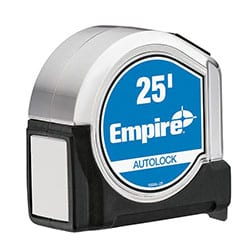
Empire hasn’t repositioned itself as a premium brand overnight. The pricing tells the real story : the most expensive model in the new lineup, a 35‑foot chrome tape, costs $15.99. The 25‑foot autolock, likely to be the volume seller, lands at just $9.99. These are working‑class tape measures, priced for the contractor who buys them by the handful, loses them to the mud, and needs them to survive until they get lost again. But within that value‑oriented frame, Empire has packed several features that simply weren’t available at this price point a few years ago : a nylon blade coating that dramatically extends legibility, a five‑point reinforced housing that resists cracking from drops, an auto‑locking brake on the autolock series, fractional printing for quick reading, and the genuinely novel inclusion of a dedicated marking surface right on the tape body. Add a limited lifetime warranty and a choice between modern autolock styling and classic chrome nostalgia, and you have a line of tape measures that disrupts expectations about what a $10 tape can do. Let’s pull the blade on each feature, break down the models, and figure out if these new Empires deserve to unseat the old favorites on your tool belt.
The Milwaukee Connection : Trickle‑Down Toughness in an Empire Badge
When Milwaukee Tool launched the Stud tape measure series, two of its headline durability features were the nylon‑bond blade protection and the 5‑point reinforced frame. The Stud tapes quickly earned a reputation for surviving drop tests that cracked competitors and for maintaining readable markings long after uncoated blades had worn down to bare steel. Those features weren’t cheap to develop, and they belonged squarely in Milwaukee’s premium hand tool lineup. But acquisitions are long‑term plays. As Empire and Milwaukee engineers collaborated under the same corporate umbrella, it was inevitable that some of Milwaukee’s hard‑won material science would migrate downward into Empire’s more accessible price tier.
The new Empire tape measures employ a nylon‑coated blade that looks, feels, and behaves remarkably like Milwaukee’s Nylon Bond coating. The nylon is integrated into the blade surface, not applied as an after‑film. This means it resists abrasion from repeated extension and retraction, from being dragged across rough lumber, and from the grit that accumulates inside a tape measure case. Markings printed beneath the nylon layer stay crisp for years, not months. The 5‑screw reinforced housing on the Empire tapes similarly mirrors the Stud’s 5‑point reinforced frame architecture : screws positioned at the corners and stress points of the case to hold the internal mechanism rigid and prevent the housing from separating when dropped. Empire’s housing is a two‑shell clamshell design held together by exactly five screws-hence the term “5‑screw reinforced.” This construction resists the torsional flex that can cause internal gears to jump a tooth, rendering a tape measure inaccurate. While Milwaukee hasn’t stated publicly that the Empire features are direct descendants, the genetic line is too clear to dismiss as coincidence. For the Pro, this means that a sub‑$10 tape now benefits from technology that was exclusive to a $20‑plus tape just a few years ago.
Nylon‑Coated Blade : The Anti‑Wear Armor That Keeps Markings Legible
A tape measure blade lives a hard life. Every time you pull it across a stud edge, graze it against a concrete form, or retract it through a dusty case mouth, you’re microscopically sanding the printed markings off the steel. Budget tapes with bare printed blades can become unreadable within weeks of heavy use, forcing you to replace the tape or squint through faded numbers. Empire’s nylon‑coated blade addresses this directly. The nylon forms a tough, transparent layer over the printed markings, taking the abrasion instead of the ink. It’s the same principle behind the premium tapes that command $20–$30 : you’re paying for legibility over the long haul.
But a blade coating is only as good as the steel underneath it. Empire uses a high‑carbon steel blade with a spring temper that balances flexibility and stiffness. The blade extends smoothly, stands out adequately for its price class (Empire doesn’t publish a standout figure, but given the price point, expect a standout in the 6‑to‑8‑foot range on the 25‑foot model-competitive but not class‑leading). The blade markings include standard 1/16‑inch increments, and on the autolock series, fractional measurements are printed directly on the blade-1/8, 1/4, 3/8, and so on-eliminating the mental math of counting ticks for apprentices and tired Pros alike. The fractional printing is a feature inherited from Milwaukee’s Stud series, where it has been widely praised, and its appearance on an Empire tape at $9.99 is a notable value add.
5‑Screw Reinforced Housing : Drop‑Test Survival at a Budget Price
If you’ve ever dropped a cheap tape measure from waist height onto concrete and watched the case split open, spilling the blade and spring across the floor, you understand why housing reinforcement matters. Empire’s new tapes use a five‑screw clamshell design that secures the front and back halves of the case at the corners and at a central stress point. This construction resists the impact energy that would otherwise pop a snap‑fit case apart. The screws are recessed into the housing, so they don’t snag on your pocket or scratch finished surfaces.
The housing material itself is a high‑impact ABS plastic with a textured grip area. It’s not rubber overmold-that’s a cost‑adder that typically pushes a tape into the $15–$20 range-but the texture provides a decent non‑slip surface even with dusty or damp gloves. The belt clip is a sturdy wire‑form steel spring that holds firmly on a tool belt. The clip is riveted to the case, and while it’s not as heavy‑duty as the thick clips on Milwaukee’s Stud tapes, it’s more than adequate for everyday use. Overall, the housing represents a significant step up from the unscrewed, snap‑together cases on most sub‑$10 tapes, and it should survive multiple drops that would spell the end for a conventional budget model.
The Marking Surface : A Notepad Built Into Your Tape
The most genuinely novel feature of the Empire tape measure series is the dedicated marking surface on the top of the case. Empire has molded a flat, slightly textured pad into the housing, designed to be written on with a carpenter’s pencil. If you’ve ever jotted a measurement on a scrap of lumber only to have it cut off and tossed, or written a number on your palm and promptly forgotten which dimension it referred to, the utility of an onboard writing surface needs no further explanation. The pad is large enough to scribble a few numbers, stud spacing, or a quick cut list. It wipes clean with a thumb or an eraser, ready for the next set of marks.
This feature is not about replacing a notepad or a smartphone. It’s about capturing a measurement in the exact moment you’re holding the tape, without putting the tape down, without reaching for a pencil and paper, and without breaking your rhythm. For a trim carpenter working through a cut list, or a framer confirming a stud layout, the marking surface provides a temporary buffer between the measurement and the cut. It’s the kind of small, human‑centric feature that often gets overlooked in spec‑sheet comparisons but delivers daily convenience that makes a tool feel more personal. Empire’s inclusion of this feature at the $7.99 starting price point is frankly surprising, and we’re curious to see how the market reacts. Some Pros will embrace it immediately; others may view it as a gimmick that takes up space. But the cost to include it is negligible, and for those who use it, it’s a genuine workflow improvement.
Autolock Series vs. Chrome Series : Two Styles, Same Core Durability
Empire offers the new tape measures under two distinct visual and functional designs, allowing the buyer to choose based on preference and intended use.
Autolock Series (500AL models) : These tapes feature a self‑locking mechanism that holds the blade extended without needing to engage a manual lock. Pull the blade out to any length, and it stays there until you press the release button to retract it. This is a huge convenience for one‑handed operation; you can extend the tape, hook it, mark, and release, all with one hand while your other hand holds the workpiece. The release button is positioned on the bottom of the case, accessible with the same hand that holds the tape. The autolock series also features the fractional printing on the blade-a huge readability advantage-and the case styling is more contemporary, with a darker color scheme and a contoured shape. The autolock models are available in 12‑foot ($7.99), 16‑foot ($8.99), and 25‑foot ($9.99) lengths.
Chrome Series (300 models) : The chrome tapes ditch the autolock mechanism in favor of a classic chrome‑plated metal case that pays homage to the Lufkin and Stanley PowerLock designs that have defined the tape measure category for generations. The chrome finish is both aesthetically appealing and functional-it resists scratches, doesn’t fade, and slides in and out of a tool pouch smoothly. These tapes require a manual thumb slide to lock the blade, which is the traditional approach that many carpenters prefer for its simplicity and tactile feedback. The blade markings are printed with standard increments, but without the fractional call‑outs of the autolock model (Empire has not stated the chrome series includes fractional printing; based on the product literature, it may be that the chrome series omits this to maintain its classic look). The chrome series spans a wider range of lengths : 12‑foot ($7.99), 16‑foot ($8.99), 25‑foot ($9.99), 30‑foot ($13.99), and a 35‑foot ($15.99) monster for heavy‑duty layout. The 35‑footer, at fifteen‑ninety‑nine, is the most expensive tape in the entire lineup, yet still cheaper than a 25‑foot Milwaukee Stud. That’s the Empire value proposition in a single price point.
Model Lineup and Pricing at a Glance
| Series | Model Number | Length | Key Features | Price |
|---|---|---|---|---|
| Autolock | 500AL‑12 | 12 feet | Auto‑lock, fractional printing, nylon blade, 5‑screw housing, marking surface | $7.99 |
| Autolock | 500AL‑16 | 16 feet | Auto‑lock, fractional printing, nylon blade, 5‑screw housing, marking surface | $8.99 |
| Autolock | 500AL‑25 | 25 feet | Auto‑lock, fractional printing, nylon blade, 5‑screw housing, marking surface | $9.99 |
| Chrome | 300‑12 | 12 feet | Chrome case, manual lock, nylon blade, 5‑screw housing, marking surface | $7.99 |
| Chrome | 300‑16 | 16 feet | Chrome case, manual lock, nylon blade, 5‑screw housing, marking surface | $8.99 |
| Chrome | 300‑25 | 25 feet | Chrome case, manual lock, nylon blade, 5‑screw housing, marking surface | $9.99 |
| Chrome | 300‑30 | 30 feet | Chrome case, manual lock, nylon blade, 5‑screw housing, marking surface | $13.99 |
| Chrome | 300‑35 | 35 feet | Chrome case, manual lock, nylon blade, 5‑screw housing, marking surface | $15.99 |
Every tape in the series is backed by a limited lifetime warranty, which covers defects in materials and workmanship. Empire honors this through its service network, and the Milwaukee ownership provides a stable corporate backing for warranty claims. For a tape measure in this price tier, a lifetime warranty is a powerful statement of confidence in the manufacturing process.
Who Should Buy the New Empire Tape Measures ?
The Empire tapes are aimed squarely at three groups :
- The value‑conscious professional : If you go through tape measures quickly-because they get dropped into wet concrete, run over by equipment, or simply worn out-spending $20–$30 per tape adds up. Empire’s $9.99 25‑footer delivers 80% of the performance and durability of a premium tape at 40% of the price. For a crew of five framers each carrying two tapes, the savings can buy an extra cordless tool each year.
- The classic‑style loyalist : Some carpenters simply prefer the look and feel of a chrome‑cased tape. It’s what they learned on, and the heft and patina of a chrome tape is deeply satisfying. Empire’s chrome series honors that tradition while adding modern nylon‑blade longevity and a reinforced housing that the originals never had. It’s a nostalgic tape with modern bones.
- The apprentice or entry‑level Pro : Starting in the trades is expensive; you’re buying tools on a tight budget. An Empire tape delivers a durable, accurate, easy‑to‑read tool that doesn’t ask you to compromise on features you’ll need every day. The fractional printing on the autolock series, in particular, is a learning aid disguised as a convenience-it helps a new worker build confidence in reading measurements correctly.
For the contractor who demands extreme standout (12‑feet plus) for solo framing, or a magnetic hook for steel stud work, the Empire tapes might fall a bit short, as they are built more for general‑purpose durability than niche high‑performance specs. But for the vast middle of the market-finish carpenters, cabinet installers, electricians, plumbers, concrete form setters, and general contractors-the feature set and price point are exceptionally well matched.
Initial Impressions and What We’ll Be Watching
At launch, the Empire tape measure series appears to be one of the most aggressive value propositions in the layout category. The nylon‑coated blade, 5‑screw housing, and marking surface are features that would be remarkable on a $15 tape; on a $7.99 tape, they’re almost disorienting. The direct line of influence from Milwaukee’s engineering team gives us confidence that these durability features aren’t just marketing terms-they have a proven track record in harder‑working, more punishing tape measures.
We’ll be watching closely for a few things as these tapes reach the field in volume : how well the autolock mechanism holds up over thousands of cycles (autolocks can be finicky and prone to grabbing too tightly or not tightly enough), whether the marking surface erodes after repeated pencil‑and‑eraser use, and whether the blade coating maintains its integrity after exposure to common jobsite chemicals like PVC cement, gasoline, and concrete splatter. Empire’s limited lifetime warranty suggests they’re confident, but real‑world feedback will tell the full story. We’ll also be comparing standout and retraction speed to the Milwaukee Stud and to other tapes in the $10 bracket, because those performance metrics matter day‑to‑day even if they’re not the headline features.
The Bottom Line : Empire Takes the $10 Tape Measure Into Professional Territory
Empire’s new tape measures represent a quiet but meaningful shift in what Pros can expect from an entry‑level‑priced layout tool. The infusion of Milwaukee’s durability DNA-nylon blade coating, reinforced housing-combined with Empire’s own practical innovations like the marking surface, creates a tape measure line that feels more expensive than it is. At $9.99 for a 25‑foot autolock with fractional printing, or $9.99 for a classic chrome 25‑footer, the value is impossible to ignore. The 35‑foot chrome tape at $15.99 undercuts many competitors’ 25‑foot prices while delivering a longer blade. For the professional who needs reliable, accurate, comfortable tapes that can be replaced without financial pain when the jobsite swallows them, the new Empire lineup is a compelling answer. It’s not a revolution-it’s an evolution with Milwaukee’s fingerprints all over it-but it brings genuinely pro‑grade durability into a price bracket that has, until now, been dominated by disposable tools. And when a tool transitions from disposable to dependable, it changes how you think about owning it. Empire has made a strong case that a $10 tape measure can be more than a consumable; it can be a trusted partner, quietly marking the seasons of a career, one fraction‑printed increment at a time.
Comments 0
Leave a Comment