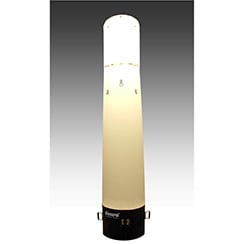
The Inflatable Tower: Why Air Is the Ultimate Support Structure
The most distinctive feature of the General Equipment Tower Lights is their inflatable support column. Instead of a metal mast with telescoping sections, locking collars, and guy wires—the traditional design for a portable light tower—these lights use a cylindrical nylon tower that is inflated by a constant‑air blower system integrated into the base of the unit. The blower, which is powered by a standard 115‑volt AC outlet or a portable generator, delivers a continuous stream of air into the tower, maintaining the internal pressure needed to keep the column rigid and upright. The tower is designed to remain inflated and functional even with minor cuts or perforations—the constant airflow compensates for small leaks, and the nylon material is tough, abrasion‑resistant, and washable. The advantages of the inflatable design over a traditional metal mast are several. First, and most importantly, it is fast. A General Equipment Tower Light can be set up and ready for operation in approximately one minute, with no special tools, no complex assembly, and no multiple‑person crew required. The user simply unrolls the tower, connects the blower to a power source, and switches it on. The tower inflates, lifting the lamp head to its full operational height, and the light is turned on. Second, the inflatable tower is inherently safe in the event of a collision. A vehicle or a piece of equipment that strikes a metal light tower can cause significant damage to both the tower and the vehicle, and can potentially cause the tower to collapse. The same collision with an inflatable tower will cause the tower to deform and rebound, minimizing damage and reducing the risk of injury. Third, the inflatable tower is lightweight and compact when deflated. A metal light tower of comparable height and stability requires a heavy base, a substantial mast, and often a trailer or a dedicated transport vehicle. The General Equipment Tower Lights, by contrast, can be transported in the back of a pickup truck, an SUV, or a van, and they can be stored in a relatively small space when not in use. The blower system, which is integrated into the base of each unit, is a 380‑watt electric blower that provides the constant air pressure needed to maintain tower rigidity. The blower is designed for continuous operation, and it is quiet enough—producing a steady hum rather than an intrusive roar—that it will not interfere with communication or become a nuisance on a job site. The tower heights available are 7.5 feet, 10 feet, and 14 feet, corresponding to the TL750, TL1000, and TL1400 models, respectively. The towers are anchored against wind using an external anchoring kit, and they are rated to remain stable in winds up to 21 miles per hour. In higher winds, the tower may need to be deflated or additional anchoring may be required.
Lamp Technology: Metal Halide, Not LED—and Why That Still Makes Sense
In an era when LED lighting is rapidly displacing every other lighting technology, the General Equipment Tower Lights use metal halide lamps rather than LED arrays. This is a deliberate and defensible choice. Metal halide lamps are a type of high‑intensity discharge (HID) lighting that produce light by passing an electric arc through a mixture of mercury vapor and metal halide salts. They are known for their high luminous efficacy—the amount of visible light produced per watt of electrical power—and for their excellent color rendering, which is important for applications like accident investigation, search and rescue, and construction where accurate color perception is critical. The TL750 and TL1000 models each use a 600‑watt metal halide lamp that produces 62,000 lumens of light—a staggering output that is equivalent to roughly sixty standard 100‑watt incandescent bulbs, concentrated into a single point source. The TL1400 uses a 1,000‑watt metal halide lamp that produces 105,000 lumens. These output levels are an order of magnitude higher than what is achievable with current LED technology at a comparable price and form factor. A comparable LED array capable of 100,000 lumens would be significantly larger, heavier, more expensive, and would require a complex thermal management system to dissipate the heat generated by the LEDs. For the specific applications that the Tower Lights are designed for—large‑scale outdoor illumination, where the light must cover an area measured in acres rather than square feet—the raw output of metal halide is difficult to match. The trade‑offs of metal halide are well‑known. The lamps require a warm‑up period of several minutes before they reach full brightness, and they cannot be restarted immediately after being turned off—the arc tube must cool down before the lamp can be restruck. The lamps have a finite life, typically several thousand hours, and they must be replaced periodically. The ballasts that drive the lamps are heavy and generate heat. But for the professional who needs to light up a nighttime construction site, a search area, or an emergency response scene, these trade‑offs are acceptable in exchange for the raw, overwhelming brightness that metal halide provides. The Tower Lights include a built‑in ballast and a weatherproof lamp housing that protects the lamp from rain, dust, and impact. The lamp housing is designed to diffuse the light, creating a 360‑degree, glare‑free illumination that is easy on the eyes and that minimizes harsh shadows—a critical advantage for environments where workers must be able to see clearly and where the harsh, directional glare of an undiffused point source could create safety hazards.
Safety, Certifications, and the Importance of Diffused Light
General Equipment Company has engineered the Tower Lights with a strong emphasis on safety and regulatory compliance. The diffused, 360‑degree light pattern is not merely an aesthetic preference; it is a deliberate design choice that enhances workplace safety. Undiffused point‑source lights, such as the bare bulbs on many portable work lights, create harsh shadows and can cause temporary blindness or disorientation if a worker looks directly at the source. The Tower Lights' nylon tower and diffusing housing soften the light, spreading it evenly across the work area and reducing the risk of glare‑related accidents. The towers are also inherently stable, with a low center of gravity and a wide, weighted base that resists tipping. The external anchoring kit provides additional security in windy conditions, and the system is designed to be deployed quickly and safely by a single person. The lights are certified for outdoor use and are built to withstand the rigors of the construction, industrial, and emergency response environments for which they are intended. The nylon tower material is resistant to abrasion, UV radiation, and common chemicals, and it can be cleaned with soap and water. The blower system is protected against dust and moisture by a sealed housing, and the electrical components are rated for outdoor use. For event organizers, the Tower Lights offer an attractive alternative to the traditional metal light towers that are often used for concerts, festivals, and outdoor gatherings. The inflatable towers have a softer, more organic visual presence than the harsh, industrial look of a metal mast, and the diffused light creates a more pleasant, ambient illumination that is suitable for social and recreational events. For advertising and promotional applications, the towers can be customized with graphics or logos, turning a functional light source into a branding opportunity.
General Equipment Company Tower Lights Specifications
| Specification | TL750 | TL1000 | TL1400 |
|---|---|---|---|
| Model Number | TL750 | TL1000 | TL1400 |
| Tower Height (Inflated) | 7.5 ft (2,286 mm) | 10 ft (3,048 mm) | 14 ft (4,267 mm) |
| Maximum Lamp Output | 62,000 lumens | 62,000 lumens | 105,000 lumens |
| Lamp Type | 600W Metal Halide | 600W Metal Halide | 1,000W Metal Halide |
| Power Source | 115 VAC, 60 Hz | 115 VAC, 60 Hz | 115 VAC, 60 Hz |
| Blower Power | 380 W (integrated) | 380 W (integrated) | 380 W (integrated) |
| Weight | 40.5 lbs | 45 lbs | 60 lbs |
| Wind Rating | Up to 21 mph (with anchoring) | Up to 21 mph (with anchoring) | Up to 21 mph (with anchoring) |
| Beam Pattern | 360° diffused, glare‑free | 360° diffused, glare‑free | 360° diffused, glare‑free |
| Price (Approx.) | ~$2,300 | ~$2,500 | ~$2,750 |
Conclusion: When You Need to Turn Night Into Day, These Towers Deliver
The General Equipment Company Tower Lights are not for everyone. They are large, heavy, relatively expensive, and they require a continuous source of AC power. They use metal halide lamps, which are less efficient and require more maintenance than modern LEDs. But for the specific applications they are designed for—large‑scale outdoor illumination for construction, emergency response, search and rescue, and major events—they deliver a level of raw, overwhelming brightness that is difficult to achieve with any other portable lighting technology. The inflatable tower design is genuinely innovative, providing rapid deployment, inherent collision safety, and compact storage in a form factor that is unlike anything else on the market. The 360‑degree diffused light pattern creates a safe, comfortable, and shadow‑free work environment, which is essential for the high‑stakes applications these lights serve. For the general contractor, the emergency services coordinator, the event organizer, or the industrial facility manager who needs to turn a dark, chaotic scene into a brightly lit, safely navigable work zone, the General Equipment Tower Lights are a compelling, purpose‑built solution. They are not subtle. They are not quiet. But they are extraordinarily effective at doing the one thing they were designed to do: turning night into day.
Comments 0
Leave a Comment