The Fundamental Insight: Why Blow‑Molded Cases Fail in the Real World
The fundamental insight behind the Get Sorted design is that the traditional method of organizing sockets and wrenches—the blow‑molded plastic case with a dedicated, laser‑cut recess for each individual tool—is elegant in theory but disastrous in practice. Those cases are designed to hold a specific set of tools, in a specific arrangement, and they are intolerant of deviation. If you lose a 10mm socket, the 10mm recess remains as a permanent, empty reminder of your carelessness. If you acquire a 12mm deep‑well socket that was not part of the original set, there is no place for it. The case becomes a puzzle that can only be solved one way, and that way requires every tool to be in its designated spot, oriented correctly, and pressed firmly into the friction‑fit recess. At the end of a long day, when your hands are tired and your patience is thin, the act of pressing each socket back into its individual, tight‑fitting nest feels like a chore, and the temptation to simply toss the sockets into the drawer and close it is overwhelming.
The Socket Tray: Channels, Sizing Blocks, and the Freedom of Gravity
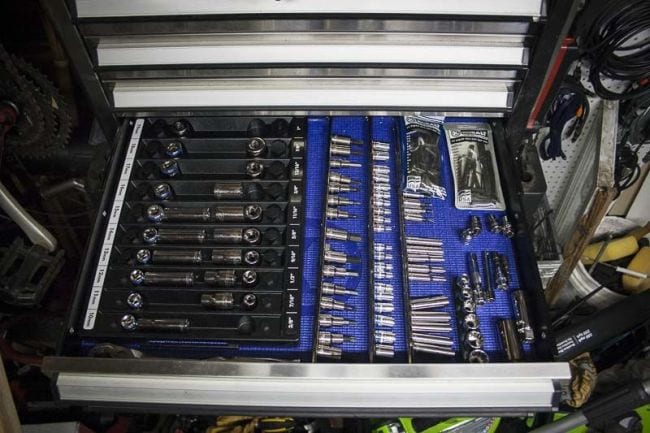
Get Sorted abandons the tyranny of the individual recess. Instead of a precisely machined cavity for each socket, the Get Sorted Socket Tray uses an open, grooved surface with raised sizing blocks. The tray has a series of parallel channels, each one sized to accommodate a range of socket diameters. Along the edges of the tray, raised blocks are marked with the socket size—metric on one side, SAE on the other—and the user simply slides the socket into the channel adjacent to the appropriate block. There is no friction fit, no precise orientation required. The socket drops into the channel and rests there, held by gravity and the walls of the channel. To retrieve it, you simply lift it out. To put it back, you drop it back into the same channel. The process is fast, intuitive, and requires almost no fine motor control. The sizing blocks serve as a visual guide, but after a few uses, the user develops a feel for where each socket belongs, and the process becomes automatic. The tray accommodates both regular and deep‑well sockets, because the channels are deep enough to hold the longer sockets without them tipping over, yet wide enough to cradle the shorter sockets securely. The range of sizes supported on a single tray covers 3/8‑inch to 1‑inch in SAE and 10mm to 19mm in metric. This covers the vast majority of sockets that a professional mechanic or a serious DIYer uses on a daily basis. The smaller sizes—below 3/8‑inch and below 10mm—are not accommodated on the standard tray, which is a limitation for users who work extensively with smaller fasteners. Those smaller sockets must be stored separately, in a different tray or a different organizer. The tray itself is molded from ABS plastic, a durable, impact‑resistant polymer that is commonly used for automotive trim, power tool housings, and consumer electronics. It is rigid enough to maintain its shape when the tray is lifted or moved, and it is resistant to the oils, solvents, and general grime that are endemic to a workshop environment. The tray is available in red or black, and it is manufactured in the United States—a distinction that matters to some purchasers and that reflects a commitment to domestic production that is increasingly rare in the consumer‑goods market. The socket tray dimensions are approximately 14.5 inches by 11 inches by 1 inch, sized to fit comfortably into a standard tool chest drawer without consuming excessive space or interfering with the drawer's ability to close.
The Wrench Tray: Interleaved Metric and SAE, and the Slide‑and‑Drop Philosophy
The Get Sorted Wrench Tray applies the same slide‑and‑drop logic to the organization of combination wrenches, but with a twist that is either ingenious or frustrating, depending on your perspective. Instead of separating metric and SAE wrenches into different trays or different rows, the Get Sorted wrench tray interleaves them. The sizing blocks along the edge of the tray alternate between metric and SAE: 10mm, then 3/8‑inch, then 11mm, then 7/16‑inch, and so on, up to 7/8‑inch and 19mm. The idea is that both sets of wrenches can coexist in the same tray, in the same space, without the user having to dedicate separate trays or separate drawers to the two measurement systems. For the mechanic who works on a mix of domestic and import vehicles, or the maintenance technician who encounters both metric and SAE fasteners throughout the day, the interleaved arrangement allows all of the commonly used wrenches to be stored in a single, compact tray. The trade‑off is that the interleaving can be confusing, particularly when the user is trying to return a wrench to the tray quickly. A 13mm wrench belongs in a specific slot, but that slot is adjacent to a 1/2‑inch slot, and a 9/16‑inch slot, and the visual distinction between them is not as immediately obvious as it would be if all the metric wrenches were on one side and all the SAE wrenches were on the other. The "slide and drop" method that Get Sorted promotes—sliding the wrench along the tray until it drops into the correct slot—is intended to make the process intuitive, but it requires the user to develop a feel for the spacing, and it is not an exact science. The wrench tray also includes a separate, open‑topped compartment for storing miscellaneous items—Allen wrenches, ignition wrenches, specialty tools—that do not fit neatly into the interleaved slots. This is a useful addition that acknowledges the reality that no wrench set is perfectly complete, and that a professional's collection inevitably includes oddball sizes and specialty tools that need a home. The tray dimensions are approximately 13.5 inches by 10 inches by 1.5 inches, and it is made from the same ABS plastic as the socket tray. The wrench slots are sized to accommodate standard combination wrenches up to 7/8‑inch or 19mm, and the tray can be placed in a drawer or carried to the work area.
Get Sorted Wrench and Socket Tray Specifications
| Specification | Wrench Tray | Socket Tray |
|---|---|---|
| Dimensions | 13.5″ × 10″ × 1.5″ | 14.5″ × 11″ × 1″ |
| Material | ABS plastic | ABS plastic |
| SAE Range | 3/8″ to 7/8″ | 3/8″ to 1″ |
| Metric Range | 10mm to 19mm | 10mm to 19mm |
| Layout | Interleaved metric and SAE | Dual‑sided metric/SAE sizing blocks |
| Special Feature | Miscellaneous tool compartment | Accommodates regular and deep‑well sockets |
| Country of Origin | USA | USA |
| Weight | 17.4 oz | 17.4 oz (approx.) |
| Colors | Red or black | Red or black |
Who Should Buy the Get Sorted System?
The Get Sorted system is not a complete solution for the professional who owns a comprehensive collection of sockets and wrenches in every possible size. The lack of accommodation for smaller sockets—below 3/8‑inch and below 10mm—means that a second tray or a different organizer is needed for those sizes. The interleaved metric‑and‑SAE arrangement of the wrench tray will appeal to some users and frustrate others, and it is very much a matter of personal preference. But for the professional who works primarily with the middle range of socket and wrench sizes, who values speed and simplicity over the rigid, single‑tool‑per‑cavity organization of a blow‑molded case, and who wants an organizational system that is made in the USA and built to last, the Get Sorted trays represent a thoughtful and practical approach to a universal problem. They will not transform a chaotic workshop into a showroom overnight, but they will make it significantly easier to find the right tool when you need it and to put it away when you are done—and that, for most of us, is enough to justify the investment. At roughly thirty dollars per tray, they represent an affordable upgrade that pays for itself in saved time and reduced frustration, and they are built to withstand the rigors of a professional workshop environment for years to come.
Comments 0
Leave a Comment