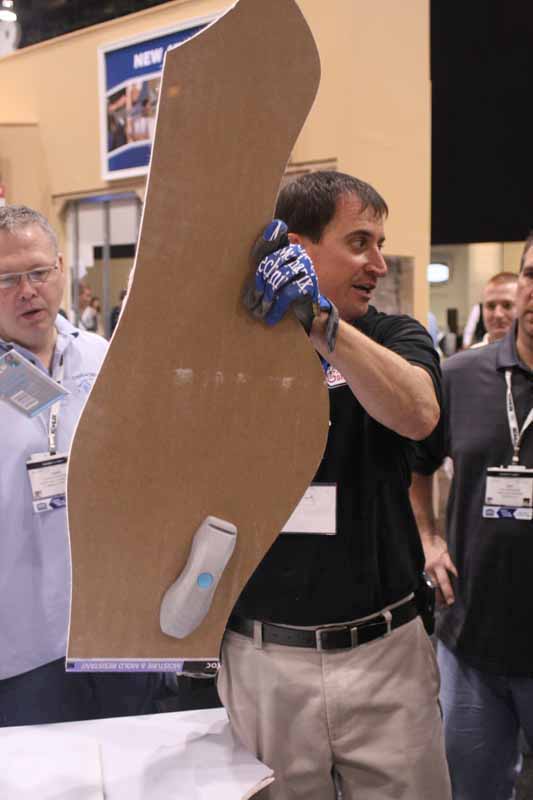
The Blade Runner is one of those rare inventions that seems obvious in retrospect—the kind of tool that makes you wonder why no one thought of it a century ago. It consists of two handheld pieces that contain sharp, replaceable cutting blades. One piece is placed on the top surface of the drywall sheet; the other is placed on the bottom surface, directly opposite. Powerful magnets embedded in each piece pull them together through the thickness of the drywall, so that when you slide the top piece along your cut line, the bottom piece follows it precisely, tracing the exact same path on the opposite face. Both blades cut through the paper and score the gypsum core on their respective sides. When you complete the cut, the drywall is severed cleanly through, with no snapping required. The two halves of the board simply separate, their edges smooth and ready for installation. It sounds like magic. It is not magic—it is magnetism, applied with clever geometry and sharp blades. But the effect is magical enough to make even a veteran drywall installer stop and stare.
The Magnetic Coupling: How Two Blades Track Each Other Through Gypsum
The key to the Blade Runner's functionality is the strength and alignment of its magnetic coupling. Each half of the tool contains a circular blade mounted in a plastic housing. The housings are shaped to be comfortable to grip, with contoured handles that allow the user to apply downward pressure on the top piece while guiding it along the desired cut line. The bottom piece is smaller and lighter, with no handle—it simply clings to the underside of the drywall via the magnetic attraction. When you place the top piece on the upper surface and the bottom piece roughly underneath it, the magnets snap them into alignment with each other. The magnetic force is strong enough to keep the bottom piece firmly pressed against the underside of the board, even when the drywall is lifted slightly off the sawhorses or when the cut line passes near the edge of the sheet. The bottom piece will not fall off unless you deliberately pull it away.
The blades in both the top and bottom pieces are circular and free‑spinning, similar to the rotary cutters used in fabric shops. As you push the top piece forward, its blade rotates and cuts through the paper face and into the gypsum core. Simultaneously, the magnetically coupled bottom piece is dragged along the underside of the board, and its blade rotates and cuts through the bottom paper face and into the core from below. The two cuts meet in the middle of the gypsum layer, effectively slicing the board in half without the need for the traditional score‑and‑snap method. Because both blades are cutting from the outside in, the paper faces on both sides are cleanly severed, with none of the ragged, torn paper that often results from snapping a scored board. The edge quality is superior to a utility knife cut, and significantly better than the jagged edge left by a saw.
Perfect 90‑Degree Corners: The Blade Runner's Party Trick
Scott Murray, the Goldblatt representative demonstrating the tool, had a favorite maneuver that drew gasps from the crowd. He would make a straight cut along the length of a drywall sheet, stop the tool at a marked point, and then—without lifting the Blade Runner from the surface—rotate the top piece 90 degrees and continue cutting in the new direction. Because the bottom piece is magnetically coupled and tracks every movement of the top piece, it also rotates 90 degrees at the exact same point on the underside of the board. The result is a perfectly square 90‑degree corner, cut simultaneously on both faces of the drywall, with no measuring, no marking of the second face, and no risk of the corner not aligning between the two sides. This is a task that, using traditional methods, requires careful measuring, precise snapping, and often a utility knife to clean up the corner. With the Blade Runner, it is accomplished in one fluid motion. For drywall installers who frequently cut around electrical boxes, HVAC registers, or window openings, the ability to make multiple directional changes without lifting the tool is a genuine productivity multiplier.
Straight Cuts, Curved Cuts, and the Learning Curve
The Blade Runner is capable of making both straight and curved cuts. Straight cuts are straightforward: you align the tool with a T‑square or a chalk line and push it steadily along the line. The magnetic coupling keeps the bottom piece tracking true, and as long as you maintain consistent forward pressure, the cut is clean and straight. Curved cuts require more skill. The user must steer the top piece along the desired curve while the bottom piece follows. Because the bottom piece is being pulled by magnetic force rather than guided by a track, it can lag slightly behind sharp directional changes, causing the bottom cut to be slightly offset from the top cut if the curve is too aggressive. With practice, a skilled user can compensate for this by slowing down on curves and applying gentle, consistent pressure. The learning curve is not steep, but it exists. The most important skill to develop is an awareness of exactly where the cutting blade is positioned on each side of the board at all times. Because the bottom blade is hidden beneath the drywall, you must trust that it is tracking correctly, and that trust is built through repetition.
Blades, Pricing, and Availability
The Blade Runner uses replaceable circular blades, similar in concept to the blades in a rotary fabric cutter. A pack of twelve replacement blades costs under $19, and a six‑pack is under $10. Given that each blade has a substantial cutting edge and is not subjected to the same abrasive wear as a utility knife blade dragged through gypsum, blade life is reasonable. The tool itself was initially priced around $80 when purchased directly from Goldblatt's website, with the expectation that retail pricing at Lowe's and other big‑box stores would be somewhat lower. For a specialty drywall tool, this is not an impulse purchase, but it is also not prohibitive. For a professional drywall installer who spends days cutting sheets to fit around complex architectural features, the time saved by eliminating the score‑and‑snap step—and the material saved by reducing broken corners and ragged edges—can quickly recoup the initial investment. For the serious DIYer tackling a basement finishing project or a whole‑house renovation, the Blade Runner offers a level of precision that is difficult to achieve with a utility knife and a T‑square, especially on long cuts where maintaining a straight line across a 4‑foot width is challenging.
Conclusion: A Gimmick That Proved Itself
Many tools that debut at trade shows with theatrical demonstrations never make the transition to widespread jobsite adoption. The Blade Runner, by all accounts, has been an exception. It solves a real problem—the difficulty of cutting drywall cleanly on both faces without snapping—in a way that is genuinely faster and more precise than the traditional method. The magnetic coupling is not a gimmick; it is the central mechanism that makes the tool work, and it works reliably. The ability to make 90‑degree turns without lifting the tool, the clean edge quality on both faces, and the reduction in airborne gypsum dust compared to sawing all contribute to a tool that feels like a meaningful evolution in drywall cutting. It will not replace every utility knife on the jobsite; there are still plenty of tasks—scoring a line for a snap, trimming a shim, cutting outlet openings—that are best done with a traditional knife. But for the specific task of cutting full sheets to width or length, and especially for making complex cuts that involve direction changes, the Blade Runner is a specialized instrument that outperforms the generalist. It is, in the best sense of the word, a tool that does one thing and does it exceptionally well.
Comments 0
Leave a Comment