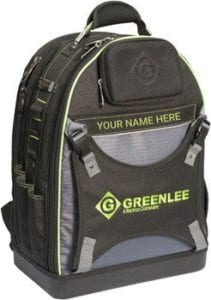
Greenlee Textron, a company that has been building tools for the electrical and utility trades for over 150 years, understands this relationship between organization and productivity at a deep, institutional level. Their Next Generation line of tool bags—which includes two backpack models, a 20‑inch tool tote, and an 11‑inch open carrier—represents a systematic rethinking of how a professional's tools should be stored, carried, and accessed. These are not merely bags with pockets sewn onto them. They are purpose‑built organizational systems, constructed from poly‑and‑nylon ripstop fabric, reinforced with double and triple stitching at critical stress points, designed with a light green interior that makes tools visible against the background, and built around a hard plastic bottom that keeps the bag standing upright and protects it from water on the ground. They are designed for the professional who is tired of digging through a jumbled bag, who wants to be able to see at a glance that all of their tools are present, and who expects a tool bag to last more than a single season before the seams give way.
The Material Foundation: Ripstop, Poly‑Nylon Blend, and Double‑Stitched Seams
The material foundation of the Next Generation line is a poly‑and‑nylon ripstop fabric. Ripstop is a weaving technique, not a specific material. It incorporates a grid of heavier threads—typically nylon—woven into the base fabric at regular intervals, usually every 5 to 8 millimeters. The heavier threads act as barriers that prevent a small tear from propagating across the fabric. If a sharp tool or a piece of debris punctures the fabric, the tear will stop at the next ripstop thread, rather than continuing to spread. For a tool bag that will be dragged across concrete, scraped against metal studs, and generally abused, this tear resistance provides a meaningful increase in longevity. The poly‑and‑nylon blend combines the abrasion resistance of polyester with the strength and flexibility of nylon, creating a material that is tough without being excessively heavy or stiff. The fabric is lighter than the 1680‑denier ballistic nylon that is used by some premium brands—a deliberate choice that prioritizes weight reduction over absolute maximum abrasion resistance, on the assumption that a lighter bag is more likely to be carried comfortably and therefore more likely to be used correctly—but the ripstop grid compensates for the lower base weight by providing additional structural integrity. The stitching on the Next Generation bags is another indicator of their intended durability. The critical seams—the attachment points for the shoulder straps, the carry handles, the base, and the stress points where pockets are sewn to the body of the bag—are double‑ or triple‑stitched with heavy‑duty thread. Single stitching is reserved for areas that experience less stress, such as internal dividers and non‑load‑bearing pockets. The zippers are nickel‑chromium, chosen for their resistance to corrosion and their smooth operation even when exposed to the dust and grit that are endemic to construction sites. The zipper pulls are oversized to accommodate gloved hands, and the zippers themselves operate smoothly without snagging.
The Hard Plastic Bottom: Why Standing Upright Matters
The hard plastic bottom is a feature that is standard on premium tool backpacks—Veto Pro Pac was among the first to popularize it—and its inclusion on the Greenlee bags signals the company's intention to compete at the professional level. The plastic base serves several functions. It protects the bottom of the bag from abrasion when it is set down on rough surfaces like concrete, asphalt, or gravel. It provides a waterproof barrier between the fabric and any standing water on the ground—a puddle, a wet floor, a damp patch of grass. It adds structural rigidity that helps the backpack stand upright when it is set down, rather than flopping over and spilling its contents or requiring the user to find something to lean it against. And it acts as a stable platform that distributes the weight of the loaded bag across a broader area, preventing the fabric from stretching and deforming under heavy loads.
The Light Green Interior: A Small Detail With Outsized Impact
The light green interior is a design choice that Greenlee has made consistently across its tool bag line, and it is one of those details that seems minor until you use a bag with a dark interior and spend five minutes squinting into a black pocket, trying to determine whether the small dark object at the bottom is the screwdriver you need or just a fold of fabric. The light green reflects ambient light, brightening the interior of the bag and creating a high‑contrast background against which the dark handles of screwdrivers, pliers, and other tools are immediately visible. In the dim light of a job site trailer, an under‑construction basement, or the interior of a panel room, the difference in visibility is stark and practical. For the electrician who is working in a space where the only light source is a single drop light or a headlamp, the light green interior can be the difference between finding the correct tool in seconds and wasting minutes emptying the bag onto the floor.
The Two Backpack Models: Professional Tool (0158‑26) and Professional Tool & Tech (0158‑27)
The two backpack models in the Next Generation line—the Professional Tool Backpack (0158‑26) and the Professional Tool and Tech Backpack (0158‑27)—are designed for different user profiles but share a common ergonomic architecture. Both feature S‑curve shoulder straps that follow the contour of the chest and shoulders, distributing weight across a broader area than straight, vertical straps. Both include a padded lumbar support panel that cushions the lower back and creates a small air gap for ventilation. Both include a sternum strap that prevents the shoulder straps from spreading apart during movement, keeping the load centered and stable. Both are equipped with a metal hang hook that allows the backpack to be suspended from a ladder, a scaffold, a conduit, or a nail. The hook is internally stored when not in use, then deployed when needed.
The Professional Tool Backpack (0158‑26) is the larger and heavier of the two, weighing 4.95 pounds empty and standing 20.5 inches tall, 17 inches long, and 10 inches wide. It features 30 pockets, two tape measure holders, an electrical tape chain, and a rear compartment with a hardshell molded pocket designed to protect safety glasses or other fragile items from impact. The front compartment is densely packed with pockets sized for hand tools, while the rear compartment offers larger pockets suited to meters and instruments. The dual‑compartment design encourages the separation of tools by category—a layout that many professionals find intuitive and that reduces the time spent searching for a specific item. The Professional Tool and Tech Backpack (0158‑27) is slightly smaller and lighter at 4.5 pounds, with 27 pockets. It sacrifices some of the bulk tool storage in exchange for a dedicated, padded laptop compartment that can accommodate a tablet or a laptop up to 15 inches. This model is aimed at the growing number of professionals who carry digital devices to the job site—supervisors who review plans on a tablet, estimators who generate reports on a laptop, technicians who use diagnostic software that runs on a portable computer. The tech compartment is zippered and padded, providing a degree of protection against the bumps and jolts of daily transport that a loose device in an unpadded pocket would lack.
The Tote and the Open Carrier: 20‑Inch Heavy‑Duty Bag (0158‑21) and 11‑Inch Electrician's Carrier (0158‑24)
The 20‑inch Heavy‑Duty Multi‑Pocket Tool Bag (0158‑21) and the 11‑inch Electrician's Open Tool Carrier (0158‑24) are designed for professionals who prefer an open‑top format or who do not need the carrying capacity of a backpack. The 20‑inch tote is a conventional tool bag with reinforced, slip‑proof padded shoulder straps that can be clipped together to hold the bag closed during transport. It has 28 pockets, a tape measure holder, an electrical tape chain, and an ABS waterproof plastic bottom. The open‑top design means that the tools are immediately accessible without unzipping—a preference for some electricians who work at a bench or a panel and want to be able to reach for a tool without any intermediate steps. The 11‑inch carrier is a smaller, more compact version, with 27 pockets and an open‑top configuration. It is designed for the technician who carries a select set of tools and who values compactness and accessibility over maximum storage capacity. Both bags feature the same light green interior, the same double‑stitched construction, and the same hard plastic bottom as the backpacks.
Greenlee Next Generation Tool Bags Specifications
| Model | 0158‑26 | 0158‑27 | 0158‑21 | 0158‑24 |
|---|---|---|---|---|
| Type | Tool Backpack | Tool & Tech Backpack | 20‑Inch Tool Tote | 11‑Inch Open Carrier |
| Height | 20.5 in | 18.5 in | 11 in | 17 in |
| Length | 17 in | 15 in | 21 in | 11 in |
| Width | 10 in | 9.5 in | 11 in | 8.5 in |
| Weight (Empty) | 4.95 lbs | 4.5 lbs | 3.5 lbs | 3.2 lbs |
| Pockets | 30 | 27 | 28 | 27 |
| Material | Poly & Nylon Ripstop | Poly & Nylon Ripstop | Poly & Nylon Ripstop | Poly & Nylon Ripstop |
| Base | Hard plastic, waterproof | Hard plastic, waterproof | ABS waterproof plastic | Hard plastic |
| Special Features | Hardshell safety glasses pocket, metal hang hook, S‑curve straps | Padded laptop/tablet compartment, metal hang hook, S‑curve straps | Slip‑proof padded shoulder straps, open‑top access | Open‑top access, compact design |
Conclusion: A Coherent, Well‑Thought‑Out Family of Professional Tool Storage
The Greenlee Next Generation line is a coherent, well‑thought‑out family of tool storage products that reflects the company's deep understanding of the electrical and utility trades. The materials are appropriate to the task—not the heaviest or most expensive available, but carefully chosen for a balance of weight, durability, and cost. The features—the light green interior, the hard plastic bottom, the metal hang hook, the S‑curve shoulder straps—are not gimmicks; they are practical solutions to real problems that professionals encounter every day. The pricing, while not yet fully disclosed for all models, positions the line competitively with other professional‑grade tool bags from Klein, Milwaukee, and Veto Pro Pac. For the electrician, the HVAC technician, or the maintenance professional who is looking for a new tool bag that will organize their tools, protect them from the elements, and survive the rigors of daily professional use, the Greenlee Next Generation line deserves careful consideration.
Comments 0
Leave a Comment