There are a lot of ways to move your tools from the truck to the job site, and most of them are wrong. The wrong way is to carry a heavy, unbalanced load in one hand while climbing a ladder, your tool belt pulling your pants down and your free arm windmilling for balance. The wrong way is to dump everything into a five‑gallon bucket, where screwdrivers hide under hammers and your multimeter screen gets scratched by a pair of linesman pliers that you cannot find anyway because everything has settled into a hopeless jumble. The right way, for a growing number of professionals, is a tool backpack. A well‑designed tool backpack distributes weight evenly across both shoulders, keeps both hands free for climbing and carrying, and organizes tools into a logical, accessible layout that makes it easy to find what you need without dumping the entire contents onto the floor. The Greenlee Professional Tool Backpack, model 0158‑26, is one of the more thoughtfully designed entries in this increasingly crowded category. It does not try to be the backpack with the most pockets—it offers 30, which is a respectable but not world‑beating number—and it does not try to be the backpack with the most capacity or the most features. What it does, and what sets it apart, is arrange its storage in a way that actively encourages the user to separate their tools into two distinct categories: hand tools in the front compartment, meters and test instruments in the rear. This division is not merely an organizational preference; it reflects a genuine understanding of how electrical professionals work, the tools they carry, and the relative fragility and value of those tools. A multimeter, a thermal camera, or a circuit tracer does not belong in the same compartment as a hammer, a set of lineman's pliers, and a cordless drill. The Greenlee backpack acknowledges this reality and builds a layout that makes it easy to do the right thing.
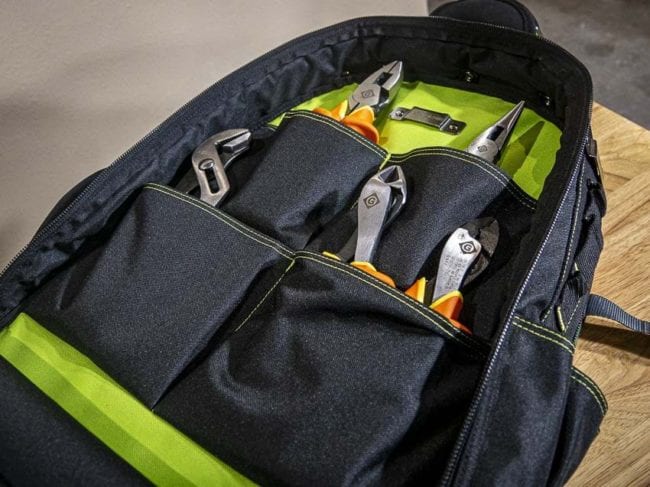
The front compartment is where the majority of the hand tool storage lives. It features twelve medium‑to‑small open pockets, arranged in tiers so that tools of different lengths can be stored without interfering with each other. Screwdrivers, nut drivers, pliers, wire strippers, and voltage testers each find a designated spot, and the tiered layout means that the handles of the longer tools do not obscure the shorter ones behind them. Below the tiered pockets, there is a bulk storage area at the base of the compartment—large enough to accommodate a cordless drill, a compact drill‑and‑impact‑driver combo, or a small parts case. This bulk area is not subdivided, which gives the user flexibility to store whatever larger item they need, but it also means that items can shift around if the backpack is jostled. Two reinforced, zippered pockets on the front flap provide secure storage for accessories, small parts, or sharp tools that should not be loose. A hook‑and‑loop closure on one of the pockets provides an additional layer of security for sensitive items. The rear compartment is configured very differently. Instead of a dense array of small pockets for hand tools, it features one large pocket and four medium pockets, all oriented vertically. This layout is ideal for storing meters, test instruments, and their associated accessories—probe leads, alligator clips, thermocouple wires, and the like. The large pocket can accommodate a full‑sized digital multimeter or a clamp meter, while the medium pockets hold smaller instruments, infrared thermometers, voltage testers, and similar tools. The vertical orientation means that the meters slide in and out easily, without snagging on adjacent pockets or getting buried under other tools. The light green interior of both compartments—a signature Greenlee design choice—provides a bright, high‑contrast background that makes black‑ and dark‑colored tools stand out visually. In the dim light of a job site trailer, an attic, or a basement, the ability to see exactly what is in each pocket without squinting or using a flashlight is a genuine productivity advantage.
The backpack is constructed from a poly‑and‑nylon ripstop fabric, a material chosen for its combination of light weight, tear resistance, and durability. Ripstop fabrics incorporate a grid of heavier threads woven into the material at regular intervals, which prevents small tears from propagating across the fabric. For a tool backpack that will be dragged across concrete, scraped against studs, and generally abused, ripstop provides a meaningful increase in longevity over a plain‑weave fabric of the same weight. The stitching is double‑reinforced at the critical stress points—the shoulder strap attachments, the carry handle, and the base of the bag. The zippers are heavy‑duty, with large, glove‑friendly pulls, and they operate smoothly without snagging. The base of the backpack is reinforced with a molded plastic foot that serves several functions: it protects the bottom of the bag from abrasion when it is set down on rough surfaces, it provides a stable platform that helps the backpack stand upright, and it acts as a moisture barrier, preventing water from wicking up into the bag from a wet floor. The plastic base is not as deep or as rugged as the waterproof, injection‑molded bases found on premium backpacks like the Veto Pro Pac, but it is adequate for the typical job site conditions that a Greenlee backpack is likely to encounter. The shoulder straps are wide, padded, and ergonomically curved. Unlike the straight‑down straps found on many backpacks, the Greenlee straps curve outward as they descend, following the contour of the rib cage. This design, combined with an adjustable sternum strap, creates a fit that hugs the torso and distributes the weight of the loaded backpack across a broader area of the shoulders and back. A padded lumbar panel provides cushioning for the lower back and creates a small air gap between the backpack and the wearer's body, allowing some airflow to reduce the accumulation of sweat—a welcome feature in the Florida heat, where temperatures routinely exceed 95 degrees. The carry handle at the top of the backpack is padded and reinforced with an internal cable, providing a comfortable and secure grip for short‑distance carrying or for hoisting the backpack up to the shoulders. A stout steel hang hook is integrated into the rear compartment, allowing the backpack to be suspended from a ladder, a scaffold, a conduit, or a nail driven into a stud. When the backpack is hanging, the compartments are accessible without removing it from the hook, and the tools are presented at a convenient height. The hook is robust enough to support the fully loaded backpack without bending or failing.
The Greenlee backpack includes several external features that add to its utility. Two tape measure clips—one on each side—allow the user to carry a pair of tape measures or to store a tape measure and a larger tool, such as a hammer or a cordless impact driver, within easy reach. An electrical tape chain—a small, retractable cord with a clip—provides a secure attachment point for a roll of electrical tape, ensuring that it is always accessible without having to dig through a pocket. A fish tape strap on the exterior of the backpack allows the user to carry a fish tape—a tool that is notoriously awkward to transport—securely attached to the outside of the bag, rather than dangling from a hand or slung over a shoulder. The fish tape strap is a simple but thoughtful feature that addresses a genuine portability problem. However, when a fish tape is attached, the backpack tends to lean forward, because the weight of the fish tape pulls the front of the bag downward, away from the wearer's back. This is a common issue with backpacks that carry heavy items on the exterior, and it is not unique to the Greenlee. The user can mitigate the lean by balancing the load with heavier items in the rear compartment, but it is a trade‑off to be aware of when considering whether to use the fish tape strap. The backpack also features a personalized nameplate—a hook‑and‑loop patch that can be customized with the user's name or company logo. This is a small touch that adds a degree of personalization and professionalism, and it helps to identify the backpack among a group of similar bags on a crowded job site. Hi‑vis reflective piping along the edges of the backpack bounces light back to its source, making the bag easier to locate in dark environments and adding a degree of visibility if the backpack is worn near traffic.
The Greenlee 0158‑26 is designed primarily as a tool backpack, not a tech backpack. It does not have a dedicated, padded laptop compartment, nor does it have a tablet sleeve or a document pocket. For the professional who carries a laptop or a tablet to the job site—an increasingly common requirement for supervisors, estimators, and technicians who use digital plans and documentation software—Greenlee offers a separate Tech Backpack model (0158‑27) that includes a laptop compartment. The 0158‑26 is for the professional who carries tools, meters, and accessories, and who does not need to carry a computer. At a street price of around $129, the Greenlee Professional Tool Backpack is positioned in the middle of the professional tool backpack market. It is more expensive than entry‑level backpacks from generic brands, but significantly less expensive than premium offerings from Veto Pro Pac and some of the higher‑end Klein models. For the professional who values thoughtful layout, durable construction, and the separation of hand tools from meters, it represents a solid value. It is a backpack that does not try to be everything to everyone, but instead focuses on doing a few things well: carrying the tools that an electrical professional needs, organizing them in a logical way, and doing so comfortably and durably. In a market crowded with feature‑stuffed backpacks that prioritize pocket count over usability, the Greenlee 0158‑26 is a refreshing exercise in restraint and purpose.
Greenlee Professional Tool Backpack 0158-26 Review
Comments 0
Leave a Comment