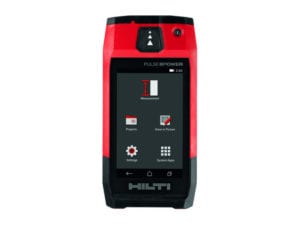
The defining feature of the PD‑C is its ability to take a photograph of a room, a wall, or a component, and then overlay the laser measurement directly onto that photograph. The user stands at one end of the room, points the PD‑C at the far wall, and presses the measure button. The laser measures the distance, and the result appears on the screen. The user can then drag that measurement onto the corresponding location on the photograph, creating a visual record that shows exactly which dimension corresponds to which part of the room. Subsequent measurements—the height of the ceiling, the width of a window, the distance from the corner to the door opening—can be added to the same photograph, building up a comprehensive, annotated record of the space. For the supervisor who is walking a job site and documenting existing conditions, or for the contractor who is preparing an estimate and needs to communicate the dimensions of a space to a client or a subcontractor, this feature eliminates the ambiguity that often accompanies a list of numbers on a piece of paper. Instead of trying to remember which measurement corresponds to which wall, or labeling each number with a written description ("north wall, left of window"), the photograph captures the spatial context permanently. The PD‑C also offers the standard measurement functions that are expected of a professional laser distance meter: direct distance measurement, indirect height measurement using the Pythagorean theorem (for measuring the height of a wall or a building when a direct line of sight to the top is not available), area calculation, and volume calculation. The tilt sensor, which is accurate to ±0.3 degrees, enables the indirect measurement functions and ensures that the laser is level when taking horizontal measurements. The device is powered by an integrated lithium‑ion battery that provides approximately 10 hours of continuous operation. The battery is rechargeable via a standard micro‑USB port, and the device can be used while charging. The IP54 rating means it is protected against dust and splashing water, and it is built to survive the drops and bumps of a construction site—Hilti does not publish a specific drop rating for the PD‑C, but the brand's reputation for durability suggests it will handle the rigors of daily professional use.
The Touchscreen Interface: Android‑Based, Glove‑Compatible, and Intuitive
The color touchscreen on the PD‑C is a significant departure from the monochrome, button‑operated displays that are standard on most laser distance meters. The screen is large enough—similar in size to a smartphone display from a few years ago—to show the measurement, the photograph, and the annotation tools clearly. The Android‑based interface is familiar to anyone who has used a smartphone, with icons, menus, and touch gestures that are intuitive and responsive. Hilti has designed the touchscreen to be sensitive enough to operate with gloved hands, which is essential for a tool that will be used on a construction site in cold weather or in environments where hand protection is required. The user interface guides the user through each measurement function, reducing the need to consult a manual or to remember complex sequences of button presses. The operating system also allows for future software updates, which means the device can be improved and new features can be added over time. The 4 GB of internal memory is partitioned to store measurements, photographs, and annotated images. The user can create separate folders for each job site, and measurements taken at a particular location are automatically saved to the appropriate folder. This organizational capability eliminates the confusion of mixing measurements from different projects and makes it easy to retrieve data weeks or months later. The user can also add text comments to individual measurements, providing additional context that might be important for the person who will ultimately use the data—the material supplier, the cabinet maker, the subcontractor.
Data Sharing and Reporting: PDF, CSV, Bluetooth, and USB
The PD‑C generates two types of reports from the captured data. A PDF report includes the photographs with their annotated measurements, formatted in a professional, easy‑to‑read layout that can be emailed directly to a client, a project manager, or a subcontractor. A CSV (comma‑separated values) report extracts the measurement data into a format that can be imported into a spreadsheet, an estimating program, or a database. The user can choose which format is most appropriate for the intended recipient and the intended use. The data can be transferred from the PD‑C to a computer via a USB cable, or to an Android device via Bluetooth. The Bluetooth transfer is particularly useful for sharing measurements with a colleague on the same job site without the need for cables or email. The annotated photographs can also be exported as JPEG image files, which can be inserted into reports, presentations, or email messages. The ability to generate a complete, professional‑quality measurement report from a handheld device, without the need for a separate computer, a scanner, or a printer, is a significant productivity enhancement. It eliminates the transcription errors that occur when measurements are written down and then typed into a report, and it ensures that the person who receives the report can see exactly what was measured and where.
The Hilti Warranty and Calibration Service: 20/2/1 and the Confidence It Provides
Hilti backs the PD‑C with its 20/2/1 warranty, a program that is unique in the tool industry. The "20" means that Hilti will repair or replace defective parts for 20 years from the date of purchase. The "2" means that for the first two years of ownership, Hilti covers all service costs, including wear and tear—if the device is damaged during normal use, Hilti repairs it at no charge. The "1" means that Hilti guarantees a one‑day repair turnaround. If the PD‑C ever needs service, it will be repaired and on its way back to the owner within one business day. This warranty fundamentally changes the economics of owning a precision instrument. Instead of worrying about the potential cost of repairs, the owner can treat the PD‑C as a long‑term investment that is protected against defects, wear, and accidental damage for the first two years, and against manufacturing defects for two decades. The calibration service, which is available through Hilti's service network, ensures that the PD‑C remains within its specified accuracy throughout its life. For the professional who relies on accurate measurements to make a living, the combination of the warranty and the calibration service provides a level of confidence that is difficult to match with products from manufacturers that do not offer comparable support.
Hilti PD‑C Laser Range Meter Specifications
| Specification | Detail |
|---|---|
| Power Source | Integrated Li‑ion battery |
| Tilt Sensor Accuracy | ±0.3° |
| Range | 656 feet (200 meters) |
| Run Time | 10 hours |
| IP Rating | IP54 |
| Memory | 4 GB (up to 3,000 measurements) |
| Data Transfer | USB, Bluetooth (Android) |
| Report Formats | PDF, CSV, JPEG (photos with measurements) |
| Warranty | 20/2/1 (20 years repair, 2 years no‑cost, 1‑day turnaround) |
Conclusion: A Measurement and Documentation Tool, Not Just a Laser Measure
The Hilti PD‑C Laser Range Meter is a tool that recognizes that measurement is not an end in itself, but a step in a larger process that includes documentation, communication, and decision‑making. By combining a high‑accuracy laser distance meter with a digital camera, a touchscreen interface, and comprehensive data management and reporting capabilities, the PD‑C addresses the entire measurement workflow, not just the moment when the laser beam strikes the wall. It is a tool designed for the professional who is responsible not only for taking measurements but for communicating those measurements to others—to the client, to the architect, to the subcontractor, to the material supplier—in a way that is clear, accurate, and actionable. The annotated photographs eliminate the ambiguity of written descriptions. The PDF and CSV reports eliminate the transcription errors of manual data entry. The Bluetooth and USB transfer eliminate the delays of physical data transport. The 20/2/1 warranty and the calibration service provide the long‑term confidence that a professional investment demands. The PD‑C is not the least expensive laser distance measure on the market, and it is not intended to be. It is a premium instrument for professionals who understand that the cost of a measurement error far exceeds the cost of a good measuring tool, and who value the efficiency and clarity that come from capturing, organizing, and sharing measurement data in a single, integrated system. For those professionals, the PD‑C is not merely a tool. It is a competitive advantage.
Comments 0
Leave a Comment