The Designer: Dmitry Sinkevich's Vision, Distilled
The Kershaw Atmos is the collaborative brainchild of Kershaw and Belarusian custom knife maker Dmitry Sinkevich, the same designer responsible for the breathtaking Zero Tolerance 0454 and 0450 models. Sinkevich's designs typically employ refined, practical details that set them apart from other knives—clean lines, meticulous proportions, and an almost architectural precision in the way components relate to one another. The Atmos carries on that tradition admirably. It is not a scaled‑down copy of his ZT designs; it is an original creation that applies Sinkevich's aesthetic sensibility to a much more accessible price point. The knife features a drop‑point blade, a manual flipper deployment via Kershaw's KVT ball‑bearing system, a liner lock, and a handle constructed from G‑10 with a carbon fiber overlay. At an MSRP of $49.99 and a street price of around $35, the Atmos is positioned as an affordable entry point into Sinkevich's design language—a knife that looks and feels far more expensive than it is.
The Handle: G‑10 and Carbon Fiber—Lightweight, Rigid, and Surprisingly Strong
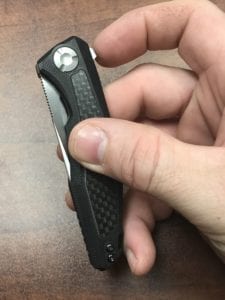
The first thing anyone notices about the Kershaw Atmos is its weight, or rather the astonishing lack of it. At 1.9 ounces, the Atmos is lighter than some house keys. Kershaw achieved this remarkable figure by building the handle scales from G‑10—a high‑pressure fiberglass laminate—with a thin layer of laminated carbon fiber on the outer surface. The carbon fiber provides a distinctive, holographic appearance that shifts between gray and black as the angle of light changes, giving the knife a premium look that belies its price. The G‑10 substrate provides the structural strength, while the carbon fiber overlay adds visual dimension and a tactile smoothness. The handle is sculpted with CNC machining, with grooves and contours that fit the hand naturally. There is no metal in the handle except for the stainless steel liner lock insert, which is precisely fitted into the G‑10 scale. The absence of metal liners, bolsters, or a backspacer is what allows the Atmos to achieve its featherlight weight.
I was initially curious—and slightly concerned—about how much lateral movement the blade would exhibit when extended, given the all‑composite handle construction. In the open position, the blade does not display a significant amount of lateral movement. There is no side‑to‑side play, and the blade does not feel loose or unstable. In the closed position, the blade centers perfectly between the two frame halves every time, a testament to the precision of the machining and assembly. I also did not experience any perceptible movement between the two handle scales when squeezing the frame tightly. For something that to a casual observer looks and feels like plastic, the structural rigidity is genuinely impressive. G‑10, recall, is made by stacking multiple layers of woven fiberglass cloth soaked in epoxy resin and compressed under heat and pressure. The resulting material is dense, stable, and exceptionally strong—the same material used for printed circuit boards and high‑stress aerospace components. The Atmos's handle is not plastic; it is an engineered composite, and it behaves accordingly.
The Blade: 8Cr13MoV, Drop Point, and a Hollow Grind
The blade of the Atmos is forged from Kershaw's standard mid‑grade 8Cr13MoV steel, a Chinese‑produced alloy with a composition similar to AUS‑8. It is a steel that squarely occupies the middle ground of the production knife market: it takes a sharp edge with minimal effort, it sharpens easily on common abrasives, and it resists corrosion adequately for everyday pocket carry. The edge retention is not at the level of S30V or D2, but for the intended role of the Atmos—light, simple, random daily tasks like opening packages, sharpening pencils, trimming threads—the steel is more than adequate. Kershaw did not design the Atmos as a survival knife or a hard‑use work blade, and the choice of 8Cr13MoV reflects that. When the edge did begin to dull after a week of moderate use, a few minutes on a ceramic rod restored it to razor sharpness. The ease of sharpening is one of 8Cr13MoV's most endearing qualities, and it makes the Atmos a practical knife for users who do not want to invest in diamond stones or guided sharpening systems.
The blade profile is a drop point with a slight hollow grind, a combination that provides a good balance of tip strength and slicing efficiency. The drop point is the most versatile and widely recommended blade shape for everyday carry, and it performs as expected here: the tip is acute enough for piercing tasks, and the belly provides a usable slicing surface. The hollow grind reduces drag through thick materials and creates a thinner cross‑section behind the edge, which improves cutting performance. The blade flats are finished in satin, with even grind lines that catch the light attractively. The jimping on the blade spine is adequate, providing a tactile reference for the thumb without being aggressive enough to abrade the skin. The flipper tab is ridged, giving the index finger a positive purchase for deployment.
Deployment: KVT Bearings, Manual Flipper, and a Lightning‑Fast Action
I expected the Atmos to feature Kershaw's SpeedSafe assisted‑opening system, given the knife's price point and the brand's tendency to equip most of its folders with spring‑assisted deployment. Instead, the Atmos uses Kershaw's KVT (Kershaw Velocity Technology) ball‑bearing system—a manual flipper that relies on caged bearings around the pivot to provide smooth, low‑friction blade rotation. The KVT system encloses the ball bearings within a ring that surrounds the pivot, a design that protects the bearings from debris and helps maintain consistent action over thousands of cycles. To deploy the blade, press rearward on the flipper tab. Overcome the detent, and the blade glides through its arc on the bearings and locks open with a crisp click from the liner lock. The action is fast—surprisingly fast, given how light the blade is. The KVT bearings give the Atmos a deployment feel that is more refined than many knives costing twice its price, and the action remained smooth and consistent throughout my three‑week testing period, with no gritty drag or hesitation developing.
The liner lock engages the blade tang securely, with no blade play in any direction. Disengaging the lock is a simple, one‑handed operation: press the lock bar inward with the thumb, and the blade can be pushed closed with the index finger. The liner lock is an insert design—a thin stainless steel plate set into the G‑10 handle scale—which is lighter than a full metal liner but provides the same functional security. The lock has not shown any tendency to slip, stick, or fail to engage fully. It is a well‑executed liner lock that inspires confidence despite the handle's composite construction.
The Clip: Deep Carry, Reversible, and Barely There
Too often, manufacturers produce fantastic knives and then equip them with a clip that feels like an afterthought—too tight, too loose, too short, or positioned awkwardly. The Atmos does not suffer from this affliction. Its pocket clip is a well‑executed deep‑carry design that positions the knife so low in the pocket that it becomes virtually undetectable. Only a small portion of the handle is visible above the pocket seam, and from the outside, it is impossible to tell whether the wearer is carrying a knife or a pen. The clip can be repositioned on either side of the handle—a welcome accommodation for left‑handed users—but only in the tip‑up orientation. The clip tension is firm without being excessive, holding the knife securely during daily activities but allowing for smooth, one‑handed removal. The clip is also notably thin, which contributes to the knife's overall sleek, unobtrusive profile. Because the Atmos is so light and thin, you will often forget you are carrying it, until you reach for it and find it exactly where it should be.
Carry Comfort and Everyday Utility
I have been carrying a Kershaw Blackwash Leek on and off for several years, and the Atmos has a remarkably similar footprint—closed length of about 4 inches, open length just under 7 inches. The similarities end there, however, in the best possible way. The Atmos is lighter, the handle is more contoured, the carbon fiber overlay adds visual interest, and the manual KVT flipper is a refreshing change from the SpeedSafe assist. Switching over to the Atmos was seamless, and within days I found myself reaching for it automatically. The small size is an asset in an office environment, where pulling out a large, aggressive knife might cause colleagues to flinch. The Atmos is unintimidating, even charming, and it handles routine tasks—opening mail, cutting strings, trimming loose threads, breaking down small boxes—with effortless competence. It is the kind of knife that becomes a quiet, unobtrusive companion, always present but never demanding attention.
Is Lightweight Perceived as Cheap?
The one potential obstacle to the Atmos's widespread acceptance is the perception that lightweight equals cheaply built. We have been conditioned by decades of heavy, metal‑handled knives to associate weight with quality. A knife that feels almost weightless can, on first impression, seem like a toy. This is a perception that EDC carriers will need to overcome before fully coming onboard with knives like the Atmos and its sibling, the Fraxion. The reality, as I discovered over three weeks of daily carry, is that the Atmos is anything but cheaply built. The G‑10 and carbon fiber handle is rigid, stable, and strong. The KVT pivot is smooth and reliable. The blade holds an edge adequately for its intended use and sharpens easily. The deep‑carry clip is well‑designed and functional. The Atmos is not a knife that will baton firewood or pry open a car door, but it was never intended to be. It is a precision cutting instrument for a civilized environment, and in that role, it excels. For the user who can set aside the association between weight and quality—who can appreciate the material science and design intelligence that make a 1.9‑ounce knife possible—the Atmos is a genuinely impressive achievement.
Kershaw Atmos Lightweight Folding Knife Specifications
| Specification | Detail |
|---|---|
| Model Number | 4037 |
| Steel | 8Cr13MoV |
| Blade Style | Slight Hollow Grind Drop Point With Satin Finish |
| Blade Pivot | KVT Ball‑Bearing |
| Handle | G‑10 With Carbon Fiber Overlay |
| Type | Manual Flipper |
| Lock | Insert Liner Lock |
| Clip | Reversible, Deep‑Carry Style (Right/Left, Tip‑Up) |
| Blade Length | 3 inches |
| Closed Length | 4 inches |
| Overall Length | 6.9 inches |
| Weight | 1.9 oz. |
| MSRP | $49.99 |
| Street Price | ~$34.99 |
Conclusion: A Featherweight Folder That Flies in the Face of Convention
The Kershaw Atmos is a knife that challenges assumptions and rewards open‑mindedness. It is not heavy, yet it is strong. It is not expensive, yet it looks and feels premium. It is not spring‑assisted, yet it deploys with speed and smoothness that rival more complex mechanisms. The G‑10 and carbon fiber handle is a masterstroke of material selection, providing an ideal combination of light weight, rigidity, and aesthetic appeal. The KVT bearing system punches above its price class, giving the Atmos a deployment feel that is genuinely satisfying. The deep‑carry clip is well‑designed, and the reversible orientation accommodates left‑handed users—a rarity in knives at this price point. The 8Cr13MoV blade steel, while not exotic, is entirely adequate for the light daily tasks the knife is designed to perform, and it sharpens with such ease that maintaining a razor edge is a matter of minutes. The Atmos is not a knife for hard use, for prying, for batoning, or for any task that demands brute force. It is a knife for the civilized EDC user who values precision, discretion, and the pleasure of carrying a tool that feels like an extension of the hand rather than a lump in the pocket. With the Atmos, Dmitry Sinkevich and Kershaw have created a lightweight folder that genuinely expands the possibilities of what a budget‑friendly everyday carry can be. It is a knife that I will continue to carry, and one that I recommend without hesitation to anyone seeking a compact, elegant, and thoroughly modern EDC.
Comments 0
Leave a Comment