Design Philosophy: Two Tools, One Handle, No Apologies
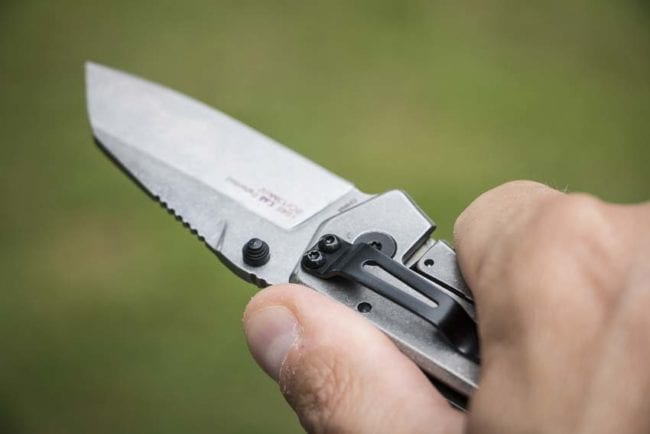
The Kershaw Barge is built on a single, continuous steel frame—no separate liners, no bolsters, just two slabs of stonewashed steel that run the full length of the knife. This is important because it means the prying tip at the rear is not an add‑on or an afterthought. It is an integral extension of the handle, formed from the same piece of steel that supports the blade pivot and the frame lock. When you apply prying force to the tip, that force is transmitted directly through the steel handle frame, not through a thin liner or a plastic spacer. The prying tip itself is shaped like a large flathead screwdriver, with a blunt end that can be wedged under a nail head, slipped between a lid and a can, or inserted into a gap between two pieces of trim. It terminates in a wide, flat blade that also functions as a serviceable large‑format screwdriver in a pinch. It will not handle delicate electronics screws, but it will turn a stubborn flathead on a junction box cover or a hose clamp.
The blade, deployed from the other end of the same handle, is a 2.6‑inch modified drop point made from 8Cr13MoV steel—the same Chinese‑produced mid‑grade steel that Kershaw uses across much of their budget line. It is a steel that divides opinion. Enthusiasts accustomed to S30V or 154CM often dismiss it as inferior because it does not hold an edge as long. But those who work with their knives daily often appreciate 8Cr13MoV for its ease of sharpening. A few minutes on a pocket stone or a Lansky system, and the blade is back to hair‑popping sharpness. The trade‑off is that you will need to sharpen it more frequently; after a day of breaking down cardboard boxes and cutting rope, I could feel the edge beginning to degrade. But the sharpening process itself is so quick and undemanding that this did not feel like a burden. It felt like routine maintenance, the same way you might touch up a chisel after a day of mortising.
Real‑World Prying: From Window Screens to Flooring Foam
I carried the Kershaw Barge for two weeks as my primary EDC, and during that time I encountered an unusual number of prying opportunities—a phenomenon that may have been genuine or may have been a result of my heightened awareness that I was carrying a knife I was actually allowed to pry with. The first task involved resetting a window screen that had popped out of its track. The screen frame was slightly bent, and it refused to seat into the groove. Using the prying tip of the Barge, I was able to gently flex the frame back into alignment and then coax it into the track. The blunt, wide tip distributed force across the aluminum frame without denting it—something a sharp blade tip would not have done. The second task involved tucking 3/8‑inch foam backer rod into the expansion gap around the perimeter of a room where I was installing Pergo Outlast flooring. The Barge's prying tip was ideal for pressing the foam rod into the gap, sliding along the wall and seating the foam flush with the subfloor. It was a task that would have been awkward with a screwdriver and impossible with a conventional knife blade.
The third task was the most aggressive: prying a painted‑shut interior door open. The door had been closed for months during a renovation, and multiple layers of latex paint had effectively glued the door to the jamb. I slipped the Barge's prying tip into the gap between the door and the stop, applied steady pressure, and the paint seal cracked. The door swung open. The knife showed no signs of stress—no bending of the handle frame, no loosening of the pivot, no deformation of the prying tip. It is worth noting that I was not jumping on the knife or using it as a crowbar; I was applying controlled, steady pressure within the tool's reasonable limits. The Barge is a prying knife, not a demolition tool. But within those limits, it performed exactly as advertised.
Ergonomics and Carry: A Long Handle, a Short Blade, and a Tight Pocket Clip
The Barge's proportions are unusual. The closed length is 4.7 inches, but the blade is only 2.6 inches—a ratio that seems backward until you understand the logic. The long handle provides the leverage needed for prying. A short blade on a long handle would be awkward, but here the handle serves double duty, and the extra length is functional. When you flip the knife around to use the prying tip, your hand wraps around the blade end of the handle, and the knife becomes essentially a compact pry bar with a comfortable grip. The finger grooves are molded from glass‑filled nylon, a material that offers decent traction and resists chemicals and moisture. The knife is comfortable in both orientations, and I did not experience hot spots during extended use.
The pocket clip, however, was problematic out of the box. It was extremely tight—so tight that I struggled to clip the knife onto the seam of my jeans without using two hands. I had to physically bend the clip outward slightly to achieve a usable tension. Once adjusted, the clip held securely, and the knife rode in a tip‑down position on the right side. The clip is reversible for left‑hand carry, but only in tip‑down orientation. There is no tip‑up option. For a knife that is designed to be pulled out and used quickly, tip‑down carry is not ideal, but given the Barge's work‑oriented rather than defensive‑oriented role, the clip position is acceptable.
Kershaw Barge Specifications
| Specification | Detail |
|---|---|
| Steel | 8Cr13MoV, stonewashed finish |
| Handle | Glass‑filled nylon over steel frame |
| Blade Length | 2.6 inches (6.6 cm) |
| Closed Length | 4.7 inches (11.9 cm) |
| Open Length | 7.3 inches (18.5 cm) |
| Weight | 5.4 oz (153.1 g) |
| Lock | Frame lock |
| Deployment | Manual, thumb stud opening |
| Clip | Reversible (left/right, tip‑down) |
| MSRP | $35 |
| Street Price | ~$25 |
Who Should Carry the Kershaw Barge?
The Barge is not for everyone. If your EDC needs are limited to opening envelopes and cutting tags off new clothing, you are better served by a smaller, lighter knife with a more refined blade steel. But if you work with your hands—if you are a carpenter, an electrician, a plumber, a flooring installer, a maintenance technician, or simply a homeowner who is constantly tackling small repairs—the Barge fills a gap that most knives ignore. It is a knife you can actually use for the tasks that typically damage knives, and it is cheap enough that you will not hesitate to use it hard. It is also an excellent travel knife for situations where you do not want to risk your expensive EDC—fishing trips, camping, days at the lake, jobs in dirty or wet environments where a $200 folder would be ruined. The 8Cr13MoV steel, while not premium, is perfectly adequate for these roles, and the frame‑lock and full‑steel‑frame construction inspire confidence that the knife will handle reasonable abuse. At $25, it is essentially a consumable tool—buy two, keep one in the truck and one in the toolbox. When it finally gives up, you have gotten your money's worth many times over.
Conclusion: A Knife That Understands How Pros Actually Work
The Kershaw Barge is a refreshingly honest tool. It does not pretend to be a gentleman's folder or a tactical blade. It acknowledges that tradespeople misuse their knives constantly, and instead of wagging a finger, it offers a solution. The integrated prying tip works. The flathead screwdriver tip is genuinely useful in a pinch. The blade is easy to sharpen and tough enough for daily work. The stonewashed finish hides scratches and ages gracefully. The Barge is not the knife you carry to a wedding or a board meeting. It is the knife you reach for when something needs to be pried, levered, jammed, or forced—and when losing or damaging it would not ruin your week. That kind of tool has immense value, and Kershaw has delivered it at a price that makes it an impulse buy. If you have ever broken a knife tip by prying with it, the Barge is the answer you have been waiting for.
Comments 0
Leave a Comment