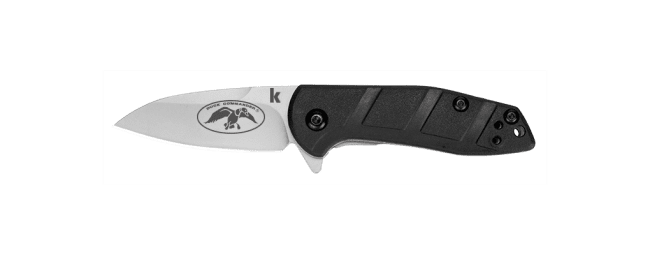
The Folders: SpeedSafe Across the Board, With One Premium Outlier
All four folding knives in the Duck Commander series share a common deployment DNA: Kershaw's SpeedSafe assisted‑opening mechanism, the torsion‑bar system that has become synonymous with the brand. SpeedSafe provides a fast, reliable, one‑handed opening experience—press the flipper or thumb stud, overcome the detent, and the spring snaps the blade into lockup with authority. It is a system that has been refined over millions of knives, and it works as well on the entry‑level Tickfaw as it does on Kershaw's premium models. The locks across the series are liner locks, which are lighter and simpler than frame locks and entirely adequate for the intended use of these knives. The pocket clips are reversible for tip‑up carry on either side, accommodating both right‑ and left‑handed users. The handles on three of the four models are glass‑filled nylon, a durable, lightweight synthetic that can be molded into complex shapes and textured for grip. The fourth model, the Rayne, upgrades to G‑10 scales with a 420HC stainless steel bolster, representing a step up in both materials and price.
The Tickfaw is the smallest and most affordable of the folders, with a 2.25‑inch blade made from 3Cr13 steel—an entry‑level stainless that prioritizes corrosion resistance and affordability over edge retention. It weighs just 2.0 ounces and, when closed, measures a mere 3.1 inches, making it an ideal pocket knife for those who prefer a discreet, unobtrusive carry. The Bisland steps up to a 3.25‑inch blade, still in 3Cr13 steel, with a glass‑filled nylon handle and a weight of 4.3 ounces. It is the workhorse of the series, sized for general EDC tasks. The Dunbar offers a 3‑inch blade, 4.0‑ounce weight, and similar materials, providing a middle ground between the Tickfaw and Bisland. All three of these knives are priced at $29.99, positioning them as affordable, impulse‑friendly purchases that Duck Commander fans can add to their collection without significant financial commitment.
The Rayne is the standout of the folder lineup, and it is priced accordingly at $59.99. It upgrades the blade steel to 8Cr13MoV—Kershaw's standard mid‑grade steel, which offers significantly better edge retention than 3Cr13—and replaces the glass‑filled nylon handle with G‑10 scales over a 420HC bolster. G‑10 is a higher‑end handle material that provides better grip, durability, and a more premium feel. The Rayne also features a slightly larger, more sculpted handle and a more refined overall finish. It is the knife for the Duck Commander enthusiast who wants something that feels like a serious cutting tool rather than a novelty item, and its $60 price point is competitive with other G‑10‑handled, SpeedSafe‑equipped knives in Kershaw's broader catalog.
The Quax Axe: A Duck‑Shaped Head and a Hickory Handle
No Duck Commander product line would be complete without something that nods to the family's duck‑hunting heritage in a way that is both functional and whimsical. The Quax—a name that is presumably a portmanteau of "quack" and "axe"—is a full‑sized axe with a 3.9‑inch blade made from 3Cr13 steel and a glass‑filled nylon handle that brings the overall length to 13 inches and the weight to 1 pound, 12 ounces. The axe head is shaped, unmistakably, like a duck in profile—the blade forming the bill, the eye forming the body. It is not a tool designed for felling timber or splitting cordwood; it is a camp axe, a companion for the duck blind, a tool for driving stakes, clearing shooting lanes, and processing kindling. The steel is adequate for those light‑to‑moderate tasks, and the synthetic handle is weather‑resistant and durable. At $59.99, the Quax is priced as a specialty item—a gift for the Duck Commander fan who already has the hats, the shirts, and the duck calls, and who now wants an axe to complete the collection. Whether it will see serious use or remain a wall‑hanger depends on the owner, but it is, undeniably, a conversation piece.
Kershaw Duck Commander Series Specifications
| Model | Blade Length | Blade Steel | Handle | Weight | Price |
|---|---|---|---|---|---|
| Tickfaw | 2.25 in. | 3Cr13 | Glass‑Filled Nylon | 2.0 oz. | $29.99 |
| Bisland | 3.25 in. | 3Cr13 | Glass‑Filled Nylon | 4.3 oz. | $29.99 |
| Dunbar | 3.0 in. | 3Cr13 | Glass‑Filled Nylon | 4.0 oz. | $29.99 |
| Rayne | 3.0 in. | 8Cr13MoV | G‑10 w/ 420HC Bolster | 4.9 oz. | $59.99 |
| Quax (Axe) | 3.9 in. | 3Cr13 | Glass‑Filled Nylon | 1 lb 12 oz. | $59.99 |
Who Should Buy the Kershaw Duck Commander Knives?
The Duck Commander series is aimed squarely at fans of the Robertson family and the Duck Dynasty brand. For those who have followed the show, who use Duck Commander calls in the blind, who wear Realtree camo as a lifestyle rather than a fashion choice, these knives are a natural extension of their enthusiasm. They are functional enough to serve as everyday carry knives, but their primary appeal is emotional rather than practical—they connect the owner to a world of flooded timber and sunrise hunts, of family prayer before meals and laughter around a campfire. For the knife enthusiast who judges a blade purely by its steel composition and pivot smoothness, the lower‑end models will feel like novelties. The Rayne, with its 8Cr13MoV blade and G‑10 handle, is a genuinely good knife that happens to wear Duck Commander branding, and it deserves consideration on its merits. The Quax axe is in a category of its own—a tool that is as much about fun as it is about function. In a knife market often dominated by tactical seriousness and spec‑sheet one‑upmanship, the Duck Commander series is a welcome reminder that knives can also be about joy, heritage, and the simple pleasure of carrying something that makes you smile.
Comments 0
Leave a Comment