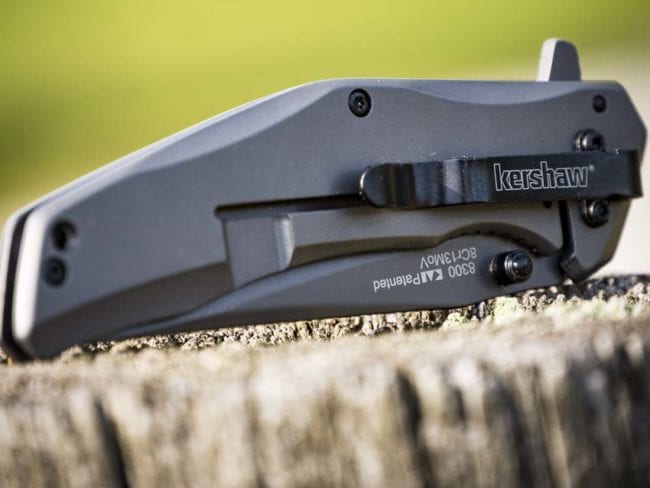
The Blade: 8Cr13MoV With a Gray TiNi Coat and a Drop‑Point Profile
Kershaw has long relied on 8Cr13MoV as the blade steel for its value‑oriented knives, and the Duojet continues that tradition. This Chinese‑produced stainless is well‑understood by now: it is comparable to AUS‑8 in its balance of properties, offering reasonable corrosion resistance, adequate edge retention, and outstanding ease of sharpening. It is not a steel that will hold an edge through a month of heavy daily cutting without attention, but it takes a keen edge in minutes on a pocket stone or a ceramic rod, and it is forgiving of sharpening mistakes that would ruin a more brittle, high‑hardness steel. For a knife at the Duojet's price, it is an entirely appropriate choice. Kershaw enhances the blade with a titanium‑nitride (TiNi) coating that gives it a distinctive gray, almost pewter‑colored finish. This coating serves a functional purpose—improving corrosion resistance and reducing surface friction as the blade passes through material—but it also defines the knife's visual identity. The gray blade, paired with the gray‑toned stainless steel handle, creates a monochromatic look that is sleek, understated, and surprisingly sophisticated. It looks less like a $25 knife and more like something from a much higher price bracket. The blade profile is a classic drop point, with a generous belly that provides ample slicing surface and a tip that is acute enough for piercing without being fragile. The blade length is 3.25 inches, which is the sweet spot for a general‑purpose EDC—long enough to handle food preparation, cardboard breakdown, and rope cutting, but not so long that it becomes cumbersome in the pocket or alarming in a public setting.
Deployment: SpeedSafe, Flipper, Thumb Studs, and the Best of Both Worlds
The Duojet deploys via Kershaw's SpeedSafe assisted‑opening mechanism, which can be actuated by either the flipper tab on the spine or the dual thumb studs on the blade. This is, in my opinion, the ideal deployment configuration. The flipper is my personal preference; it provides a natural index‑finger motion that launches the blade into lockup with a satisfying snap. The SpeedSafe torsion bar does the heavy lifting, ensuring that the blade opens fully and securely every time, regardless of whether you apply a little or a lot of finger pressure. But having thumb studs as a backup—or as the primary method for users who prefer them—adds a layer of versatility that many flipper‑only knives lack. If you are wearing heavy gloves, if your index finger is injured, or if you simply prefer the thumb‑stud motion, the Duojet accommodates you. The thumb studs are positioned symmetrically on both sides of the blade, so left‑handed users can operate them without difficulty. The action is smooth and consistent, with no gritty drag or hesitation, and the blade tracks perfectly centered between the handle scales when closed.
The Handle: Gray TiNi Steel, Carbon‑Fiber Inlays, and a Single‑Position Clip
The handle of the Duojet is made from stainless steel coated in the same titanium‑nitride finish as the blade, creating a seamless gray‑on‑gray look. The steel is contoured with a slightly angular peak on the back, a departure from the steady curve found on many knives, and this gives the Duojet a profile that is reminiscent of Zero Tolerance designs—chunky, purposeful, and a little aggressive. On the presentation side, two carbon‑fiber inlays are set into the steel. These inlays are not structural; they are decorative, and they add a touch of visual warmth to an otherwise cool, industrial palette. The carbon fiber has a subtle holographic quality, shifting between gray and black as the angle of light changes. On the lock side, the frame lock occupies roughly two‑thirds of the handle, and it engages the blade tang with a solid, authoritative click. The lock bar is thick and well‑positioned, disengaging smoothly with thumb pressure and holding the blade open with zero play in any direction.
The pocket clip is the Duojet's most significant limitation. It is a single‑position design, set for tip‑down carry on the right side only. There is no option to switch it to tip‑up, and no provision for left‑hand carry. For users who prefer tip‑up carry—and that is the majority of the EDC community, because tip‑up positions the knife for a faster draw into a forward grip—this is a frustration. It is not a dealbreaker at $25, but it is a feature that may push some buyers toward alternatives. The clip itself is a deep‑carry design, positioning the knife low in the pocket with only a small portion of the handle visible. The tension is decent, holding the knife securely during daily activity. The knife weighs 4.8 ounces, which is on the heavier side for its size, but the weight feels like quality rather than bulk. It sits in the hand with a pleasant solidity, and the balance point is at the index finger, making the knife feel lively and responsive during cutting tasks.
Kershaw Duojet Specifications
| Specification | Detail |
|---|---|
| Model | Kershaw 8300 |
| Blade Length | 3.25 inches |
| Open Length | 7.75 inches |
| Closed Length | 4.5 inches |
| Deployment | SpeedSafe spring assist with flipper and thumb studs |
| Lock | Frame lock |
| Blade Material | 8Cr13MoV with titanium‑nitride coating |
| Handle Material | Stainless steel with titanium‑nitride coating and carbon‑fiber inlays |
| Clip | Single‑position, tip‑down, right‑side carry |
| Weight | 4.8 ounces |
| MSRP | $47.24 |
| Street Price | ~$25 |
Who Should Carry the Kershaw Duojet?
The Duojet is an ideal knife for the budget‑conscious EDC enthusiast who wants a knife that looks and feels more expensive than it is. It is also an excellent gift knife—the gray titanium‑nitride finish and carbon‑fiber inlays give it a premium aesthetic that will impress even non‑knife people, and the SpeedSafe deployment is fun and easy to demonstrate. For the professional tradesperson, the Duojet is a capable work knife, provided you are willing to sharpen it regularly and you are comfortable with tip‑down carry. The frame lock is strong, the blade is tough, and the weight and balance are well‑suited to all‑day use. If the single‑position clip is a frustration—and it will be, for some—there are many other options at this price point. But few of them look this good. Few of them feel this solid. And few of them offer the combination of a flipper, thumb studs, a frame lock, and a TiNi coating for the price of dinner for two. The Duojet is a quiet overachiever, and it deserves a place in the pocket of anyone who appreciates a well‑made, affordable knife that does not ask for attention but earns it anyway.
Comments 0
Leave a Comment