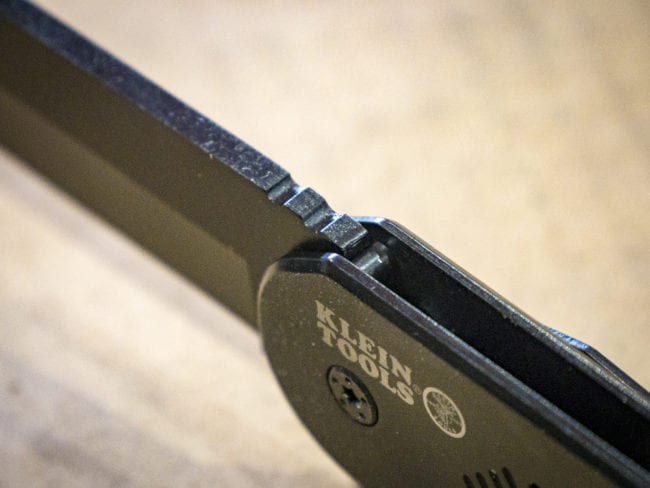
Blade Steel and Geometry: 440A, Tanto Strength, and the Black Oxide Shield
The blade on the Klein 44213 is made from 440A stainless steel, a material that occupies the lower end of the 440 family. 440A contains less carbon than 440C (roughly 0.65–0.75% versus 0.95–1.20%), which means it cannot achieve the same level of hardness or edge retention. What it offers instead is excellent corrosion resistance—better than 440C, and significantly better than high‑carbon tool steels—and it is extremely easy to sharpen. A few passes on a pocket stone or a ceramic rod will bring back a working edge. The trade‑off, predictably, is that the edge will not last as long under hard use. After a day of breaking down cardboard and cutting rope, you will notice a decline in sharpness. This is the nature of the steel, and at a $28 price point, it is an acceptable trade‑off. Klein adds a black oxide coating to the blade, which improves corrosion resistance further and gives the knife a tactical, low‑reflectance appearance. The coating also helps to hide scratches and wear marks that would be more visible on a satin‑finished blade.
The blade profile is a tanto style, a Japanese‑inspired design characterized by a strong, reinforced tip and a relatively straight cutting edge that angles upward to meet the spine at a secondary point. The tanto tip is significantly stronger than the fine, acute point of a drop‑point or clip‑point blade. It resists snapping or deforming when subjected to lateral force or when used for piercing tough materials. The trade‑off is that the tanto profile lacks the continuous belly curve that makes a drop‑point blade excel at long, smooth slicing cuts. The Klein tanto is not a pure American tanto, with its characteristic hard angle; it has a slightly curved transition between the primary edge and the tip, which gives it a hint of drop‑point DNA and makes it more versatile than a strict tanto. The blade length is 3.4 inches, which is substantial enough for most EDC tasks without crossing into the territory where some jurisdictions begin to restrict carry. The overall length when open is 8.0 inches, providing a full four‑finger grip.
Handle: Skeletonized Aluminum, Light Weight, and a Slick Surface
The handle of the Klein 44213 is machined from anodized aluminum, a material choice that I generally applaud. Aluminum is lighter than steel, stronger than most plastics, and takes anodizing well, producing a durable, attractive finish. The handle on the 44213 is skeletonized—cut with large, decorative openings that reduce weight and give the knife an industrial, high‑tech aesthetic. The anodizing is a dark gray or black, depending on the lighting, and it matches the black oxide blade finish cohesively. The skeletonization is successful in its primary goal: the knife weighs 5.2 ounces according to our scale, which is light enough to carry comfortably in a pocket without feeling insubstantial. The balance point is slightly forward of the pivot, which gives the blade a lively, responsive feel during deployment.
However, the handle's slickness is a legitimate concern. The anodized aluminum surface is smooth, with almost no texture to enhance grip. There is some jimping at the base of the blade spine—deep enough to provide a purchase point for the thumb—and additional jimping on the finger stop integrated into the blade tang. These two jimping zones, combined, offer a reasonably secure hold for the thumb and index finger. But the rest of the handle, where the remaining three fingers wrap around, is smooth aluminum. In dry conditions, this is manageable. In wet, sweaty, or oily conditions, the knife could become slippery. This is the kind of compromise that a $28 price point demands, and it is worth considering if your work environment involves moisture or if you frequently use your knife with gloves.
Deployment: Bearing‑Assisted Flipper With a One‑Position Clip Quirk
The Klein 44213 uses a bearing‑assisted deployment mechanism actuated by a finger flipper. This is my preferred deployment method on bearing knives—the flipper provides leverage, and the bearings provide smooth, fast rotation. The action on the Klein is not as refined as what you would find on a Kershaw or a CRKT bearing knife. There is a slight roughness to the initial movement as the detent is overcome, and the blade does not glide into lockup with the glassy smoothness of a higher‑end bearing system. But it works. The blade deploys reliably, locks up with a satisfying click from the frame lock, and does not feel like it is going to fail. It is a functional bearing flipper at a price where most knives are still using simple washers.
The pocket clip is where the design becomes frustrating. It is a single‑position clip, set for right‑hand, tip‑down carry only. There is no option to switch it to tip‑up, and no provision for left‑hand carry. For a defensive or tactical knife, tip‑up carry is generally preferred because it allows a faster deployment—you pull the knife from your pocket and your thumb is already on the flipper or thumb stud. Tip‑down carry requires you to rotate the knife in your hand after drawing it, which adds a fraction of a second. For a work knife, this distinction is less critical, but still worth noting. The clip itself is a deep‑carry design that positions the knife low in the pocket, with only a small portion of the handle visible. The clip tension is decent, holding the knife securely during activity, but it is not the strongest clip I have encountered; it can be bent outward with moderate force. If you habitually catch your knife clip on door frames, table edges, or seat belts, you may need to re‑tighten it periodically.
Klein Bearing‑Assisted Pocket Knife 44213 Specifications
| Specification | Detail |
|---|---|
| Model Number | Klein 44213 |
| Blade Type | Tanto |
| Blade Material | 440A Stainless Steel with black oxide coating |
| Handle Material | Skeletonized anodized aluminum |
| Lock Style | Frame Lock |
| Deployment | Bearing‑assisted flipper |
| Clip | Single‑position, right‑hand tip‑down |
| Weight | 5.2 oz |
| Blade Length | 3.4 inches |
| Overall Length | 8.0 inches |
| MSRP | $28 |
Who Should Carry the Klein 44213?
The Klein Bearing‑Assisted Pocket Knife is best suited for the professional tradesperson—particularly electricians, who form Klein's core customer base—who wants a capable EDC knife that deploys quickly, locks securely, and does not represent a significant financial loss if it is damaged or lost on the jobsite. The tanto blade is a good match for piercing tasks like opening junction boxes and cutting through zip ties, and the frame lock provides a level of security that inspires confidence during heavy cutting. The weight and balance are well‑suited to all‑day carry, and the deep‑carry clip keeps the knife discreet in mixed work environments. The knife is also a reasonable choice for the budget‑conscious enthusiast who wants to experience a bearing‑assisted flipper without spending $50 or more. At $28, it is an accessible entry point into bearing deployment, and the Klein brand carries a warranty and a reputation for standing behind its products. The trade‑offs—lower‑grade blade steel, a slick handle, and a single‑position clip—are real, but they are the kind of compromises that are entirely acceptable at this price point. The Klein 44213 is not a knife you buy to impress anyone. It is a knife you buy to use, to carry, and to replace without regret when the time comes.
Comments 0
Leave a Comment