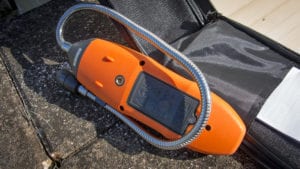
There is a grade‑school maxim, known to every child who has ever ridden a school bus or sat in a cafeteria, that goes: "He who smelt it, dealt it." It is a phrase that reduces the universal human experience of detecting an unpleasant odor to a simple, blame‑shifting game. In the world of professional trades, however, the detection of gas is no laughing matter. Natural gas, propane, and other combustible gases are odorless in their natural state—the distinctive "rotten egg" smell that we associate with a gas leak is actually an odorant, mercaptan, that is added specifically so that humans can detect a leak before it reaches a dangerous concentration. But relying on the human nose to detect gas is unreliable. A person with a cold, allergies, or a diminished sense of smell may not notice the odor. The odorant can fade over time, particularly in new piping or in certain soil conditions. And in an industrial environment, other odors—solvents, paints, fuels—can mask the smell of gas. The Klein Combustible Gas Leak Detector, model ET120, is a tool that replaces the fallible human nose with a calibrated electronic sensor, providing an objective, sensitive, and reliable means of detecting the presence of combustible gases and pinpointing the source of a leak. It is designed for the HVAC technician, the plumber, the gas fitter, the maintenance professional, and the home inspector—anyone who needs to verify that a gas system is leak‑free, or to locate a leak that is known to exist. It is a tool that can, quite literally, prevent an explosion, and it does so with a simplicity and an intuitiveness that makes it accessible to any professional.The ET120 is built around a solid‑state semiconductor sensor that reacts to the presence of combustible gases—including methane (natural gas), propane, butane, and other hydrocarbons—by changing its electrical resistance in proportion to the gas concentration. The sensor is housed in a metal‑sheathed probe at the end of an 18‑inch flexible gooseneck, which can be bent, twisted, and positioned to reach into tight spaces, behind appliances, around pipe fittings, and into the corners of confined areas where gas might accumulate. The gooseneck is stiff enough to hold its position once bent, but flexible enough to be shaped easily by hand. When not in use, it clips onto the side of the meter body for compact storage. The meter is powered by four AAA batteries, and it performs an automatic zero‑point calibration at startup. During the calibration process, which takes approximately 50 seconds, the meter samples the ambient air and establishes a baseline reading. This calibration ensures that the meter is not falsely triggered by background levels of gas that may be present in the environment, and it compensates for changes in temperature and humidity that could affect the sensor's response. Once calibrated, the meter is ready to detect gas concentrations from approximately 50 parts per million (ppm) up to 10,000 ppm—from a trace that is barely detectable by the human nose to a concentration that is approaching the lower explosive limit (LEL) of most combustible gases. The meter has two sensitivity settings: High sensitivity, which covers the range from 50 to 1,000 ppm, and Low sensitivity, which covers 50 to 10,000 ppm. The High setting is used for most leak‑detection work, where the goal is to find the source of a small leak. The Low setting is used when the gas concentration is high enough that the sensor would be saturated on the High setting—for example, when you are working in a room where a significant amount of gas has accumulated and the priority is to locate the general area of the leak before switching to High sensitivity for the final pinpointing. The user interface is designed to be intuitive, providing feedback through both audible and visual channels. A series of five red LEDs on the face of the meter illuminate progressively as the gas concentration increases—one LED for a trace, all five LEDs for a high concentration. An 85‑decibel audible alarm beeps at a rate that increases with the gas concentration, creating a "hot‑and‑cold" effect that allows the user to zero in on the source of the leak without constantly looking at the display. The closer the probe gets to the leak, the faster the beeping becomes, until the alarm is a continuous, urgent tone. For situations where silence is required—such as working in an occupied building where a loud alarm would cause alarm or disruption—the audible alarm can be muted, and the user can rely solely on the visual LED indicators. A digital LCD displays the approximate gas concentration in ppm, providing a quantitative reading that can be recorded for documentation purposes. A Hold button freezes the current reading on the display, allowing the user to capture a measurement and then bring the meter to a better‑lit area to read it or to show it to a colleague. The meter automatically powers off after 10 minutes of inactivity to conserve battery life. The overmolded housing provides a comfortable, secure grip and some degree of drop protection, and the meter comes with a storage pouch that protects it when not in use. The flexible gooseneck is one of the ET120's most valuable features. Traditional gas leak detectors with rigid probes require the user to contort their hand and arm to reach around pipes, behind appliances, or into corners. The gooseneck allows the probe to be shaped to follow the contours of the equipment being inspected, reaching places that a rigid probe cannot. It also allows the user to position the probe in a location and then step back, monitoring the readings from a distance—a safety advantage when working with potentially explosive gas concentrations. The Klein ET120 is calibrated for use with methane and propane, which are the two most common combustible gases encountered in residential and commercial settings. It will also detect other combustible gases, though the ppm readings may not be quantitatively accurate for gases other than methane. For the HVAC technician checking a furnace gas line, the plumber leak‑testing a new gas piping installation, the maintenance professional troubleshooting a gas odor complaint, or the home inspector verifying the safety of a gas appliance, the ET120 provides a fast, reliable, and easy‑to‑use solution. It is priced at around $100, which makes it accessible to any professional who works with gas systems, and it is backed by Klein's reputation for building durable, professional‑grade tools.
Klein ET120 Combustible Gas Leak Detector Specifications
| Specification | Detail |
|---|
| Catalog Number | ET120 |
| Detection Range | ~50 to 10,000 ppm (based on Methane) |
| Sensitivity Levels | High (~50–1,000 ppm), Low (~50–10,000 ppm) |
| Sensor Type | Solid‑state semiconductor |
| Alarm Types | 5 red LED visual indicators, 85 dB audible (can be muted) |
| Gooseneck Length | 18 inches, flexible |
| Calibration | Automatic zero‑point at power‑up (~50 seconds) |
| Auto Power Off | After 10 minutes of inactivity |
| Power Source | 4 × AAA (included) |
| Weight with Batteries | 15 oz (425 g) |
| Included | Detector, 4 AAA batteries, instruction manual, storage pouch |
| Price | ~$100 |
Conclusion: A Simple, Sensitive, and Potentially Life‑Saving Diagnostic Tool
The Klein Combustible Gas Leak Detector is not a tool that will be used every day. But on the day that it is needed—the day when a customer reports a gas smell, when a new piping installation must be leak‑tested, when a furnace or a water heater is suspected of leaking gas—it becomes the most important tool in the truck. It is designed to be easy to use, even for a professional who does not use it frequently. The automatic calibration, the intuitive audible and visual indicators, and the flexible gooseneck make locating a gas leak a straightforward process, rather than a frustrating and potentially dangerous guessing game. At its price point, the ET120 offers exceptional value for any professional who works with gas systems. It is a tool that pays for itself the first time it prevents a callback, a failed inspection, or—in the worst case—a fire or an explosion. It belongs in the tool bag of every HVAC technician, plumber, gas fitter, and home inspector.
Comments 0
Leave a Comment