There is a particular kind of tool bag that lives in the back of a lineman's truck, rides up and down in a bucket lift, sits on the ground next to a vault, and gets rained on, snowed on, and generally abused in ways that would destroy a lesser bag within weeks. It is not the sleek, black, pocket‑lined backpack that an electrician carries into a finished office building. It is not the modular, stackable, hard‑sided case system that protects delicate instruments. It is the heavy, simple, indestructible bag—the duffel, the bucket, the open‑topped carrier—that holds the bulky, the heavy, the wet, and the dirty. Klein Tools, a company that has been making equipment for electrical linemen and utility workers for over 160 years, understands this category of tool storage intimately. Their new line of vinyl bags—a lineman's duffel, a top‑closing bucket, and a serial apron—are not designed to impress with pocket count or ergonomic sophistication. They are designed to be seen (in hi‑viz orange that is unmistakable on any job site), to protect their contents from the weather, to drain water away from the tools that are put away wet, and to survive the kind of rough handling that turns lesser bags into tatters. They are made in the USA from global materials, they are constructed from heavy‑gauge vinyl, and they are built with an understanding of what happens to a bag when it is left out in the rain, dragged across concrete, and filled with tools that have just been pulled out of a muddy trench.
The material choice is the defining characteristic of this line. Vinyl—polyvinyl chloride, in sheet form—is not as abrasion‑resistant as the 1680‑denier ballistic nylon that dominates the premium tool backpack market. It will not withstand the same kind of rubbing, scraping, and puncturing that a nylon bag can endure. But vinyl has a set of properties that make it uniquely suited to a specific type of tool storage. It is inherently waterproof. Rain, snow, and puddle water will not soak through vinyl the way they will through even the most heavily coated nylon. A vinyl bag can be left out in a downpour, and the tools inside will remain dry, as long as the closure is secure. Vinyl is also easy to clean. Mud, grease, and general grime can be wiped off with a rag, or hosed off and left to drip‑dry. It does not absorb stains, and it does not develop the permanent, ingrained dirtiness that eventually afflicts every fabric bag. Vinyl is also, critically, not breathable. This might seem like a disadvantage—and for a bag that is intended to carry clothes or equipment that needs to dry, it would be—but Klein has turned it into a feature. The Lineman Duffel, the largest bag in the line, is designed with mesh strips and drain holes. The mesh strips, located on the sides of the bag, allow air to circulate when the bag is open, helping wet tools and equipment to begin drying. The drain holes in the bottom allow any water that accumulates inside the bag—from wet tools, from rain that entered while the bag was open, from a spilled water bottle—to escape, rather than pooling and rusting the contents. The bag is not waterproof in the sense that it can be submerged; water can enter through the zipper and the mesh strips. But it is weather‑resistant in the sense that it will protect its contents from normal outdoor exposure, and it will not trap moisture inside when the tools are put away damp. This is a design that reflects a genuine understanding of how linemen and utility workers actually use their bags. They work outdoors, in all weather. Their tools get wet. They put those wet tools into the bag at the end of the shift. A bag that traps that moisture will turn into a rust‑promoting, mildew‑breeding environment. A bag that drains and breathes will allow the tools to dry, preserving their condition and extending their life.
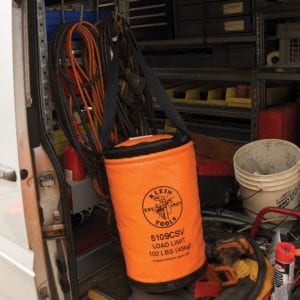
The Klein Lineman Duffel, model 5216V, is a large, zippered bag measuring 24 inches long, 12 inches wide, and 12 inches tall. It weighs 2 pounds empty, which is surprisingly light for a vinyl bag of this size—the vinyl material is thinner and lighter than the heavy, abrasive‑resistant fabrics used for tool backpacks, which is appropriate for a bag that is intended to be carried by its handles or slung over a shoulder, rather than worn on the back for extended periods. The carry handles are sized generously, long enough that the user can slip their arms through them and carry the bag like a backpack, with the weight distributed across both shoulders. This is not a configuration for hiking miles; the handles are not padded, and the bag is not contoured to fit the back. But for the short walk from the truck to the job site, or for climbing a ladder where both hands are needed for safety, the backpack‑style carry is a practical option. The zipper closure runs the full length of the bag, providing wide access to the interior. The interior is a single, undivided compartment—no pockets, no sleeves, no organizers. This is a bag for bulk storage: a set of climbing gear, a coil of rope, a large tool case, a spare hard hat and gloves, a change of clothes. The simplicity of the design is its strength. There is nothing to break, nothing to snag, nothing to complicate the process of packing and unpacking. The mesh strips and drain holes work passively, without any user intervention. The bag is stamped with the Klein logo and the unmistakable hi‑viz orange color, which serves both practical and branding purposes. On a job site, a hi‑viz bag is easy to locate—it stands out against the muted colors of dirt, concrete, and equipment. In the back of a truck, it is less likely to be overlooked and left behind. The orange color also brightens the interior of the bag, making it easier to see the contents, particularly in low‑light conditions. The Klein Vinyl Top‑Closing Bucket with Swivel Snap, model 5109CSV, is a different form factor but shares the same material and design philosophy. It is a cylindrical bucket, 17 inches tall and 12 inches in diameter, with a zippered top closure that keeps tools contained during transport and prevents debris from falling into the bucket when it is not in use. The bucket has a 100‑pound load rating, which is reduced from the capacity of a comparable canvas bucket, but still sufficient for the tools and materials that a lineman or an electrician would typically carry. The swivel snap attaches to the bucket handle and allows the bucket to be secured to a truck bed, a hoist line, or a scaffold, preventing it from being knocked over or blown away. The handle extends down the sides of the bucket and is reinforced at the molded polypropylene bottom, which provides structural support and resists wear when the bucket is set down on rough surfaces. Like the duffel, the bucket has drain holes to prevent water accumulation. The Klein Small Serial Apron, model 51828, is a wearable tool carrier designed for the technician who needs a selection of hand tools close at hand. It has eight small tool pockets, a pouch, and a small swivel snap hook. The apron measures 19.5 inches by 18 inches and weighs 2.2 pounds. The pockets are sized for the small hand tools that a lineman or a service technician uses frequently—screwdrivers, pliers, wire strippers, voltage testers. Two straps are riveted in place to reinforce the pouch and prevent it from pulling away from the apron body under load. The apron is worn around the waist, secured by a buckle, and it provides a convenient, hands‑free way to carry a small set of tools when moving around a job site or working in a confined space. The vinyl material is easy to wipe clean, and the hi‑viz orange color keeps the apron visible.
The pricing of the Klein vinyl bag line reflects the cost of domestic manufacturing and the quality of the materials. The Lineman Duffel retails for around $89, the bucket for $79, and the apron for $79. These are not inexpensive products, particularly when compared to import bags that use similar materials but are manufactured in lower‑cost markets. The price premium is the cost of the "Made in the USA" label, which for many professionals—particularly those who work in the utility and electrical trades, where Klein's brand loyalty is exceptionally strong—is a meaningful factor in purchasing decisions. A product made in the USA supports domestic manufacturing jobs, is subject to American labor and environmental standards, and carries a certain pride of ownership that an import cannot replicate. Klein has been manufacturing tools in the United States since the company was founded in 1857, and the vinyl bag line is a continuation of that tradition. The bags are not for everyone. They are not as abrasion‑resistant as heavy nylon, not as ergonomic as a backpack, not as protective as a hard case. But for the lineman, the utility worker, the electrician, or the maintenance professional who needs a simple, weather‑resistant, highly visible bag that will drain water, breathe, and survive the back of a truck for years, they are an excellent choice. They are tools, in the purest sense—designed for a specific job, built to do it well, and priced to reflect the quality of their construction and the integrity of their manufacturing.
Klein Tools Vinyl Duffel Bag, Tool Bucket, and Apron
Comments 0
Leave a Comment