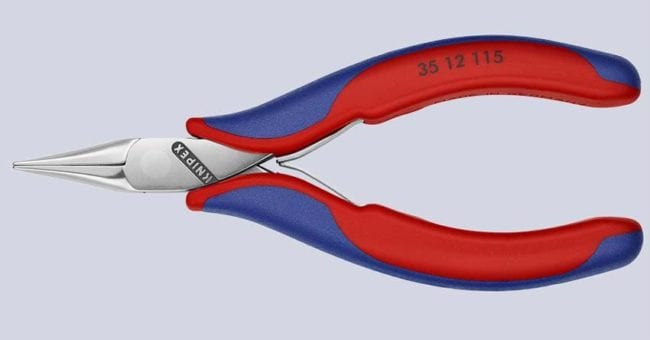
The elephant in the room, for anyone who follows Knipex closely, is the manufacturing process. Knipex is touting what they describe as a "unique" and "proprietary" manufacturing process for the new electronics pliers, but the company is keeping the specifics under wraps. At this point, mum's the word about what that process actually entails. What they are willing to share is the outcome: the pliers are built around a base material of ball‑bearing steel, a material choice that is unusual in the hand‑tool world and that signals a deliberate prioritization of service life. Ball‑bearing steel is designed to withstand enormous cyclic stresses without deforming, without developing surface fatigue, and without losing dimensional accuracy over millions of revolutions. When that steel is forged and machined into the jaws, pivot, and handles of a pair of electronics pliers, the result is a tool that should maintain its precise, light‑closing action and its sharp cutting edges far longer than a tool made from conventional tool steel. For the professional who works on small components daily—stripping 28‑gauge wire, cutting component leads flush to a board, gripping a tiny nut in an impossibly tight space—that longevity translates directly into consistency and reduced replacement cost over a career.
The Box Joint and the Double‑Guided Design: Why Smoothness Matters
The pivot joint on a pair of pliers is the heart of the tool. A sloppy joint leads to blade gap, to uneven cutting pressure, to jaws that wander out of alignment under load, and to a frustrating user experience that makes precision work feel like a wrestling match. Knipex has long been known for the quality of their box joints, and the new electronics pliers take that reputation further with a large, double‑guided box joint design. The term "double‑guided" refers to the way the two halves of the joint interlock and support each other. Unlike a simple lap joint where one half of the pliers merely overlaps the other, a box joint nestles one half into a precisely machined recess in the other, providing support along multiple planes. The double‑guided design adds an additional point of contact, further reducing any tendency for the halves to twist or separate under load. The result, according to Knipex, is no backlash—the tiny, barely perceptible wiggle that occurs when you change the direction of force on a less precise pair of pliers. For an electronics technician who is gripping a component lead with precisely the right amount of force to hold it without crushing it, the elimination of backlash is not a luxury. It is the difference between a clean, confident movement and a hesitant, uncertain one.
The smoothness of the action is further enhanced by the manufacturing process itself. The proprietary technique that Knipex is keeping secret presumably involves tighter tolerances, more sophisticated heat treatment, or a novel method of fitting the two halves of the joint together. Whatever the specifics, the end result is a pair of pliers that opens and closes with a fluid, hydraulic smoothness that makes even the most delicate spring‑loaded designs feel crude by comparison. The double‑guided box joint distributes the closing force evenly across the full width of the joint, eliminating the high‑pressure contact points that cause localized wear and eventually lead to joint looseness. For the user, this means the pliers will feel as smooth and precise on their thousandth day of use as they did on their first.
Ergonomics and Handle Design: Longer Grips, Less Effort
One of the most immediately noticeable changes in the updated Knipex electronics pliers is the handle length. Knipex has extended the handles on many models, a change that serves two purposes. First, longer handles provide more leverage, which means less hand force is required to perform a given cutting or gripping task. For a professional who may repeat the same motion hundreds of times in a day—cutting component leads to length, stripping insulation, crimping connectors—the reduction in required effort adds up to a meaningful reduction in hand fatigue over the course of a shift. Second, the longer handles provide a more secure, more comfortable grip. The additional length allows the user to grip the pliers with all four fingers, rather than having the pinky dangle off the end or tuck awkwardly against the palm. The handle contours are shaped to follow the natural curve of the hand, and the surface texture is designed to provide traction without being abrasive. The result is a tool that feels like an extension of the hand rather than an object that must be wrestled into submission.
The ergonomic improvements extend beyond mere length. Knipex has focused on dexterity and control, qualities that are paramount when working with components that can be measured in millimeters. The handles are designed to encourage a light, fingertip‑based grip when precision is called for, while still providing the palm‑filling authority needed when more force is required. The spring‑loaded opening mechanism—a feature on many of the models—reduces the effort needed to open the jaws between cuts, further reducing repetitive strain. The handles are available in a range of styles, including standard dipped grips, multi‑component comfort grips, and electrostatic discharge (ESD) safe handles for use in environments where static electricity can damage sensitive components. The ESD handles are a critical feature for anyone working on modern circuit boards, where a single static discharge can destroy a microprocessor or a memory chip. For the professional who works in both standard and ESD‑sensitive environments, Knipex offers the ability to choose the handle style that matches the job.
Rounded Jaw Edges: Accessibility and Protection
A subtle but significant change to the head design of the new Knipex electronics pliers is the rounding of the jaw edges. The outside edges of the pliers' head, which on many tools are sharply machined at right angles, have been radiused to a smooth, rounded profile. This serves two functions. First, it improves accessibility in tight spaces. A rounded head can slip past obstructions that would snag on a sharp corner, allowing the pliers to reach components that are deeply recessed or positioned close to other parts. Second, and perhaps more importantly, the rounded edges reduce the risk of accidentally damaging adjacent components. When you are working on a densely populated circuit board, the pliers must navigate a forest of capacitors, resistors, transistors, and delicate traces. A sharp corner on the pliers, brushing against the wrong component, can scratch a surface, crack a ceramic package, or even lift a trace off the board. The rounded edges act as a sort of passive safety feature, allowing the tool to slide past obstructions without gouging or catching. It is a detail that reflects a deep understanding of how electronics professionals actually use their tools, and it is the kind of refinement that separates Knipex from manufacturers who simply stamp out pliers to meet a price point.
The Steel and the Service Life: Ball‑Bearing Steel as a Long‑Term Investment
The choice of ball‑bearing steel as the base material for the new electronics pliers warrants further discussion because it is, in many ways, the most significant upgrade in the entire line. Ball‑bearing steel, typically a high‑carbon chromium alloy like AISI 52100, is engineered for one purpose: to withstand the extreme contact stresses that occur when a hardened steel ball rolls between two races under load. It is characterized by exceptionally high hardness—typically in the range of 60 to 64 HRC after heat treatment—combined with a fine, uniform grain structure that resists the initiation and propagation of fatigue cracks. When this steel is repurposed for the cutting edges and pivot joint of a pair of pliers, the benefits are numerous. The high hardness translates into excellent edge retention; the cutting blades stay sharp through thousands of cuts. The fine grain structure translates into toughness; the blades resist chipping when they encounter a harder‑than‑expected material. And the fatigue resistance translates into a pivot joint that remains tight and smooth over years of daily use, because the steel does not gradually deform under the repeated stress of opening and closing.
The comparison to conventional tool steels is instructive. A typical set of electronics pliers might use a steel like AISI 1075 or a low‑alloy chromium‑vanadium steel, hardened to perhaps 55 to 58 HRC. These steels are adequate for most applications, but they will lose their edge more quickly, they are more prone to developing pivot looseness, and they may chip if overloaded. The ball‑bearing steel in the new Knipex pliers represents a deliberate step up in material quality, and the corresponding increase in service life justifies the higher price that Knipex tools command. For a professional who uses electronics pliers as a primary tool—a technician who assembles wire harnesses, an engineer who prototypes circuits, a repair specialist who reworks boards—the longer service life means fewer replacements, less downtime, and greater consistency in the quality of the work. For a hobbyist who uses the pliers less frequently, the ball‑bearing steel means the tool will remain in peak condition for decades, outlasting the user and potentially being passed down to the next generation of makers.
Force Distribution and Longevity: The Engineering Behind the Head Design
Beyond the material choice, Knipex has optimized the head design of the new electronics pliers for better force distribution. The forces that occur during cutting—particularly when trimming a thick component lead or a small bolt—are concentrated at the cutting edges and transmitted through the head to the pivot. If the head geometry is not optimized, those forces can create stress concentrations that lead to cracking, chipping, or permanent deformation over time. Knipex has used finite‑element analysis and other modern engineering tools to shape the head so that the stress flows smoothly from the cutting edges to the pivot and then into the handles. The result is a design that is both stronger and lighter than a comparable head designed by traditional, experience‑based methods. The improved force distribution also benefits the user in terms of cutting feel. When the head flexes less under load, the cutting action feels crisper and more direct. The user can feel the exact moment when the blades sever the material, and that tactile feedback is essential for precise, controlled work.
A Line of Over 80 Tools: Navigating the Options
The Knipex electronics pliers line, with its more than 80 individual tools, can be daunting to navigate. The line includes box joint diagonal cutters, end cutting nippers, and gripping pliers, each available in a range of sizes, jaw configurations, and handle styles. The diagonal cutters, perhaps the most commonly used tool in the line, are available with several different bevel types: standard bevel, semi‑flush bevel, and flush bevel. A standard bevel leaves a slight peak on the cut surface, which is acceptable for general‑purpose work. A semi‑flush bevel leaves a smaller peak, more appropriate for applications where the cut surface will be visible or where a closer cut is required. A flush bevel leaves the cut surface nearly flat, ideal for precision work on circuit boards where a protruding lead could cause a short circuit. The choice of bevel type depends on the specific requirements of the job, and many professionals will own multiple pairs of cutters with different bevel types to cover the range of tasks they encounter.
The end cutting nippers are designed for trimming leads and small fasteners flush to a surface, a task that is common in printed circuit board assembly and repair. The jaw geometry on these nippers is critical; the cutting edges must be precisely aligned to cut cleanly without leaving a stub or damaging the board. Knipex has optimized the jaw geometry on the new models, and the full‑flush cutting capability is among the best in the industry. The gripping pliers in the electronics line include needle‑nose pliers, flat‑nose pliers, and round‑nose pliers, each with finely serrated jaws that provide a secure grip on small components without marring the surface. The jaws are available in various lengths and widths to accommodate different component sizes and access requirements. For the professional who needs to grip, bend, and shape component leads, the selection of gripping pliers provides the right tool for every task.
Additional Features: Lead Catchers, Double Springs, and Carbide Cutting Edges
Many of the models in the new Knipex electronics pliers line are available with optional features that enhance their functionality for specific applications. A lead catcher is a small device that clips onto the pliers and captures the cut‑off end of a component lead, preventing it from flying across the room and landing in a place where it could cause a short circuit or become lost. For anyone who has spent time on their hands and knees searching for a tiny, clipped‑off piece of wire that pinged away into the unknown, the value of a lead catcher is self‑evident. Double springs—two independent springs acting on the handles—provide a more balanced opening force and greater redundancy than a single spring. If one spring breaks, the other continues to function, allowing the user to finish the job without interruption. For critical applications where downtime is unacceptable, double springs provide an extra margin of reliability. Carbide cutting edges, available on select models, provide extreme wear resistance for cutting particularly hard or abrasive materials, such as the steel leads on some high‑reliability components. Carbide is significantly harder than even the best tool steel, and it maintains a sharp edge through thousands of cuts that would dull a conventional steel blade. The trade‑off is that carbide is more brittle and more expensive, but for the applications that require it, there is no substitute.
Initial Impressions and Market Reception
The announcement of the updated Knipex electronics pliers was met with enthusiasm from the loyal Knipex user base and with curiosity from professionals who had not previously considered the brand. The improvements—ball‑bearing steel, double‑guided box joints, rounded jaw edges, longer handles—are the kind of incremental, detail‑oriented upgrades that distinguish a premium tool manufacturer from a commodity producer. They do not represent a radical departure from the previous generation of Knipex electronics pliers; rather, they represent a refinement of an already excellent product. For existing Knipex users, the new models provide a reason to upgrade aging tools or to expand their collection. For new users, the updated line provides a compelling entry point into the Knipex ecosystem, with the promise of a service life that justifies the initial investment. The electronics pliers market is competitive, with offerings from established brands like Erem, Lindstrom, and Xuron, each with their own loyal followings. Knipex's entry into this market with a comprehensive, fully re‑engineered line signals a serious intent to compete at the highest level. The combination of German engineering, premium materials, and a manufacturing process that the company describes as unique positions the new electronics pliers as a compelling choice for the professional who demands the best.
Knipex Electronics Pliers: Key Upgrade Summary
- Base Material: Ball‑bearing steel for exceptional hardness, wear resistance, and service life.
- Joint Design: Large, double‑guided box joint that eliminates backlash and ensures consistent, smooth operation.
- Manufacturing Process: Proprietary process that enhances precision, joint fit, and overall durability.
- Ergonomics: Longer handles that reduce effort, improve control, and accommodate a full four‑finger grip.
- Jaw Edges: Rounded profiles that improve accessibility in tight spaces and prevent accidental damage to adjacent components.
- Force Distribution: Redesigned head geometry that optimizes stress flow and improves cutting feel and durability.
- Model Range: Over 80 tools including diagonal cutters, end cutting nippers, and gripping pliers with various bevel types and jaw configurations.
- Optional Features: Lead catchers, double springs, ESD handles, and carbide cutting edges available on select models.
Conclusion: Knipex Takes the Electronics Pliers to a New Level
The re‑engineering of the Knipex electronics pliers line is not a story of flashy innovation or marketing hype. It is a story of quiet, determined refinement driven by a deep understanding of what electronics professionals need from their tools. The ball‑bearing steel base material promises a level of durability that few competitors can match. The double‑guided box joint delivers the smooth, precise action that Knipex is known for. The rounded jaw edges and longer handles enhance usability and comfort in the real‑world conditions where these tools are used. The breadth of the line—over 80 models covering cutting, nipping, and gripping tasks—ensures that there is a Knipex tool for virtually every electronics application. For the professional who relies on their pliers to make a living, the investment in a pair of Knipex electronics pliers is not just a purchase; it is a long‑term commitment to quality, precision, and the confidence that comes from using a tool that will perform exactly as expected, day after day, year after year. Knipex has earned its loyal following, and with the new electronics pliers, that following is likely to grow. If you have not yet experienced the Knipex difference, this updated line is an excellent place to start.
Comments 0
Leave a Comment