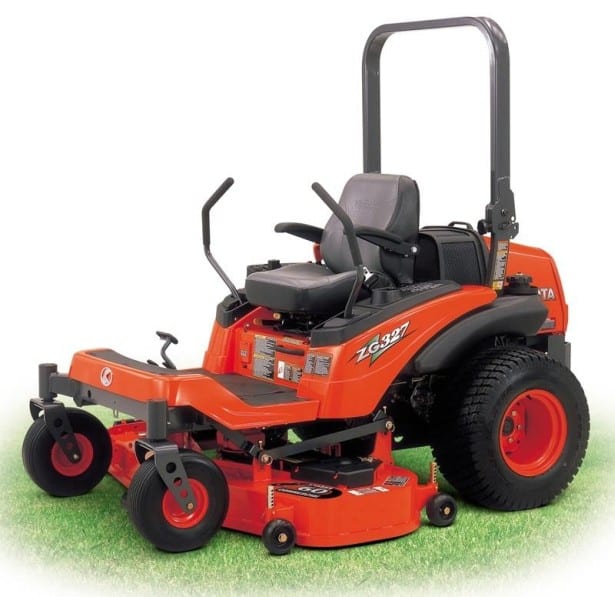
The affected mowers were not difficult to identify. The recalled units were all zero‑turn riding mowers, the kind of machine that looks like a small, squat, four‑wheeled vehicle with two steering levers instead of a steering wheel, a wide cutting deck slung beneath the frame, and a roll bar arching overhead like the canopy of a fighter jet. They were powered by gasoline V‑twin engines—the same kind of engine configuration that has powered motorcycles, generators, and outdoor power equipment for decades, prized for its smooth power delivery and compact packaging. The mowers came with cutting decks in three widths—48 inches, 54 inches, and 60 inches—and with engines rated at either 22 or 27 horsepower. They were, in every respect, serious machines designed for serious work. And they were painted, unmistakably, in Kubota orange—a color so deeply associated with the brand that it is almost a trademark in itself. The model number and serial number were located on a data plate affixed to the right side of the frame, either just forward of the mower deck or just behind it, depending on the specific model. The serial number range was the key to determining whether a particular mower was affected by the recall. For the ZG222, the affected serial numbers ran from 10002 through 13673. For the ZG227, from 10002 through 12957. For the ZG327, from 10004 through 13318. If a mower's model designation and serial number fell within those ranges, it was subject to the recall, and its owner was instructed to stop using it immediately and contact an authorized Kubota dealer for a free inspection and replacement of the defective carburetor. The recall notice was published on the CPSC website, distributed to the media, and communicated through Kubota's dealer network. Dealers who had sold the affected mowers were responsible for contacting their customers and scheduling the repair. For a company with Kubota's reputation and dealer infrastructure, this was a manageable task—9,500 units is a significant number, but it is not an overwhelming one, particularly when compared to the millions of units involved in some automotive recalls. The challenge, as with any recall, was ensuring that every owner was reached, that every defective carburetor was replaced, and that no mower remained in service with the fire hazard still present.
The Carburetor: A Small Component With an Outsized Potential for Catastrophe
To understand the nature of the Kubota recall, it is necessary to understand, at least in general terms, the function of the carburetor and the specific failure mode that prompted the recall. A carburetor is a mechanical device that mixes air and fuel in the correct proportions for combustion in the engine. It is an elegantly simple piece of engineering, relying on the Venturi effect—the reduction in fluid pressure that occurs when a fluid flows through a constricted section of a pipe—to draw fuel from a reservoir and atomize it into a fine mist that can be ignited by the spark plug. The carburetor sits atop or alongside the engine, connected to the fuel tank by a supply line and to the intake manifold by a mounting flange. Inside the carburetor, a float regulates the level of fuel in the bowl, opening and closing a needle valve as the fuel level rises and falls. When the float, the needle valve, or the gaskets and seals that contain the fuel within the carburetor fail, the result can be a fuel leak. Gasoline can seep from the carburetor body, drip onto the engine below, and pool on hot surfaces such as the exhaust manifold, the cylinder head, or the muffler. Gasoline has a flash point—the temperature at which it can be ignited by a spark or a hot surface—of approximately minus 45 degrees Fahrenheit. This means that under virtually any ambient temperature, liquid gasoline that comes into contact with a sufficiently hot engine component can ignite. The fire that results can spread rapidly, consuming the plastic and rubber components of the engine, igniting the fuel in the tank, and engulfing the entire mower in flames. For an operator sitting atop the machine, a fire that starts in the engine compartment can be a terrifying and potentially deadly event. The operator must recognize the fire, dismount the machine safely—avoiding contact with the hot exhaust, the rotating blades, and the flames themselves—and escape to a safe distance. If the mower is parked in a garage or a shed when the fire occurs, the structure itself can be at risk. A gasoline fire that starts in an attached garage can spread to the living quarters of a home in a matter of minutes, long before the occupants are aware that anything is wrong.
The specific carburetor defect in the recalled Kubota mowers was not described in exhaustive detail in the CPSC recall notice, as such notices typically provide only a summary of the hazard and the remedy. However, based on the description—"the carburetor can fail allowing fuel to leak"—and the remedy—a free replacement carburetor installed by an authorized dealer—it can be inferred that the defect was not repairable through a simple adjustment or a replacement gasket. A carburetor that can "fail" in a way that allows fuel to leak is a carburetor with a manufacturing defect—a crack in the casting, a defect in the float mechanism, a flaw in the machining of the needle valve seat, or a similar structural problem that cannot be corrected in the field. The fact that Kubota elected to replace the entire carburetor, rather than repairing the existing one, suggests that the defect was internal to the carburetor body or to a component that could not be reliably replaced or adjusted by a dealer technician. A full carburetor replacement is a more expensive remedy for the manufacturer than a simple repair, but it is also a more definitive one. It eliminates any uncertainty about whether the repair was successful, and it ensures that the owner receives a carburetor that is known to be free of the defect. For the owner of a Kubota mower, the carburetor replacement was an inconvenience—a trip to the dealer, a wait while the work was performed, and a temporary loss of the use of the machine—but it was also a reassurance. The new carburetor would not leak. The fire hazard would be eliminated. The mower would be safe to use again. And because the recall was voluntary and the repair was free, the owner would bear no financial cost for correcting a defect that was the manufacturer's responsibility.
The Economics of a Recall: $7,600 Mowers, 9,500 Units, and the Cost of Doing the Right Thing
From a financial perspective, a recall of 9,500 units is a significant event for a manufacturer, but not a catastrophic one. The cost of the recall includes the direct costs of the replacement carburetors, the labor to install them—paid to the dealers by the manufacturer—the administrative costs of managing the recall, the costs of communicating with owners, and the indirect costs of lost sales, damaged reputation, and potential legal liability. For a large, diversified company like Kubota—which sells tractors, construction equipment, utility vehicles, and a wide range of other products in addition to consumer mowers—the cost of a recall of this size is substantial but manageable. It is a line item on a quarterly financial statement, an expense to be absorbed and moved past. But from the perspective of the mower owner, the recall represents a different kind of cost: the cost of uncertainty. A person who paid $8,000 or $10,000 for a mower, who chose Kubota over less expensive competitors because they believed they were paying for quality and reliability, is forced to confront the reality that their expensive machine has a hidden flaw that could burn down their garage. The trust that they placed in the brand is shaken. The confidence that they felt every time they turned the key is replaced, at least temporarily, by a nagging doubt. Will the replacement carburetor be any better? What other hidden defects might the mower have, waiting to manifest at the worst possible moment? Is the entire brand, for all its reputation, built on a foundation that is less solid than it appears? These are questions that cannot be answered by a recall notice, no matter how well‑crafted or transparent. They are questions that linger in the back of the owner's mind, and they are the true cost of a safety recall to a premium brand. Kubota's response to the recall—a voluntary, cooperative effort with the CPSC, a clear and specific description of the affected models, a straightforward remedy, and a network of authorized dealers equipped to perform the repair—was consistent with the company's reputation. There was no attempt to hide the defect, to minimize its significance, or to delay the recall until a more convenient time. The recall was issued, the dealers were notified, and the work was done. For the vast majority of the 9,500 owners, the recall was a minor interruption—a trip to the dealer, a few hours without the mower, and a return to normal service. The fire hazard was eliminated, the mower was safe, and the trust, over time, was gradually restored. But for a minority of owners—those who never learned of the recall, those who ignored the notice, those whose contact information had changed since the purchase—the defective carburetor remained in place, silently waiting for the moment when it would fail and leak fuel onto a hot engine. And for those owners, the recall was not a success. It was a failure—a failure of communication, a failure of the systems that are supposed to protect consumers from dangerous products, a failure that could, in the worst case, result in a fire that had been foreseen and could have been prevented. This is the paradox of every product recall: it is only as effective as its ability to reach the people who need to know about it. A recall that is announced but not received is a recall that has not happened. A defect that is identified but not corrected is a defect that remains, lurking in garages and equipment sheds, waiting for the right combination of circumstances to transform itself from a potential hazard into an actual tragedy.
Kubota Zero‑Turn Riding Mower Recall Details
| Detail | Information |
|---|---|
| Manufacturer | Kubota Manufacturing of America Corp., Gainesville, Georgia |
| Product Recalled | Kubota Zero‑Turn Riding Mowers |
| Model Numbers | ZG222 (S/N 10002–13673), ZG227 (S/N 10002–12957), ZG327 (S/N 10004–13318) |
| Quantity | Approximately 9,500 |
| Hazard | Carburetor can fail, allowing fuel to leak and posing a fire hazard |
| Engines | Gasoline V‑twin, 22 or 27 horsepower |
| Deck Sizes | 48‑inch, 54‑inch, 60‑inch |
| Mower Color | Bright orange with KUBOTA decals |
| Sale Period | February 2008 through December 2008 |
| Price Range | $7,600 to $10,000 |
| Sold At | Authorized Kubota dealers nationwide |
| Remedy | Immediately stop using the mower; contact an authorized Kubota dealer for free inspection and carburetor replacement |
| Contact | Kubota Tractor at (800) 752‑0290, Monday through Friday |
The Role of the Authorized Dealer: The Front Line of a Recall Response
When a recall like the Kubota carburetor replacement is issued, the burden of execution falls not on the corporate headquarters in Gainesville, Georgia, or on the parent company in Japan, but on the network of independently owned and operated authorized Kubota dealers scattered across the country. These dealers are the face of the brand to the consumer. They are the ones who sold the mower, who serviced it, who built the relationship with the customer. And when a recall is announced, they are the ones who must take the phone calls, schedule the appointments, order the replacement parts, perform the labor, and reassure the worried owner that the problem will be fixed and the mower will be safe. For a dealer, a recall is a mixed blessing. On one hand, it generates service traffic and provides an opportunity to strengthen the relationship with the customer by demonstrating responsiveness and professionalism. On the other hand, it is an unbillable expense—the manufacturer reimburses the dealer for the parts and labor, but the reimbursement rate is often lower than the dealer's standard shop rate, and the administrative burden of processing recall claims can be significant. A dealer who is already busy with paying service work may find a recall to be a disruption to their normal workflow. The Kubota carburetor recall, with its relatively small number of affected units—9,500 spread across the entire country—was unlikely to overwhelm any individual dealer. But for the dealers who had sold a significant number of the affected ZG‑series mowers, the recall meant a flurry of phone calls, a stack of warranty claims to process, and a temporary increase in the workload for their service technicians. The technicians themselves faced a straightforward but repetitive task: removing the old carburetor, installing the new one, checking for fuel leaks, and sending the mower back to its owner. The work was not complex, but it required care and attention to detail. A carburetor that was not properly seated, a fuel line that was not securely clamped, a gasket that was pinched during installation—any of these errors could create a new leak, potentially as dangerous as the defect that the recall was intended to correct. The dealer technicians, like the engineers who designed the carburetor and the workers who assembled the mower, were links in a chain of safety that ultimately determined whether the recall would succeed or fail. And like every chain, it was only as strong as its weakest link.
Lessons Learned: What the Kubota Recall Teaches Us About Product Safety, Brand Reputation, and the Imperfect Art of the Recall
The Kubota zero‑turn mower recall of 2009, viewed from a distance of years, offers a set of lessons that extend beyond the specific carburetor defect and the specific mowers that were affected. The first lesson is that no brand, no matter how prestigious or how expensive, is immune to manufacturing defects. Quality control is a statistical exercise, a game of probabilities and sampling rates and six‑sigma targets. Even the best quality control system, operated by the most conscientious manufacturer, will occasionally allow a defective product to reach a consumer. The measure of a manufacturer is not whether defects occur—they always will, in any product of sufficient complexity—but how the manufacturer responds when they are discovered. Kubota, by all available evidence, responded appropriately: a voluntary recall, a clear communication, a free and definitive remedy. The second lesson is that the recall system, as it exists in the United States, is fundamentally imperfect. It relies on the cooperation of multiple parties—manufacturers, retailers, regulators, and consumers—each of whom may have different incentives and different levels of engagement. A manufacturer that issues a recall cannot compel a consumer to read the recall notice, to check the serial number on their mower, or to bring the mower to a dealer for repair. A retailer that sold the product may or may not assist in the notification process. A consumer who registers their product will receive a direct notification; a consumer who does not may never learn of the recall at all. The result is that every recall, no matter how well‑executed, leaves behind a residue of unrepaired products, still in use, still potentially dangerous. The size of that residue depends on the effectiveness of the notification effort, the severity of the hazard, and the diligence of the affected consumers. For the Kubota recall, the residue is likely small—the affected mowers were relatively few in number, they were sold through a dedicated dealer network that had a relationship with the customers, and the hazard was serious enough to motivate a response. But it is almost certainly not zero. Somewhere, in a garage or a shed, there may still be a Kubota ZG‑series mower with a defective carburetor, its owner unaware that the machine they trust to cut their grass could, under the right—or wrong—conditions, catch fire. That mower is the silent, persistent reminder that product safety is never a finished project. It is an ongoing effort, a continuous cycle of design, manufacture, inspection, detection, recall, and repair. It is a system that works, most of the time, for most of the people. But it is not perfect. And for the people for whom it fails, the consequences can be devastating. The third lesson is a broader one, about the relationship between price and safety. A $10,000 Kubota mower is not inherently safer than a $1,500 mower from a less prestigious brand. Price and brand reputation are indicators of expected quality, but they are not guarantees. Safety is the product of engineering, manufacturing, and quality control—processes that can fail at any price point. A consumer who buys a premium product does so partly in the hope that the premium will buy them a margin of safety—that the engineers who designed it, the machinists who built it, and the inspectors who checked it were held to a higher standard than the ones who worked on the cheaper alternative. That hope is generally justified. Premium brands, on average, have fewer defects than budget brands. But the average is not a promise. It is a statistical tendency, and every statistical tendency has outliers. The Kubota recall is a reminder that safety is not something you can buy. It is something that must be continuously earned—by the manufacturer, through rigorous quality control; by the regulator, through vigilant oversight; and by the consumer, through the simple but essential acts of registering products, paying attention to recalls, and taking action when a defect is discovered. The mower in the garage is a machine, not a promise. It will serve faithfully for years, but it is not infallible. And when it fails, the difference between a minor inconvenience and a major catastrophe depends, in large part, on the choices that were made long before the failure occurred—the choice of the manufacturer to issue a recall, the choice of the dealer to perform the repair, and the choice of the owner to bring the mower in.
Conclusion: A Recall That Preserved a Reputation
The Kubota zero‑turn mower recall of 2009 is not a story of corporate malfeasance, regulatory failure, or consumer outrage. It is a story of a defect that was discovered, a hazard that was acknowledged, and a remedy that was provided—all before, as far as the public record shows, anyone was injured. It is, in that sense, a success story. A small, quiet success, measured not in sales figures or market share but in fires that did not happen, in garages that did not burn, in people who were not hurt. The recall was an inconvenience for the 9,500 owners who had to take their mowers to the dealer. It was an expense for Kubota, and a logistical challenge for the dealer network. It was a blemish on the reputation of a brand that had earned its premium status through decades of quality and reliability. But it was also a demonstration of what a responsible manufacturer does when a problem is discovered: it fixes it. It does not hide it. It does not minimize it. It does not delay until the next product cycle, hoping that the problem will go away. It issues a recall, it notifies its customers, and it makes them whole. That is what Kubota did. And for the thousands of owners who brought their mowers in, had the carburetor replaced, and returned to mowing their lawns with the confidence that the machine beneath them was safe, that was enough. The trust was shaken, but it was also repaired—restored by the simple, honest act of acknowledging a mistake and correcting it. In a world where corporate behavior is often characterized by denial, evasion, and the calculated weighing of legal liability against public safety, the Kubota recall stands as a quiet example of the right way to handle a product safety problem. It is not a dramatic story. But it is a story that deserves to be remembered, because it shows that even in the imperfect world of manufacturing, where defects are inevitable, integrity is still possible. And for the people who own the mowers, the people whose safety depends on the integrity of the manufacturer, that is the story that matters most.
Comments 0
Leave a Comment