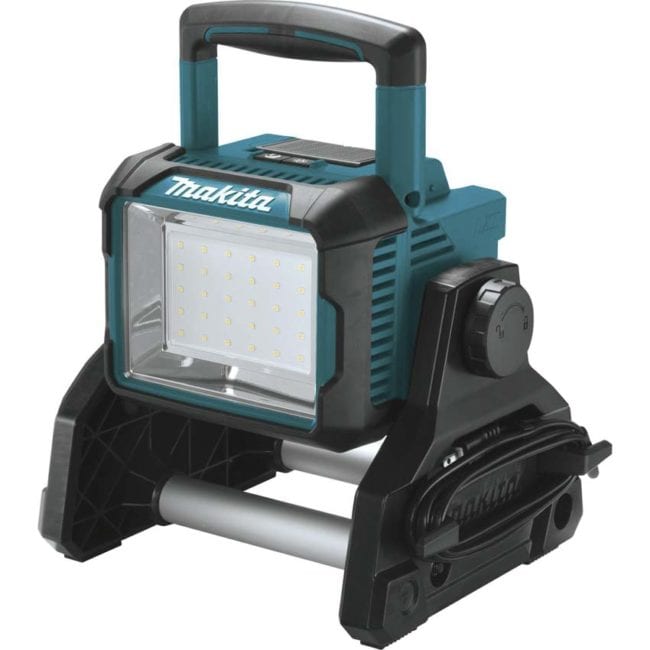
The DML811 is not a small light. At roughly 10 inches wide, 12 inches tall, and 14 inches deep, and weighing over 10 pounds with a battery installed, it is a substantial piece of equipment. It is not designed to be clipped to a belt or carried in one hand while climbing a ladder. It is a stationary work light, intended to be set up in a central location and left to illuminate a broad area for hours at a time. The size and weight are a direct consequence of the light's capabilities—the large LED panel, the heavy‑duty housing, the internal power supply that enables the hybrid operation—and they are entirely appropriate for the light's intended role. The housing is a combination of impact‑resistant engineering plastic—the same type of material used for Makita's power tool housings—and thick rubber overmold that wraps around the edges, the corners, and the base. The overmold serves a dual purpose: it absorbs impact in the event of a drop or a collision, protecting the internal electronics and the LED panel, and it provides a non‑slip surface that keeps the light stable when placed on a sloped or uneven surface. The light can be positioned upright on its base, which is wide and flat enough to resist tipping, or it can be laid on its back, sides, or face—the overmold protects the housing and the lens in any orientation. The LED panel is recessed behind a protective bezel that prevents the lens from being scratched or struck when the light is set face‑down. The power switch and the mode selector are integrated into a single, large, rubber‑covered button on the back of the housing. The button is easy to locate by feel, even when wearing thick work gloves, and it cycles through the three brightness settings—High (3,000 lumens), Medium (1,500 lumens), Low (750 lumens)—and Off. A battery indicator light next to the switch provides a rough indication of the remaining charge in the installed battery, glowing green when the battery is full, yellow when it is partially depleted, and red when it is nearing empty. This indicator is a useful feature that allows the user to check the battery status without having to remove the battery and press the button on the pack.
Hybrid Power and Automatic Switchover: Why AC + Battery Is Better Than Either Alone
The hybrid power system is the DML811's most significant feature, and it is worth examining in detail because it represents a genuine improvement over both purely corded and purely cordless work lights. When the light is connected to AC power via the included cord—a heavy‑duty, oil‑resistant cable with a cord wrap for storage—it operates indefinitely, with no limit on run time and no degradation of brightness. It draws a modest amount of current, well within the capacity of even a small generator or a heavily loaded temporary power panel. The AC power supply is internal, with no external power brick, and the cord attaches to a recessed connector on the back of the housing. The connector is protected by a rubber flap that seals against dust and water when the cord is not in use. When the light is running on AC power and a Makita 18V battery is installed, the battery remains in a fully charged state—the light does not draw from the battery while AC power is available. This is a deliberate design choice that preserves the battery's charge for the moment when it is needed. If the AC power fails—because a breaker trips, a generator runs out of fuel, a cord is accidentally unplugged—the light does not go dark. It automatically and instantaneously switches to battery power without a flicker, without a pause, and without any interruption in the light output. The user may not even be aware that the switch has occurred unless they are watching the battery indicator. This is a critical safety feature for professionals who work in environments where a sudden loss of light could create an immediate hazard. An electrician working in a live panel, a plumber working in a trench, a carpenter working on scaffolding—in any of these situations, a sudden plunge into darkness could result in injury. The DML811 ensures that the light stays on, no matter what happens to the AC power supply. When AC power is restored, the light automatically switches back to AC operation, preserving the battery charge for the next outage. The user can also choose to run the light solely on battery power, without connecting the AC cord, for applications where no outlet is available or where the cord would create a tripping hazard. On a 6.0 amp‑hour battery, the light will run for approximately 3 hours on High, 6 hours on Medium, and 13 hours on Low. These are realistic run times, based on Makita's published specifications, and they are sufficient for most typical work scenarios. For extended use on High, a spare battery and a charger are recommended, and Makita's Rapid Optimum Charger can replenish a depleted 6.0 Ah battery in approximately 55 minutes—fast enough that a single spare battery can keep the light running almost continuously if the user is diligent about swapping.
Light Output and Quality: 3,000 Lumens of Neutral White
The DML811 produces its light from a panel of multiple LED chips arranged behind a diffusing lens. The lens softens the light, spreading it into an even flood pattern that is free of the hot spots, artifacts, and harsh shadows that can characterize a single‑point light source. The beam is broad, covering a wide area from a relatively short distance, which makes the light well‑suited to illuminating a room, a work area, or a section of a job site. The effective range for detailed work is approximately 10 to 20 feet, depending on the ambient light level and the reflectivity of the surrounding surfaces. At 3,000 lumens on High, the DML811 is bright enough to light up a large residential room, a commercial office space, or a section of a warehouse. It is not as bright as some of the larger, corded‑only LED floodlights on the market—the Southwire ProBuilt XLE series, for example, produces 6,500 to 15,000 lumens per head—but it is significantly brighter than most cordless work lights, and the hybrid power capability gives it a versatility that corded‑only lights lack. The Medium setting of 1,500 lumens is useful for smaller spaces or for situations where the High setting would create uncomfortable glare. The Low setting of 750 lumens extends run time dramatically—13 hours on a 6.0 Ah battery—and is sufficient for safety lighting, for navigating around a dark space, or for tasks that do not require high visual acuity. The color temperature is approximately 5000K, a neutral white that renders colors accurately and does not cause the eye strain or color confusion that can result from working under light with a strong blue or yellow cast. For professionals who need to distinguish wire colors, match paint, or identify subtle variations in surface texture, the 5000K temperature is ideal. The light is flicker‑free at all brightness settings, a characteristic that is important not only for video and photography but also for the comfort of workers who spend hours under the light. Flicker, even when it is not consciously perceptible, can cause eye strain, headaches, and fatigue, and it is a common problem with cheaper LED lights that use low‑quality power supplies. The DML811's flicker‑free output is a mark of a well‑designed driver circuit and a commitment to quality that is consistent with Makita's reputation.
The Future of Makita Lighting: 10,000 Lumens and a Handheld Spotlight
The DML811 is not the end of Makita's lighting ambitions; it is the beginning. The company has announced additional models that will expand the line into new categories and higher output levels. The DML809 is a larger, more powerful hybrid light capable of producing 10,000 lumens. It shares the same basic design language as the DML811—the hybrid AC/battery power system, the rugged housing, the IP65 rating—but scales up the LED panel and the output to cover larger areas. The DML809 can run on one or two 18V batteries, providing extended run time or higher output, and it can also be powered by AC. It is expected to retail for around $229, positioning it as a high‑output, professional‑grade area light. Both the DML811 and the DML809 are compatible with a tripod that Makita is developing, which will allow the lights to be elevated for better coverage of large spaces. This tripod‑mounted configuration is intended to replace the traditional two‑light halogen tripod setup that has been standard on construction sites for decades, offering the same or better light output with a fraction of the energy consumption, no bulb replacements, and the ability to operate cordlessly when necessary. Makita is also planning a handheld spotlight/flashlight with a pivoting head and a beam distance of 700 yards. This is a departure from the area‑flood design of the DML811 and DML809, targeting a different set of applications—search and rescue, long‑range inspections, outdoor navigation—that require a tight, concentrated beam rather than a broad wash of light. The pivoting head can be positioned inline, like a traditional flashlight, or swung to a 90‑degree angle for use as a work light, and the light is expected to be powered by Makita's 18V LXT batteries. Together, these three new lights—the DML811, the DML809, and the handheld spotlight—represent a significant expansion of Makita's presence in the professional lighting market, a category that has been growing rapidly as LED technology has matured and as professionals have recognized the advantages of cordless, impact‑resistant, energy‑efficient work lights over the fragile, hot, and inefficient halogen lights that were the standard for decades.
Makita DML811 Cordless/Corded Work Light Specifications
| Specification | Detail |
|---|---|
| Model | Makita DML811 |
| Power Sources | Makita 18V LXT battery or AC (120V) |
| Light Output | 750 / 1,500 / 3,000 lumens |
| Run Time (6.0 Ah Battery) | ~13 hrs / ~6 hrs / ~3 hrs |
| IP Rating | IP65 |
| Weight With Battery | ~10.4 lbs |
| Dimensions (W x H x D) | ~9‑3/4″ x 11‑7/8″ x 14‑1/4″ |
| AC Cord | Included, with cord wrap |
| Automatic AC‑to‑Battery Switchover | Yes |
| Expected Retail Price | $159 (bare tool) |
Conclusion: The Work Light That Refuses to Leave You in the Dark
The Makita DML811 Cordless/Corded Work Light is a tool designed by people who understand the realities of professional job site lighting. It is bright, with 3,000 lumens of clean, flicker‑free, 5000K illumination. It is durable, with an impact‑resistant housing, substantial rubber overmold, and an IP65 rating against dust and water. It is versatile, with three brightness settings and the ability to run on battery power, AC power, or both, with an automatic switchover that ensures the light stays on even when the power goes out. It is built to the standard that Makita's professional users expect, with the same attention to detail, the same quality of materials, and the same focus on long‑term reliability that have made the company's cordless tools a benchmark in the industry. It is not the cheapest work light on the market, nor is it the brightest. But it strikes a balance between output, portability, durability, and power flexibility that few other lights can match. For the Makita 18V user, it is a natural addition to the tool kit, leveraging batteries that are already owned and charged. For the professional who is considering a new cordless platform, it provides one more reason to choose Makita. And for anyone who has ever been left in the dark by a dead battery or a tripped breaker, the DML811's automatic switchover is the kind of feature that, once experienced, is very hard to live without. This is not merely a good work light. It is a well‑engineered, thoughtfully designed tool that addresses a genuine safety concern while delivering performance that meets the demands of professional use. It is a light that earns its place on the job site, and it is a harbinger of the brighter, safer, and more capable lighting solutions that are coming from Makita and the rest of the tool industry.
Comments 0
Leave a Comment