The Triple‑Strap Harness: Distributing Weight Across the Crown
The first thing anyone who has worn a heavy headlamp knows is that a single horizontal strap, no matter how wide or how carefully adjusted, will eventually become uncomfortable. The weight of the light pulls downward on the forehead, and the strap must be tightened to the point of leaving marks on the skin to counteract that pull. After an hour, the user has a red groove across their brow and a mild headache that only worsens as the day progresses. Maxxeon addresses this with a triple‑strap system that adds an over‑the‑top crown strap to the standard horizontal band. The crown strap transfers a significant portion of the light's weight from the forehead to the top of the head, where the skull is better able to bear it without discomfort. The horizontal strap can then be worn looser, providing stability without excessive pressure. The result is a headlamp that, once properly adjusted, can be worn for an entire shift without the user feeling an urgent need to remove it and massage their forehead. I will admit that my first attempt at fitting the WorkStar 620 was not successful. I tightened the straps too aggressively, attempting to compensate for the light's weight by clamping it to my skull. The ribbed plastic housing left marks on my forehead, and I was prepared to write off the harness as a design flaw. But a quick adjustment—loosening the horizontal strap and letting the crown strap take the majority of the load—transformed the experience. The light felt secure without being oppressive, and after a few minutes I forgot I was wearing it. One piece of advice: wear a hat. The crown strap will bisect your hair like a grizzly bear plowing through a cornfield, leaving a distinctive ridge that announces to the world that you have been wearing a headlamp. A ball cap or a beanie eliminates both the hair issue and any remaining pressure points. The harness also includes four hard‑hat clips, allowing the headlamp to be affixed directly to protective headgear. For construction professionals who are required to wear hard hats, this is a critical feature. The clips are sturdy, easy to install, and hold the light securely without slipping. The headlamp can be worn on the hard hat in exactly the same configuration as on the bare head, with the crown strap running over the top of the helmet and the horizontal strap encircling it. The weight distribution is less critical on a hard hat, because the helmet itself acts as a rigid platform, but the crown strap still provides additional stability that prevents the light from shifting during vigorous movement—climbing a ladder, bending over to pick up tools, or working in an awkward position where the head is tilted.
Power Source: 18650 Lithium‑Ion Cells and the Convenience of USB Recharging
The Maxxeon WorkStar 620 is powered by a pair of 18650 lithium‑ion cells, the same format used in high‑performance flashlights, laptop battery packs, and even some electric vehicles. The 18650 designation refers to the cell dimensions—18 millimeters in diameter and 65 millimeters in length—and the format has become the standard for serious portable lighting because it offers an excellent combination of energy density, discharge rate, and cycle life. The cells included with the WorkStar 620 are rated at 2800 mAh each at a nominal voltage of 3.7 volts, for a total energy capacity of approximately 20.7 watt‑hours. This is sufficient to power the headlamp for up to 8 hours on its lowest setting of 150 lumens, roughly 4 hours on the medium setting of 300 lumens, and about 2 hours at the full 600‑lumen output. These run times are competitive with, and in many cases superior to, the run times of headlamps that use integrated, non‑replaceable battery packs. The use of standard 18650 cells is a deliberate choice that benefits the user in several ways. First, the cells are replaceable. All rechargeable batteries lose capacity over time as they accumulate charge cycles, and eventually they must be replaced. With an integrated battery pack, the user must either send the entire headlamp in for service—a costly and inconvenient proposition—or discard the tool. With the WorkStar 620, the user can simply purchase new 18650 cells at any electronics retailer, online vendor, or vape shop, and swap them in. The cost of replacement cells is modest, typically between $10 and $20 per pair, which is far less than the cost of replacing a proprietary battery pack. Second, the cells are field‑swappable. If a user anticipates a long shift with no access to charging, they can carry a spare set of charged 18650s and swap them in seconds. This eliminates the downtime that plagues headlamps with built‑in batteries, which must be plugged in and recharged before they can be used again. Third, the use of 18650s allows the headlamp to achieve its impressive output and run time without becoming excessively bulky. The two cells are housed in a holder affixed to the rear of the headband, directly opposite the light head. This arrangement balances the weight of the light across the head, with the front head and the rear battery pack acting as counterweights that distribute the load evenly. The battery holder is hard‑wired to the light head via a short, durable cable that is routed along the headband and protected from snagging and abrasion. The cells are recharged without removing them from the holder. A covered USB port on the side of the holder accepts a standard micro‑USB cable, which is included with the headlamp, along with an AC wall adapter. An LED indicator glows red while charging and green when charging is complete, providing clear, unambiguous status information. The charger outputs at 500 mA, which means a full charge takes approximately 4 hours. This is not a fast charge by modern standards—many USB chargers now output at 1 amp, 2.1 amps, or even higher—but for a tool that can run for 8 hours on a charge, the 4‑hour recharge time is not a significant inconvenience. The headlamp can be used while charging if a continuous power source is available, such as a USB battery pack or a laptop, which adds a layer of versatility for extended indoor work. The rubber cover on the USB port provides a seal against dust and moisture, and the port itself is positioned on the bottom of the battery holder, where it is protected from direct rain and splashes.
The Zoom Lens: From Flood to Spot With a Push and Pull
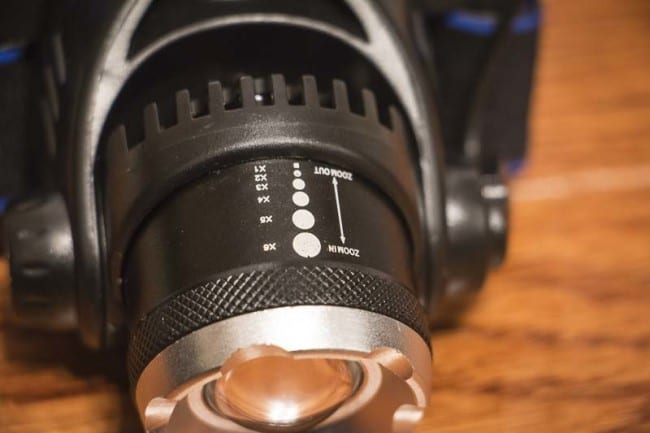
The single most distinguishing feature of the Maxxeon WorkStar 620 is its adjustable zoom lens, a mechanism more commonly found on handheld flashlights than on headlamps. The lens assembly slides forward and backward along the light head, changing the focus of the beam from a wide, uniform flood to a tight, long‑throw spot. At its widest setting, the beam produces a 1:1 ratio—a circle of light one foot in diameter at a distance of one foot from the lens. This is ideal for close‑up work, where the user needs to see a broad area without moving their head. An electrician working inside a panel can illuminate the entire interior with a single, even wash of light, without having to aim the beam at each individual component. At its tightest setting, the beam produces a 6:1 ratio—a circle of light only two inches in diameter at one foot, or one foot in diameter at six feet. This is the setting for distance work, for spotting a wire run across an attic, for identifying a leak in a dark mechanical room, for navigating an unlit construction site. The beam is adjustable between these two extremes, and the lens assembly moves smoothly, with just enough friction to hold its position. The mechanism feels robust, with no wobble, no gritty drag, and no tendency to shift on its own. The lens is protected by a durable plastic housing with a ribbed grip ring that is easy to operate even when wearing work gloves. The LED at the heart of the system is a 10‑watt Cree chip, a brand that has become synonymous with high‑efficiency, high‑output solid‑state lighting. Cree LEDs are used by many of the top flashlight and headlamp manufacturers, and they are known for their brightness, their color consistency, and their longevity. The chip in the WorkStar 620 is rated for tens of thousands of hours of operation, which means it is unlikely to ever need replacement during the useful life of the headlamp. The output lumens are rated as "out the front" (OTF) measurements, a testing method that yields slightly lower but more realistic numbers than the ANSI standard procedure. OTF measurements account for losses in the lens and reflector, giving the user a more accurate picture of the light that actually reaches the workpiece. The 600‑lumen high mode is genuinely bright—bright enough to be uncomfortable to look at directly—and it is more than sufficient for any task a professional is likely to perform while wearing a headlamp. The beam color is a cool white, which provides good contrast and color discrimination. The throw is remarkably clean for a zoomable optic, with no dark rings, no artifacts, and a well‑defined hotspot that transitions smoothly into the spill. This is not a light that will compete with a dedicated handheld thrower for extreme distances—it is a headlamp, after all—but for the ranges at which a headlamp is typically used, the beam quality is excellent.
Controls, Pivoting, and Everyday Usability
Operating the Maxxeon WorkStar 620 is refreshingly simple. There is a single pushbutton on the back of the battery holder, positioned where it can be reached easily with the right hand. Pressing the button cycles through the modes in a logical sequence: Low, Medium, High, Off. There is no strobe mode, no SOS mode, no hidden menu system to navigate. Just three brightness levels and off. The button is made of aluminum with a slight wobble—a minor manufacturing variance that does not affect function but is noticeable. It is responsive, with a positive click that provides tactile feedback, and it can be operated reliably while wearing gloves. The headlamp always starts in Low mode, a thoughtful feature that prevents the user from accidentally blinding themselves or others when turning the light on in a dark environment. If a higher brightness is needed, subsequent presses ramp up the output. The light head pivots between four detented positions, allowing the user to angle the beam from straight ahead down to directly in front of their feet. The detents are firm and hold the light in place during movement, but they are easy to override when a different angle is needed. I found that the most comfortable and useful position for general work was the second detent, which angled the light slightly downward, illuminating the area about three to six feet in front of me—the zone where most hand work occurs. The top position, pointing the light level with the eyes, was useful for walking and navigating, while the bottom position was ideal for close‑up inspection of a work surface directly below. The pivoting mechanism is integrated into the head design and does not add bulk or complexity. The entire headlamp, despite its substantial capabilities, is designed to be as compact as possible. The light head is not much larger than a typical flashlight head, and the battery holder is slim and contoured to fit the curve of the skull. The overall aesthetic is utilitarian—this is a tool, not a fashion accessory—but the black anodized aluminum and the ribbed plastic housing give it a professional, durable appearance. The build quality feels solid, with tight tolerances and no loose or rattling components. The headlamp is not rated for submersion, and Maxxeon does not provide an IP rating, but the seals on the battery compartment and the USB port are adequate to protect against the splashes, rain, and sweat that a professional headlamp will encounter in normal use. It is not designed for cave diving or for working in a downpour, but for the vast majority of professional applications, it is sufficiently weather‑resistant.
Real‑World Applications: The Technician, the Mechanic, and the Electrician
The Maxxeon WorkStar 620 is marketed primarily as a technician's headlamp, and that is an appropriate positioning. For the automotive technician who spends hours under a dashboard or inside an engine bay, the zoom lens is invaluable. Set it to flood mode, and the entire work area is bathed in even, shadow‑free light. Set it to spot mode, and a single bolt, a specific connector, or a hard‑to‑read part number is illuminated with surgical precision. The triple‑strap harness keeps the light stable even when the technician is lying on their back, looking up at the underside of a vehicle, or contorting into an awkward position to reach a hidden fastener. The 600‑lumen high mode is bright enough to overcome the ambient light in a well‑lit shop, ensuring that the technician can see what they are doing even when the overhead lights are washing out a less powerful headlamp. For the electrician working inside a residential or commercial panel, the zoom lens is equally useful. The flood mode lights up the entire interior of the panel, making it easy to trace circuits, identify wire colors, and check the tightness of connections. The spot mode can be used to focus on a specific breaker, a terminal screw, or a label. The headlamp eliminates the need to hold a flashlight in one hand while working with the other, which is a significant safety benefit when working around live electrical components. Both hands remain free for the task at hand, and the light follows the user's gaze automatically. For the plumber, the HVAC installer, the maintenance technician, or any professional who works in dark, confined spaces, the WorkStar 620 provides an immediate and obvious improvement over a handheld flashlight or a work light that must be positioned separately. The ability to recharge the batteries without removing them from the holder is a small but meaningful convenience that eliminates the annoyance of having to manage a separate battery charger. Simply plug the USB cable into the headlamp at the end of the shift, and it will be fully charged and ready for the next day by morning. The 18650 cells, as I have noted, are replaceable, and the cost of a spare set is low enough that keeping a backup on hand is a sensible precaution for professionals who cannot afford downtime. The headlamp is also an excellent choice for serious outdoor enthusiasts—hunters, anglers, campers, and hikers—who need a reliable, bright, hands‑free light that can run for hours on a single charge and can be adjusted to suit the task at hand.
What the WorkStar 620 Lacks—and Why It Does Not Matter
The Maxxeon WorkStar 620 does not have the highest lumen rating on the market. There are headlamps that produce 1,000, 2,000, even 3,000 lumens, and for certain extreme applications—cave exploration, search and rescue, night mountain biking—that kind of output is necessary. But for professional trade work, 600 lumens is more than sufficient, and the ability to zoom the beam means that those 600 lumens are used efficiently, concentrated where they are needed rather than wasted in spill light that the user cannot utilize. The headlamp does not have a built‑in charger for the cells; it relies on the external USB cable and the charging circuit in the battery holder. This means that the cells cannot be charged independently of the headlamp without a separate 18650 charger. This is a minor inconvenience for users who already own such a charger, but for most users it will not be an issue. The headlamp is not the lightest on the market, and users who prioritize absolute weight above all else may prefer a smaller, lower‑output model. But the weight of the WorkStar 620 is a direct consequence of its capabilities—the large battery, the metal light head, the zoom lens—and for the professional who needs those capabilities, the weight is a reasonable trade‑off. The price, at around $50, is competitive with other high‑output headlamps, and it is significantly less expensive than many premium models that offer comparable features. The replaceable battery is a cost‑saving feature over the life of the tool, because the user will not need to replace the entire headlamp when the battery eventually wears out. The aluminum button on the battery compartment does exhibit some wobble, which is a minor manufacturing variation that does not affect function but is worth noting for buyers who expect flawless fit and finish. The overall build quality, however, is solid, and the headlamp feels like a tool that will survive the drops, bumps, and general abuse of a professional job site.
Maxxeon WorkStar 620 Headlamp Specifications
| Specification | Detail |
|---|---|
| Model | Maxxeon MXN00620 |
| LED | 10W Cree (cool white) |
| Brightness (OTF) | Low: 150 lm / Medium: 300 lm / High: 600 lm |
| Run Time | Low: 8 hrs / Medium: 4 hrs / High: 2 hrs |
| Beam Ratio | 1:1 flood to 6:1 spot (adjustable zoom) |
| Battery | 2 x 18650 Li‑ion (2800 mAh, 3.7V), user‑replaceable |
| Recharge Time | ~4 hours (500 mA USB charger) |
| Weight | 11 ounces (approx.) |
| Head Strap | Triple‑strap (horizontal + over‑the‑top crown strap) |
| Hard Hat Compatible | Yes (includes 4 clips) |
| Pivoting Positions | 4 detented angles |
| Charging | Micro‑USB, covered port, AC adapter included |
| Warranty | 1 year against manufacturing defects |
| Price | ~$50 (retail) |
Conclusion: A Technician's Headlamp That Refuses to Compromise
The Maxxeon WorkStar 620 is not the headlamp for everyone. It is heavier than the minimalist models favored by ultralight backpackers, and it lacks the extreme lumen output of the specialized search‑and‑rescue tools. But for the professional who needs a reliable, bright, adjustable headlamp that can be worn comfortably for an entire shift, that can be recharged without removing the batteries, and that can be repaired rather than replaced when the cells eventually wear out, the WorkStar 620 is an outstanding choice. The triple‑strap harness solves the comfort problem that plagues heavy headlamps, and the zoom lens provides a level of versatility that fixed‑beam lights cannot match. The 18650 power source offers an ideal combination of run time, output, and long‑term cost, and the ability to swap cells in the field means that the light can run continuously if the user carries a spare set. The build quality is solid, the beam quality is excellent, and the user interface is refreshingly simple. At its price point, the WorkStar 620 competes with headlamps from better‑known brands and, in many respects, outperforms them. It is a tool designed by people who understand the demands of professional trade work, and it shows. Whether you are an automotive technician, an electrician, a plumber, an HVAC installer, a maintenance professional, or simply someone who demands more from a headlamp than the consumer‑grade models can deliver, the Maxxeon WorkStar 620 belongs on your head—or, better yet, on your hard hat, where it can do its best work, illuminating the dark corners of the job site with the steady, reliable brilliance of a tool that was built for exactly that purpose.
Comments 0
Leave a Comment