We already reviewed the Axis heated jacket following our heated jacket shootout, and I will not rehash the whole thing here. However, here is a brief summary from Chris Boll, PTR Editor: "From an objective standpoint, the Milwaukee Axis Heated Jacket performed consistently well, though it never ran away with the show. From a more subjective place, this jacket seems like the biggest crowd‑pleaser for our team. It can function as a middle or outer layer, it is comfortable as all get out, the battery is not terribly obtrusive, it gets warm fast and stays there. All things considered, it is easy to recommend the Milwaukee Axis to anyone looking to stay warm on the job site." That foundation—a heated jacket that is comfortable, effective, and unobtrusive—is the starting point for the layering system. The Axis on its own is a capable cold‑weather garment, but Milwaukee recognized that a single jacket cannot cover the full range of conditions that a professional encounters. A jacket that is warm enough for a 20‑degree morning is too warm for a 50‑degree afternoon. A jacket that is waterproof enough for a driving rain is too heavy and non‑breathable for a dry, cold day. The layering system addresses this by separating the functions—insulation, wind protection, water resistance, active heating—into distinct garments that can be combined or separated as the conditions dictate.
The HydroBreak Rain Shell: 10k Waterproofing, Seam‑Sealed Construction, and a Hood That Fits Over a Hard Hat
The Milwaukee HydroBreak rain shell is the outer layer I chose for my layering system, and it is the option that will appeal to professionals who are more likely to encounter rain, sleet, and wet snow than the extreme dry cold that the Gridiron shell is designed to combat. The HydroBreak is constructed from a RipStop polyester with a polyurethane laminate, giving the jacket a 10,000‑millimeter waterproofing rating. A 10k waterproof rating means that a column of water 10,000 millimeters—roughly 33 feet—tall can be placed on the fabric before water begins to seep through. This is a substantial level of waterproofing, sufficient to keep the wearer dry in moderate to heavy rain, and it is achieved not through a temporary spray‑on coating but through a laminate that is bonded to the back of the face fabric. The laminate is a continuous, non‑porous membrane that blocks liquid water from passing through while still allowing water vapor—sweat—to escape, though the breathability of a laminate is inherently lower than that of an uncoated fabric. The trade‑off for the high waterproof rating is that the wearer must manage moisture from the inside, which is why the HydroBreak includes ventilation features such as pit zips—zippers under the arms that can be opened to allow air to flow directly into the jacket and carry away excess heat and moisture.
The construction of the HydroBreak is similar in approach to the rain gear I rely on from Grundens or Carhartt. It is primarily double‑stitched, with single stitching in some of the lower‑wear areas like the hood connection and the zipper flap. I would always love to have double‑stitching all the way around, but I do not see anything that causes me concern with this build. On the inside of the jacket, there is additional waterproofing covering every single one of the seams, ensuring no water creeps in through the threads. Seam taping is the critical step that separates a genuinely waterproof garment from one that is merely water‑resistant. A garment can be made from the most waterproof fabric in the world, but if the seams—the lines of needle holes where the pieces of fabric are joined—are not sealed, water will eventually find its way through those holes. The tape is a thin, waterproof strip that is heat‑bonded to the inside of every seam, covering the stitching and the needle holes and creating a continuous, impermeable barrier that spans the entire garment.
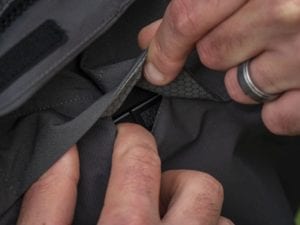
The HydroBreak shell includes three pockets for storage. Two lower front pockets have storm flaps and Velcro closures to keep the rain out when your hands are not in them. The upper left chest has a zippered side entry pocket and conceals a pass‑through hole to access the temperature controls on the Axis jacket. This pass‑through is a small but significant design element that speaks to the intentionality of the layering system. When the HydroBreak shell is worn over the Axis jacket, the Axis's temperature control button is hidden beneath the rain shell. To adjust the heat, the wearer would normally have to unzip the shell, reach inside, and fumble for the button—a process that is inconvenient at best and, in a downpour, exposes the inner jacket to rain. The pass‑through solves this problem by providing a direct, weather‑protected opening through which the wearer can access the Axis's controls without opening the shell. It is a feature that would not exist if the HydroBreak were merely a generic raincoat, and it is evidence of the engineering thought that went into designing the system as a system.
The hood on the HydroBreak is sized to accommodate a hard hat—a non‑negotiable requirement for any rain gear that will be worn on a construction site. OSHA regulations require hard hats on most job sites, and a rain jacket that cannot be worn over a hard hat forces the wearer to choose between staying dry and staying safe—a choice that no professional should have to make. The HydroBreak hood is generous without being excessively roomy, and the front Velcro closure can be adjusted to snug the hood around the face when a hard hat is not being worn. The one potential downside is that the front Velcro closure rides up too close to my chin to close when I am wearing a hard hat. The extended tail of the HydroBreak is another feature that speaks to the realities of working in the rain. The jacket drops approximately 8 inches below the top of the belt, providing coverage for the lower back and the waistline even when the wearer is bending, reaching, or kneeling. This extra length prevents the common experience of rain running down the back of the jacket and soaking the waistband of the pants—a small but persistent misery that anyone who has worked outdoors in the rain knows well.
Wearing the System: Comfort, Mobility, and the Absence of Bulk
The Axis heated jacket has a ripstop polyester outer with a softer quilted pattern than most heated jackets. That makes it perfect for layering over, since the additional layer slides easily over the sleeves and slips down around it well. As a layered system, the Axis with HydroBreak is very comfortable to wear and highly moveable. Neither jacket bunches up as I move through my full range of motion. The only issue I came across is that when I reach overhead, the sleeves expose several inches of my wrists. The choice comes down to that or having the jacket raise up when I have the Velcro cuffs tighter. While that is not uncommon with jackets in general, I seem to expose more wrist than my other jackets. One of the things I really like about the rain shell is that it has an extended tail. Even when I reach overhead, it keeps my waistline covered.
Considering this is a jacket for the job site, it is important that you can wear a hard hat under the hood without any issues. Milwaukee does a great job here, covering your hard hat and still leaving enough frontal exposure that you do not cover up your headlamp. I am pleased with how bulky this system is not. With both jackets on, it is still less bulky than my go‑to winter jacket and pretty similar to what I wear when temps are in the 40s. When there is no threat of rain, there is even less bulk and more than enough heat from the Axis on its own.
If you already have the Axis heated jacket, you can grab the HydroBreak shell for $99. Just be sure to order the same size for the correct fit. As a combo kit, the Axis with HydroBreak is $269. If you are thinking the Gridiron combo is more your style—with its 60‑gram body and 40‑gram sleeve insulation paired with a Gridiron ripstop polyester outer—it is $299. There is no option for just the Gridiron outer shell that I have seen. The Axis heated jacket is excellent on its own, and the Milwaukee Axis Heated Jacket Layering System makes it even better. Buy it with the HydroShell package when moisture protection is your highest priority. Go with the Gridiron package if you need additional insulation on top of active heating to push through the worst Jack Frost has to throw at you.
Milwaukee Axis Heated Jacket Layering System Specifications
| Component | Specification |
|---|---|
| Axis Heated Jacket | Ripstop polyester outer, brushed tricot inner, M12 battery, 3 heat zones (chest, back, shoulders), 3 settings, washer/dryer safe, 1‑year warranty |
| Axis Jacket Price | $169 bare / $199 kit |
| HydroBreak Shell | Ripstop polyester with polyurethane laminate, 10k mm waterproofing, seam‑sealed, 3 pockets, hard‑hat‑compatible hood, extended tail |
| HydroBreak Shell Price | $99 shell only / $269 combo kit with Axis |
| Gridiron Shell | Gridiron ripstop polyester outer, 60G body / 40G sleeve insulation, 4 pockets |
| Gridiron Combo Price | $299 (Axis jacket + Gridiron shell) |
Comments 0
Leave a Comment