Materials and Design Philosophy: A Knife That Refuses to Apologize
The first thing to understand about the Milwaukee Fastback Camo is that it was not designed to compete with the Zero Tolerances and Spydercos of the world on their own terms. It was designed to work. The blade is made from stainless steel—Milwaukee uses a proprietary blend, so we cannot compare it directly on the Rockwell hardness scale or discuss its exact edge retention relative to known quantities like 8Cr13MoV or AUS‑8. This would normally frustrate me. I like data. I like being able to say with confidence that a given steel will hold an edge for approximately X number of cardboard cuts before requiring a touch‑up. But the more I used the Fastback Camo, the less I cared about the specs. Here is why: at $25, this knife is almost a consumable. It is priced so that if you lose it, break it, or loan it to an apprentice who never returns it, the financial sting is minimal. You can buy three of these for the price of a single Spyderco Tenacious. You can buy six for the price of a Benchmade Griptilian. At that price point, the steel's exact composition becomes less important than whether the knife is sharp out of the box (it is), whether it cuts what you need it to cut (it does), and whether it holds up under the kind of abuse that would make you cringe if you were carrying a $200 folder (it mostly does). The Milwaukee Fastback Camo is not a piece of art that is afraid to get dirty. It is a tool, in the most honest sense of the word.
Handle Design: Realtree Camo, Gentle Curves, and a Grip That Needs More Texture
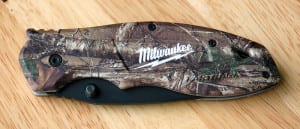
The handle of the Fastback Camo is wrapped in Realtree camouflage, a pattern that will be instantly familiar to hunters and outdoor enthusiasts. I love the look of it. Against the black oxide blade, the camo pattern creates a visual contrast that is both rugged and appealing. The gentle curves of the handle back fit comfortably in my palm, and with the blade deployed, the front of the handle accommodates a forward grip exceptionally well. This is a solid, ergonomic design that many brands have used successfully, and Milwaukee has executed it competently. The handle material—likely a G‑10 or glass‑filled nylon composite over stainless steel liners—feels durable and resistant to the chemicals and moisture common on job sites. The jimping on the handle spine and along the liner lock provides additional grip reference points for the thumb and index finger. However, the overall texture of the handle is on the slick side. The camo pattern adds some visual grip but not much tactile grip, and the smooth surface of the material can become slippery when wet or when hands are sweaty. This is the knife's most significant ergonomic shortcoming. For dry‑handed use in an office or workshop, the grip is adequate. For outdoor use in humidity, rain, or when wearing gloves, the handle could benefit from more aggressive texturing or a rubberized overmold. It is a compromise that is acceptable at $25 but worth noting for those whose work environments involve moisture.
Blade Design: Tanto, Partially Serrated, and Built to Take Abuse
The Fastback Camo features a tanto‑style blade with a partially serrated edge. The tanto profile is characterized by a strong, reinforced tip created by angling the belly upward to meet the spine at a secondary point. This tip geometry is significantly stronger than a traditional drop‑point or clip‑point tip, and it resists snapping or deforming when subjected to lateral force—exactly the kind of force a blade might encounter when used to pry, poke, or penetrate tough materials on a job site. The partial serrations occupy roughly the rear third of the cutting edge, closest to the handle, while the forward two‑thirds is a plain edge. This configuration is a perennial subject of debate among knife enthusiasts, with advocates praising its versatility and detractors arguing that it compromises both functions. For the intended use of the Fastback Camo—cutting rope, strapping, rubber hose, insulation, and the thousand other materials a tradesperson encounters—the serrations are genuinely useful. They bite into fibrous materials that would resist a plain edge and allow a sawing action that speeds up cutting. The plain edge handles the majority of everyday slicing tasks efficiently. It is a practical, work‑oriented design that prioritizes capability over aesthetics.
Deployment: Spring‑Assisted, Strong, and Confident—If Not Particularly Smooth
The Fastback Camo is spring‑assisted, deploying via dual thumb studs that actuate a torsion bar mechanism. Compared to the refined SpeedSafe systems on Kershaw knives or the bearing‑smooth action of higher‑end folders, the Milwaukee's deployment is less polished. There is a slight roughness to the initial movement, a slight grittiness that suggests the pivot is not as precisely tuned as it could be. But—and this is a significant but—the action is strong and confident. The spring provides a forceful, authoritative snap that drives the blade into lockup every single time. Even if the pivot becomes contaminated with jobsite debris—sawdust, drywall powder, pocket lint—the strong spring is likely to overcome the added friction and still deploy the blade. For a knife that is expected to work in dirty, dusty, and demanding environments, this robustness is arguably more valuable than the glassy smoothness of a bearing pivot that might bind up when contaminated. The thumb studs are positioned symmetrically for ambidextrous operation, and they provide adequate purchase even when wearing light gloves. The liner lock engages the blade tang securely, with no tendency to slip or disengage under moderate spine pressure. It is not the most refined locking mechanism, but it is functional and reliable.
The Belt Clip: Wire‑Form, Reversible, and On the Weak Side
The pocket clip is a wire‑form design that can be moved from its original tip‑down carry position to a tip‑up position. It is not, however, reversible for left‑hand carry. The wire‑form clip is a matter of personal preference—some users appreciate its springy flexibility and deep‑carry potential, while others find it too weak to hold securely. I fall into the latter camp. The clip on the Fastback Camo held the knife in my pocket during normal daily activities, but it bent outward more easily than I would like. I have a habit of catching my knife clips on table corners, wall corners, banisters, and virtually anything else I walk too close to. The Fastback Camo's clip required re‑bending more frequently than most of my other knives. It is a minor annoyance that does not affect the knife's cutting performance but does affect the overall ownership experience. A sturdier clip—perhaps a stamped steel design rather than a wire form—would be a welcome improvement in a future iteration.
Who Should Buy the Milwaukee Fastback Camo?
The Fastback Camo is not the knife you buy to impress your friends at a knife meetup. It is not the knife you carry to a formal event or to a business meeting where appearances matter. It is the knife you buy to use hard—to carry on a job site, in an auto shop, in a hunting blind, on a fishing boat, or in any environment where a $200 knife would be at risk of damage or loss. It is the knife you reach for when your pretty knives do not want to get dirty. The blade design is versatile and tough, the handle is comfortable (if slightly slick), the deployment is strong and reliable, and the price is so low that you will not hesitate to use the knife as intended. Milwaukee backs it with a limited lifetime warranty, which adds a layer of confidence. For $25, the Fastback Camo is essentially a consumable tool—buy two, keep one in the truck and one in the toolbox. When it finally gives up after years of hard service, you have gotten your money's worth many times over. It is not a knife that will ever occupy a place of honor in a display case. It is a knife that will live in a pocket, a pouch, or a glove box, always ready to cut, pry, scrape, and slice. And for that, it deserves respect.
Conclusion: A Working Knife That Knows Its Place
The Milwaukee Fastback Camo Spring‑Assisted Knife is a tool that understands its audience. It does not try to be a gentleman's folder or a tactical showpiece. It does not make excuses for its mid‑grade materials or its slightly gritty deployment. It simply works. The blade is sharp, the lock is secure, the handle fits the hand, and the price is so accessible that it removes all anxiety about using the knife as hard as the job demands. For the professional tradesperson, the outdoor enthusiast, or anyone who needs a reliable cutting tool that can take a beating and keep cutting, the Fastback Camo is an easy recommendation. It will not replace the high‑end knives in your collection, but it will sit alongside them as the beater that you are never afraid to use. And sometimes, that is exactly what you need.
Comments 0
Leave a Comment