Design and Versatility: A Rotating Clip, Dual Magnets, and Five LED Chips
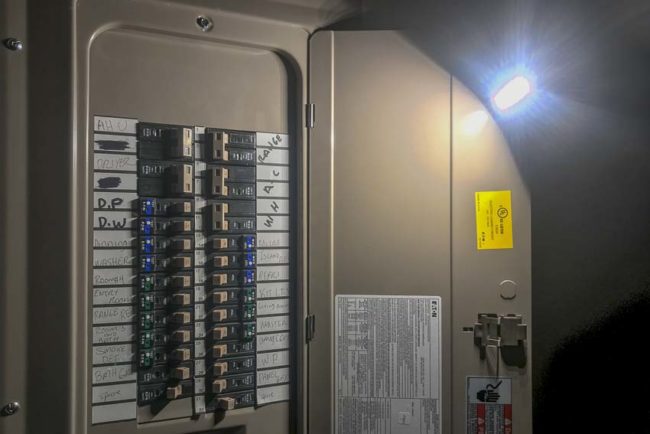
The Milwaukee 2108 is built around a slender, rectangular body that is approximately 5.4 inches long, less than an inch wide, and about three‑quarters of an inch thick. It is small enough to fit in a standard pants pocket, a tool pouch, or the palm of a hand. The body is made from Milwaukee's typical high‑impact, glass‑reinforced polymer, with a matte finish that resists scratches and a slight texture that provides grip. The five LED chips are arranged in a row behind a protective lens, and they are designed to cast a broad, even flood of light rather than a focused spot. The beam is wide—roughly five feet across at a distance of one foot from the light—which makes it ideal for illuminating a close‑range work area, such as the inside of a cabinet, the back of an electrical panel, or the under‑hood area of a vehicle. The defining physical feature of the 2108 is the rotating metal clip that wraps around the body of the light. The clip serves multiple functions. In its primary orientation, it is a pocket clip, allowing the light to be attached to a belt, a tool pouch, or a shirt pocket. But the clip can be rotated around the body, and in its alternate position, it functions as a base that props the light at an angle—either a slight upward tilt for illuminating a vertical work surface, or a straight‑up orientation for casting light directly forward. The clip also houses a pair of magnets—one on the clip itself, one on the battery cap—that allow the light to be stuck to any ferrous metal surface. The magnets are strong enough to hold the light securely on a steel panel, a duct, a conduit, or a metal stud, in any orientation. The combination of the rotating clip, the magnets, and the compact size gives the 2108 a level of positional versatility that is genuinely useful. Stick it to the side of a panel, and the light shines sideways across the work area. Stick it to the underside of a steel shelf, and the light shines downward. Clip it to a belt, and the light illuminates the path ahead. Prop it on a workbench with the clip as a base, and the light illuminates the work surface. There is even a small hole in the clip that can be used to hang the light from a finish nail, providing an overhead illumination option when no steel surface is available.
Performance: 300 Lumens, AA Batteries, and a Clean, Wide Beam
The 2108 produces 300 lumens on its High setting and 100 lumens on Low. These figures are modest by modern standards—there are pocket‑sized lights that produce 1,000 lumens or more—but for the intended application, which is close‑range task lighting in small, dark spaces, 300 lumens is more than adequate. The light is designed to be positioned within a foot or two of the work surface, and at that distance, 300 lumens provides bright, clear, shadow‑free illumination. The High mode is governed by a timed step‑down: after a few minutes of continuous operation, the light will reduce output to prevent overheating and extend battery life. This is a common feature on compact, high‑output lights, and it is a sensible engineering choice. The Low mode of 100 lumens provides extended run time—approximately 16 hours on a pair of fresh AA alkaline batteries—and is suitable for safety lighting, for navigating a dark space, or for tasks that do not require maximum brightness. The beam quality is excellent. The five LED chips, arranged behind a diffusing lens, produce a smooth, even flood of light with no visible hot spots, no dark rings, and no color fringing. Milwaukee's TrueView technology ensures that the color temperature is a neutral white, approximately 5000K, which renders colors accurately and does not create the eye strain or color confusion that can result from working under light with a strong blue or yellow cast. The light is flicker‑free at both brightness settings. The power button is located on the side of the body, near the top, and it cycles through High, Low, and Off with each press. The button is large enough to operate with gloved hands, and it provides a positive click. The battery compartment is accessed via a screw‑cap at the base of the light, which takes about an eighth of a turn to open. The cap is sealed with an O‑ring, contributing to the light's IP54 rating for dust and water resistance. One minor complaint: the cap can be accidentally opened with a slight twist, because the rotation required is so small. I would prefer a bit more security—perhaps a quarter‑turn or a half‑turn—to prevent inadvertent opening. The light carries Milwaukee's limited lifetime warranty on the light and the LEDs, which is a strong statement of confidence in the product's durability.
AA vs. Rechargeable: The Battery Trade‑Off Explained
The single most significant difference between the 2108 and its rechargeable sibling, the 2112 Rover Personal Flood Light, is the power source. The 2112 uses a RedLithium USB lithium‑ion battery that is rechargeable via a micro‑USB port on the light itself. It produces up to 445 lumens on High—significantly more than the 2108's 300 lumens—and has a similar run time on High. The 2112 costs approximately $60, roughly twice the price of the 2108. The 2108, by contrast, uses two AA batteries—either alkaline, lithium primary, or rechargeable NiMH. It produces 300 lumens on High and has a longer run time on Low (16 hours versus the 2112's 11 hours). The cost of the 2108 is lower, but the user will need to purchase replacement batteries over the life of the light. The choice between the two models depends on the user's priorities. For the professional who uses the light heavily, on a daily basis, the rechargeable 2112 is the better long‑term value. The higher initial cost is offset by the elimination of battery purchases, and the higher output on High is a meaningful advantage. For the occasional user, the homeowner, or the professional who keeps the light as a backup in a tool bag and uses it only sporadically, the 2108 makes more sense. The lower upfront cost is appealing, and the long shelf life of AA batteries means the light will always be ready when it is needed, even if it has been sitting unused for months. The AA format also provides the flexibility to use readily available alkaline batteries in a pinch, which can be critical in remote locations or during extended power outages where recharging is not an option.
Milwaukee Rover Magnetic Flood Light 2108 Specifications
| Specification | Detail |
|---|---|
| Model | Milwaukee 2108 |
| Lumen Output | High: 300 lm; Low: 100 lm |
| Run Time | High: ~5 hrs; Low: ~16 hrs |
| Power Source | 2 x AA (included) |
| Beam Type | Wide flood |
| Mounting | Rotating clip/base, dual magnets, hanging hole |
| IP Rating | IP54 |
| Drop Rating | 12 feet (4 meters) |
| Length | 5.39 inches |
| Weight | 0.14 lbs |
| Warranty | Limited Lifetime (light and LEDs) |
| Price | ~$24 |
Conclusion: Affordable, Versatile, and Genuinely Useful
The Milwaukee Rover Magnetic Flood Light 2108 is a well‑designed, well‑built personal work light that punches above its price. It is not the brightest light in its class, and the use of AA batteries means the user will incur ongoing battery replacement costs over the life of the tool. But for the professional who wants a compact, versatile, and affordable light that can be clipped, stuck, hung, or propped in a variety of positions, the 2108 is an excellent choice. The beam quality is superb, with a smooth, even flood and accurate color rendering. The rotating clip, the dual magnets, and the hanging hole provide a level of positional flexibility that is rare at this price point. The IP54 rating and the 12‑foot drop protection ensure that the light will survive the rigors of the job site. And Milwaukee's limited lifetime warranty provides assurance that the light will be repaired or replaced if it fails due to a manufacturing defect. At around $24, the 2108 is inexpensive enough to be an impulse purchase, and useful enough to become a permanent part of a professional's tool kit.
Comments 0
Leave a Comment