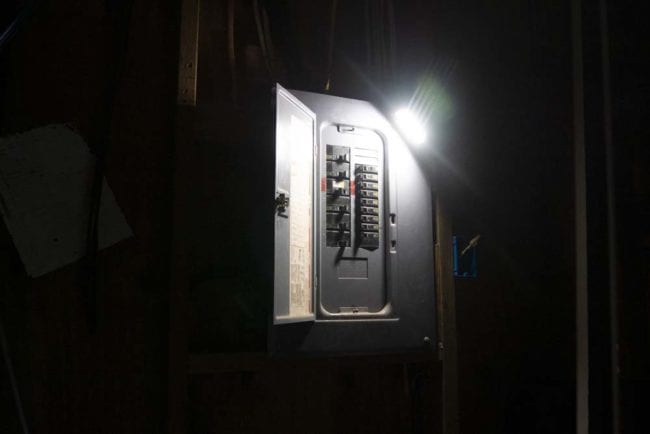
The first thing to understand about the Rover 2114 is that it is not trying to compete with the larger, higher‑output lights in Milwaukee's M18 and M12 lineups. This is not an area light, a task light, or a stand light. It is a personal light—small enough to fit in a pocket, light enough to clip to a shirt collar, and modest enough in its output that it is intended to be used within arm's reach of the work. The three brightness settings—550 lumens on High, 250 lumens on Medium, and 100 lumens on Low—are adequate for illuminating a single work area, such as the inside of an electrical panel, the space under a sink, the engine bay of a vehicle, or the shadowed corner of a crawl space. The beam is a broad flood, not a tight spot, which means the light is evenly distributed across the work area without the harsh central hot spot that can make it difficult to see detail. Milwaukee's TrueView technology, which is present across the entire RedLithium USB line, ensures that the color temperature of the light is a neutral white that renders colors accurately. For the electrician who needs to distinguish red, black, blue, and green wires, or the HVAC technician who is reading the faded label on a capacitor, the accurate color rendering is not a luxury but a necessity. The beam is free of artifacts, with no dark rings, no color fringing, and a consistently even brightness across the entire illuminated area. The sidespill—the light that escapes the main beam and illuminates the periphery—maintains the same color temperature as the center of the beam, which is a mark of quality that many lesser lights fail to achieve. Often, cheaper LED work lights will have a cool white center and a yellow or blue fringe, which can be distracting and can make it difficult to perceive colors accurately at the edges of the beam. The Rover has no such issues. It is a clean, well‑engineered light, and the quality of the beam is immediately apparent the first time you turn it on.
The Pivoting Head: 120 Degrees of Positional Versatility
The defining physical feature of the Rover is its pivoting head. The light is roughly rectangular, about five and a half inches long, less than an inch thick, and less than an inch wide—similar in size and shape to a small pocket flashlight. Near the top of the body, a hinge allows the head to rotate through an arc of approximately 120 degrees, from a position where the LED panel faces straight forward—like a conventional flashlight—to a position where it faces nearly straight down, perpendicular to the body. The hinge is firm, with enough resistance to hold the head in any position within its range, but smooth enough to adjust with one hand. There are no detents, no clicks, no preset positions. The continuous adjustment means the user can dial in exactly the angle they need, whether that is a slight upward tilt to illuminate the inside of a cabinet, a 90‑degree bend to cast light across a workbench, or a full downward angle to beam into a dark opening. The pivoting head, combined with the magnetic base and the integrated carabiner, gives the Rover a level of positional versatility that is rare in a light of this size. The magnetic base is strong, with a pair of rare‑earth magnets embedded in the bottom edge of the body. It will hold the light securely against any ferrous metal surface—the side of a breaker panel, a steel door frame, a duct, a conduit, the frame of a vehicle—in any orientation. Stick it to the side of a panel, pivot the head to face into the enclosure, and both hands are free to work. The magnets are strong enough to hold the light against vibration, bumps, and the occasional accidental nudge, but the light is still easy to remove when you are ready to reposition it. The integrated carabiner, which is molded into the top of the body, clips securely onto a belt loop, a tool bag strap, a backpack, or a MOLLE webbing loop. It is not a spring‑loaded, climbing‑grade carabiner—it is a molded plastic clip—but it is sturdy enough for daily use, and it has a small notch in the top that allows the light to be hung from a nail, a screw, or a piece of wire. When hung from this notch, the light is balanced at its center of gravity, so it hangs straight and the beam can be directed downward for overhead illumination. This hanging feature is surprisingly useful—it is not something you notice until you find yourself in a space where there is no flat surface to set the light on and no steel to stick it to, but a convenient nail or a wire loop gives you a hanging point. The light can also be placed on any flat surface and will sit stably on its base, casting light forward or upward depending on the pivot angle. For low‑angle work, the light can be laid on its back with the head pivoted upward, creating an uplight that illuminates a vertical surface.
Power and Run Time: The RedLithium USB Battery and the Micro‑USB Port
The Rover is powered by Milwaukee's RedLithium USB battery, a single‑cell lithium‑ion pack that is shared across the entire RedLithium USB family. The battery is user‑replaceable—it slides into a compartment at the base of the light and is held in place by a hinged door—and it is rechargeable via a micro‑USB port located on the side of the light. The light can be charged while the battery is installed, using the included USB cable and wall adapter, or the battery can be removed and charged in Milwaukee's standalone RedLithium USB charger. The battery compartment door is sealed with a rubber gasket, contributing to the light's IP54 rating for dust and water resistance. The run times, tested to Milwaukee's published specifications, are approximately 2 hours on High, 4.5 hours on Medium, and 11.5 hours on Low. These are not class‑leading run times—they are adequate, not exceptional—and they reflect the inherent limitation of a light that draws its power from a single, relatively small lithium‑ion cell. The trade‑off is the light's compact size and light weight. A larger battery would require a larger housing, and the Rover would lose the pocketability that is one of its primary attractions. For the professional who uses the light intermittently throughout the day—a few minutes here, a few minutes there—the run time on High is sufficient, and the Medium and Low settings provide extended endurance for tasks that do not require maximum brightness. If you anticipate needing the light on High for extended periods, a spare RedLithium USB battery or a battery/charger starter kit is a sensible investment. The battery indicator system is straightforward and intuitive. When the light is first turned on, a small LED near the power button briefly glows green, yellow, or red to indicate the remaining charge. Green means the battery is above approximately 50 percent. Yellow means it is between 10 and 50 percent. Red means it is below 10 percent and will need recharging soon. The indicator is visible only briefly, but it provides enough information to let the user know whether they can count on the light for the next few hours. The power button itself cycles through the three brightness modes—High, Medium, Low, Off—with each press. There is no strobe mode, no SOS mode, no hidden shortcuts to memorize. The interface is simple and robust, designed to be operated with gloved hands and without looking at the light.
Build Quality and Durability: Tool Grade, Not Tactical Grade
The Rover is built from the same high‑impact, glass‑reinforced polymer that Milwaukee uses for its power tool housings. It is not the cool, sleek aluminum of a high‑end tactical flashlight, and it does not pretend to be. It is a tool, designed to be dropped, scraped, splashed, and generally abused, and it is built to survive that treatment. The housing is molded with a slightly textured surface that provides grip without being abrasive. The lens is recessed behind a protective lip that prevents it from being scratched when the light is set face‑down. The pivot hinge is robust and does not feel like it will loosen or wear over time. The carabiner clip, while not as strong as a metal clip, is integrated into the housing in a way that distributes stress and resists breakage. The battery compartment door fits tightly, sealed with a rubber gasket, and it closes with a satisfying click. The overall construction is consistent with Milwaukee's reputation for building tools that survive on the job site. The light carries an IP54 rating, which means it is protected against dust ingress that could interfere with operation and against splashing water from any direction. It is not submersible, and it should not be used in heavy rain for extended periods, but it will handle the dust, the occasional splash, and the damp conditions that are common on a construction site. The light has been drop‑tested to survive falls from a reasonable height—Milwaukee does not specify an exact drop rating for this model, but the RedLithium USB series generally withstands drops of 4 to 6 feet onto concrete without damage. In my use, the Rover has been dropped, knocked over, splashed with water, and covered in sawdust, and it continues to function perfectly.
Real‑World Use: The Specialist That Earns Its Keep in Tight Spaces
I tested the Rover in a variety of professional and personal settings, and it became clear that its optimal role is as a close‑range task light in confined spaces. For an electrician working inside a residential breaker panel, the Rover could be stuck to the steel enclosure, pivoted to face into the wiring, and set to Medium brightness—bright enough to see the details of every wire and terminal, but not so bright that it created glare off the copper bus bars. The magnetic base held the light securely even when the panel door was bumped, and the pivoting head allowed me to reposition the beam as I moved from one section of the panel to another without un‑sticking the base. For a plumber working under a kitchen sink, the Rover was clipped to a nearby pipe via the carabiner, with the head pivoted downward to illuminate the area around the trap and the supply lines. The light was easy to reposition, and it did not get in the way of the work. For an automotive technician working under the hood, the Rover was stuck to the underside of the raised hood—assuming a steel hood—and pivoted to face down into the engine bay. The broad beam provided good general illumination, and the Medium setting was bright enough to see the details of connectors, hoses, and fasteners. For camping and outdoor use, the Rover served as a compact, lightweight area light for the tent, the picnic table, and the path to the latrine. The long run time on Low—over 11 hours—meant it could be left on all night as a low‑level safety light without exhausting the battery. The carabiner clipped to the tent loop, and the pivoting head allowed the light to be directed wherever it was needed. The one area where the Rover did not excel was in long‑distance illumination. It is not a searchlight, and it is not designed for outdoor navigation at distances beyond a few dozen feet. The broad beam, so useful at close range, disperses too quickly to be effective at throwing light a long distance. For that application, a dedicated spotlight or a high‑output handheld flashlight is the better choice. But within its intended range—the arm's‑reach workspace, the dark corner, the confined enclosure—the Rover is exactly the light you want.
Milwaukee Rover Pivoting Flood Light 2114 Specifications
| Specification | Detail |
|---|---|
| Model | Milwaukee 2114‑21 |
| Lumen Output | 550 / 250 / 100 lumens |
| Run Time | ~2 hrs / ~4.5 hrs / ~11.5 hrs |
| Pivot Range | ~120° continuous |
| Mounting | Magnetic base, integrated carabiner, hanging notch, freestanding |
| Battery | RedLithium USB (included, user‑replaceable) |
| Recharging | Micro‑USB port (on‑board), AC wall adapter included |
| IP Rating | IP54 |
| Length | 5.39 inches |
| Weight | 0.14 lbs |
| Warranty | Limited Lifetime (light and LEDs), 2 years (battery) |
| Price | $69 (kit with battery and charger) |
Conclusion: A Specialized Light That Becomes Indispensable
The Milwaukee Rover Pivoting Flood Light is not the light you buy to illuminate a room, to search a field, or to signal for help. It is the light you buy to clip to your tool bag, to stick to a panel, to hang from a pipe, and to pivot into just the right angle to see what you are doing. It is a specialist, and in its specialty—close‑range, hands‑free illumination in tight, dark, confined spaces—it is among the best in its class. The combination of the pivoting head, the magnetic base, the carabiner clip, and the balanced hanging notch gives it a positional versatility that is unmatched by most lights of its size. The TrueView color accuracy, the artifact‑free beam, and the three brightness settings ensure that the light is comfortable to use and effective at revealing detail. The RedLithium USB battery system provides the convenience of rechargeability with the flexibility of user‑replaceable cells, and the IP54 rating provides confidence that the light will survive the dust and moisture of the job site. The run time on High is relatively short, and the light is not bright enough to serve as a primary area light for large spaces—but those are not the applications for which it was designed. For the professional who works in small, dark spaces, who needs a light that can be positioned and repositioned quickly, and who values the quality of the illumination as much as the quantity, the Rover Pivoting Flood Light is an indispensable tool. It is the kind of light that, once you have carried it for a week, you will wonder how you ever worked without it.
Comments 0
Leave a Comment