If you've been following Dewalt and Milwaukee closely over the past couple of years, you've noticed the performance claims getting bolder. More runtime. More power under load. Better thermal management. These aren't just marketing assertions - they're the measurable results of a fundamental change in how the cells inside these batteries are designed and manufactured. Understanding what's actually changed, and why it matters, is worth the time for anyone who depends on cordless tools professionally.
What Are Tabless Cells, and Why Do They Matter ?
To understand tabless technology, it helps to understand what it replaced. Traditional lithium-ion battery cells - the kind that have powered cordless tools for the past two decades - use metal tabs to connect the electrode layers inside the cell to the external terminals. These tabs are small metal strips that conduct electricity between the cell's internal chemistry and the outside world.The tab design works, but it has inherent limitations. Tabs create points of resistance in the electrical path, which generates heat. That heat has to go somewhere, and in a high-drain application like a power tool under load, thermal management becomes a genuine engineering challenge. Excessive heat degrades battery chemistry over time, reduces performance during demanding tasks, and ultimately shortens the useful life of the pack.
Tabless cells eliminate this bottleneck through a fundamental redesign of the cell's internal architecture. Rather than conducting electricity through small metal tabs, tabless cells use the full surface area of the electrode as the conduction path. The result is a dramatically shorter electrical pathway, significantly reduced internal resistance, and - critically - far more efficient heat dissipation across the entire cell rather than concentrated at tab connection points.
The performance implications of this change cascade through everything the battery does. More power density means more energy packed into the same physical space. Better thermal management means consistent performance even under sustained heavy loads. Extended runtime means more work completed between charges. These aren't marginal improvements - they represent a meaningful step change in what battery technology can deliver.
Dewalt's Approach : The PowerStack
Dewalt's entry into tabless cell technology came through the PowerStack platform - a series of compact battery packs that use pouch-format tabless cells rather than the traditional cylindrical cell format that has dominated cordless tool batteries for years.The pouch cell format is itself worth understanding. Cylindrical cells - the familiar tube-shaped cells used in most cordless tool batteries - have served the industry well, but their geometry creates inherent inefficiencies in how they pack together. Pouch cells are flat and flexible, allowing them to be stacked in configurations that make better use of available space and create more surface area for thermal management.
Combine the pouch format with tabless architecture, and you get a battery that punches significantly above its weight class in terms of power delivery. The PowerStack compact packs deliver performance that previously required much larger, heavier batteries - a development that matters enormously for tool balance, user fatigue, and the viability of compact tool configurations for professional use.
Dewalt has been deliberate about integrating PowerStack technology across its 20V MAX platform, ensuring that the benefits of tabless cells are accessible across the full range of professional tools rather than siloed in a premium sub-platform.
Milwaukee's Approach : The FORGE Platform
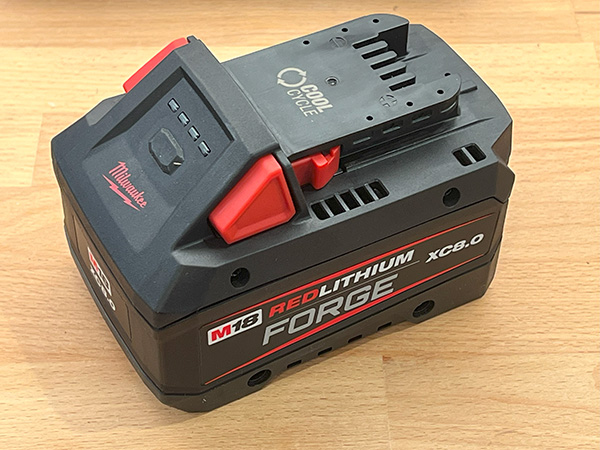
Milwaukee's tabless technology arrived through the FORGE battery platform, with the 8Ah FORGE pack representing the flagship expression of what the technology can deliver. Where Dewalt's PowerStack emphasized compact form factor as a primary selling point, Milwaukee's FORGE platform led with outright performance - specifically, the ability to maintain high power output under sustained load without the thermal throttling that limits conventional batteries.The FORGE 8Ah pack is a substantial battery by any measure, but its performance under demanding conditions is what sets it apart. Tasks that would cause conventional high-capacity packs to throttle back - sustained cuts through dense hardwood, extended concrete drilling, repeated high-torque fastening - are handled by the FORGE with a consistency that reflects the thermal advantages of tabless cell architecture.
For professional users whose work involves sustained high-demand applications, that consistency isn't just a convenience - it's a productivity multiplier. A battery that maintains its performance curve through an entire charge cycle completes more work per charge than one that throttles under load, even if their nominal specifications look similar on paper.
The Broader Industry Context : Bosch and Beyond
Dewalt and Milwaukee are the most visible adopters of tabless technology in the North American professional tool market, but they're not operating in isolation. Bosch has been pioneering tabless cell technology in global markets, with implementations across its professional tool platforms that have demonstrated the technology's viability at scale.The fact that multiple major manufacturers are independently converging on tabless cell architecture is significant. It's not a single company betting on an unproven technology - it's an industry-wide recognition that the fundamental limitations of tabbed cell design have been solved, and that tabless architecture represents the direction forward for high-performance battery technology.
As Makita, Ridgid, Metabo, and other major platforms begin their own tabless implementations, the technology will transition from a competitive differentiator to an industry standard. The question for each manufacturer is not whether to adopt tabless cells, but how quickly they can integrate the technology across their platforms while managing the supply chain and manufacturing complexities involved.
The Investment Reality : What Tabless Technology Actually Costs
Premium performance comes at a premium price, and tabless battery platforms are no exception. Both the Dewalt PowerStack and Milwaukee FORGE packs command significant price premiums over conventional battery packs of comparable capacity. For budget-conscious buyers or casual users, that premium is difficult to justify.For professional users, the calculation is different. Professional tool users measure battery value not in purchase price but in cost per hour of productive work. A battery that delivers more consistent performance, generates less heat over its charge cycles, and maintains its capacity over more charge-discharge cycles has a lower total cost of ownership than a cheaper battery that needs to be replaced more frequently or that throttles performance during the most demanding parts of the workday.
Both Dewalt and Milwaukee have recognized that the path to broader adoption of their tabless platforms runs through strategic pricing during key retail windows. Black Friday and holiday season promotions have featured aggressive discounts on FORGE and PowerStack packs, often bundled with tools or chargers in configurations that significantly reduce the effective per-battery cost. These promotions serve a strategic purpose : getting tabless technology into the hands of professional users who might be hesitant to pay full retail price, knowing that once those users experience the performance difference, they're unlikely to return to conventional packs.
Performance Longevity : The Long Game
One of the less-discussed advantages of tabless cell architecture is its implications for long-term battery health. The reduced internal resistance and improved thermal management of tabless cells don't just improve performance in the short term - they reduce the degradation mechanisms that cause battery capacity to decline over time.Conventional battery packs lose capacity gradually through a combination of factors : chemical changes in the electrode materials, physical degradation from thermal cycling, and resistance increases at the tab connection points. Tabless architecture addresses several of these mechanisms directly, particularly the thermal cycling issue that tab-based designs are most vulnerable to.
For professional users who might put hundreds of charge cycles on a battery pack in a single year, the difference in long-term capacity retention between tabless and conventional packs is financially significant. A pack that retains 90% of its original capacity after 500 cycles is worth considerably more than one that retains 75%, even if their initial purchase prices were identical.
What This Means for Your Tool Platform Decision
If you're currently evaluating which cordless platform to invest in - or whether to expand your existing investment - tabless cell technology is a factor worth weighting heavily. Platform decisions are long-term commitments. The batteries you buy today will power tools you purchase over the next several years, and the performance ceiling of those batteries will define the upper limit of what those tools can deliver.Dewalt and Milwaukee have demonstrated, through the PowerStack and FORGE platforms respectively, that tabless technology is mature, reliable, and ready for professional deployment. The performance advantages are real and measurable. The thermal management improvements are particularly significant for users whose work involves sustained high-demand applications.
For users already invested in either platform, the upgrade path to tabless batteries is straightforward - both companies have maintained backward compatibility with their existing tool ecosystems. You don't need new tools to benefit from new battery technology.
The Road Ahead : An Intensifying Competition
The cordless power tool landscape five years from now will look meaningfully different from today, and tabless cell technology is a significant part of why. As the technology proliferates across manufacturers and price points, the performance baseline for professional cordless tools will rise - and with it, the expectations of the professionals who depend on them.The competition to deliver the most capable cordless tools is intensifying in ways that ultimately benefit end users. When Dewalt improves its battery technology, Milwaukee responds. When Milwaukee raises the performance ceiling, Dewalt follows. That competitive dynamic - accelerated by the industry-wide adoption of tabless architecture - is compressing the development cycle and pushing genuine innovation into the market faster than previous generations of tool technology.
We are, in the most practical sense, living through the best moment in the history of cordless power tool performance. The tools available today, powered by tabless battery technology, outperform what professional-grade cordless equipment could deliver just five years ago by a margin that would have seemed implausible at the time.
The next five years promise more of the same - and for anyone whose livelihood depends on the performance of their tools, that's genuinely exciting news.
Comments 0
Leave a Comment