Bamboo as a Level Material : Tensile Strength Approaching Steel, at a Fraction of the Weight
Bamboo has been quietly taking over the sustainable materials world for years. It grows with astonishing speed—some species can shoot up nearly three feet in a single day—and it can be harvested without killing the root system, making it one of the most renewable structural materials on the planet. It gets processed into flooring, furniture, cutting boards, and even bicycle frames. But a spirit level? That’s a new one. Ox Tools’ decision to use bamboo isn’t a gimmick; it’s based on some compelling material science. Bamboo exhibits a tensile strength that approaches that of steel, yet it weighs dramatically less. The result is an impressive strength‑to‑weight ratio that allows Ox to produce a 48‑inch box level that is roughly one‑third the weight of a comparable aluminum level. For a mason who spends hours holding a level against block and brick, that weight reduction isn’t a luxury—it’s an ergonomic advantage that reduces fatigue and strain.
Ox also claims that bamboo is less affected by temperature‑induced expansion and contraction than steel or aluminum. Every metal level frame expands slightly when it’s hot and contracts when it’s cold. Over a 48‑inch span, that thermal movement can be measured in thousandths of an inch—not enough to matter on a rough framing job, but potentially enough to introduce a tiny error on precision masonry or millwork. Bamboo, being a natural composite of cellulose fibers bound by lignin, has a much lower coefficient of thermal expansion than metals. In theory, a bamboo level should maintain its calibration more consistently across the temperature swings that define outdoor masonry work—from a frosty morning to a blazing afternoon. It’s a real advantage, and one that tradespeople who work outdoors in variable climates will appreciate.
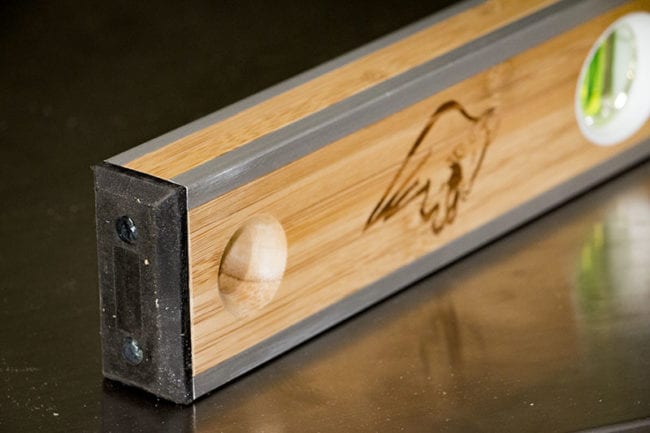
The bamboo in the Ox level is not raw, unfinished grass. It is laminated—multiple layers of bamboo fibers pressed and bonded under heat and pressure to form a dense, rigid, dimensionally stable beam. The lamination process eliminates the voids and inconsistencies found in natural wood, creating a material that resists warping, swelling, and twisting far better than a solid piece of timber. The long edges of the level are protected by extruded aluminum bindings that serve as the reference surfaces for marking and measuring, and the short edges are capped with standard rubberized end caps to absorb impact from drops and bumps. The overall aesthetic is striking : the blonde bamboo body, accented by the silver aluminum rails and black rubber end caps, looks more like a piece of high‑end architectural millwork than a construction tool. It’s genuinely beautiful, and I’ve had more than one client comment on it when I’ve pulled it out on a job.
Accuracy, Vials, and Field Calibration : 0.00075 Inches Per Inch and the 180‑Degree Flip Test
A level can look gorgeous, but if the bubble lies, it belongs on a wall as art, not on a jobsite as a tool. The Ox Tools Trade Wood Mason Level is calibrated to an accuracy of 0.00075 inches per inch. For context, the industry gold standard for professional levels—set by Empire’s e75 True Blue series, Milwaukee’s Redstick models, and Stabila’s premium lines—is 0.0005 inches per inch. That means the Ox level has roughly 50% greater potential error than those top‑tier competitors. But we’re talking about numbers so tiny that they border on theoretical. Over the 48‑inch length of this level, the maximum possible deviation at 0.00075 in/in is about 0.036 inches—just a hair over 1/32 of an inch. At 0.0005 in/in, that same length would have a maximum deviation of 0.024 inches. The difference is 0.012 inches, roughly the thickness of three sheets of standard printer paper. For the masonry work I do—setting stone veneer, laying brick, building block walls—a deviation of 1/32 of an inch over four feet is completely undetectable. The Ox’s accuracy is more than sufficient for its intended applications, and only the most demanding precision millwork or machine‑setup tasks would require tighter tolerances.
The level features three solid block acrylic vials : two for plumb (one at each end, allowing vertical readings in both orientations) and one for level in the center. Solid acrylic vials are the modern standard for professional levels because they resist shattering far better than glass, they don’t crack when subjected to rapid temperature changes, and they can be machined to high precision. The vials on the Ox are easy to read, with clear, high‑contrast bubble edges against the standard yellow‑green liquid. Even in the bright Florida sunshine, where glare can wash out lesser vials, these remained legible without squinting. The acrylic blocks are sealed and shock‑mounted within the bamboo body, protected from direct impact by the aluminum rails and end caps.
I periodically checked the level’s accuracy throughout the testing period using the simplest and most reliable field method available : the 180‑degree reversal test. You place the level on a reasonably flat surface and note the bubble’s position, say, in the left plumb vial. Then you spin the level 180 degrees, so the vials swap places. If the bubble reads identically in that same vial (which is now on the right side), the level is true. If the bubble position differs, the vial is out of calibration. The Ox passed this test consistently every time I checked it, both fresh out of the box and after several weeks of being hauled around in the back of my truck and used on dusty, gritty masonry sites. That kind of out‑of‑the‑box accuracy, combined with the dimensional stability of the laminated bamboo, gives me confidence that this level will stay true longer than a metal frame that’s been dropped a few times.
Weight and Feel : A Featherweight Level That Doesn’t Feel Fragile
The first thing anyone notices when they pick up the Ox bamboo level is the weight—or rather, the lack of it. A typical 48‑inch aluminum box beam level weighs around 3 to 5 pounds. This Ox level comes in significantly lighter. For a mason or a stoneworker who is already hoisting heavy materials all day, shedding a couple of pounds from the tool you hold in your non‑dominant hand is genuinely meaningful. It reduces arm fatigue, makes overhead leveling less of a chore, and allows you to move the level around with one hand without your wrist complaining after the tenth adjustment.
Lightweight tools often carry an association with cheapness or flimsiness, but the bamboo level doesn’t feel that way. It feels solid, dense, and well‑made, like a piece of engineered hardwood. The aluminum rails are machined flat and provide a smooth, durable marking edge. The rubber end caps are thick and shock‑absorbent, and the two handholds—cutouts in the bamboo body—are positioned at comfortable gripping points that balance the level nicely. There’s also a hang hole at one end for storing the level on a pegboard or a nail. The overall fit and finish are excellent; the lamination lines are even, the aluminum bindings are flush, and the vials are set straight and true.
Durability and the Mason’s “Tap” : Can Bamboo Survive Being Used as a Persuasion Tool?
Here’s where the rubber meets the road—or rather, where the level meets the brick. Masons and concrete finishers use their levels differently than carpenters. A carpenter sets a level on a board, reads the bubble, and marks a line. A mason sets a level on a newly laid block or brick, reads the bubble, and then gently—or not so gently—“taps” on the level to nudge the masonry into plumb and alignment. The level becomes a percussive tool, a block to persuade heavy material into its final resting place. Over weeks, months, and years of this treatment, a level absorbs thousands of small impacts. Aluminum levels can handle this; they may dent or scratch, but they generally stay straight. How will laminated bamboo hold up under the same abuse?
The tensile strength of bamboo gives me confidence in the material’s ability to resist breaking or splintering. Bamboo is incredibly tough along its grain—it’s one of the reasons it’s used for scaffolding in parts of Asia. The lamination process further reinforces the structure, binding the fibers in multiple directions to create a material that resists splitting. The aluminum bindings protect the long edges, which are the surfaces most likely to be tapped against a hard, rough material like brick. I’ve been using the Ox level on stone veneer projects and a small block wall for several weeks now, tapping it with a rubber mallet and occasionally giving it a firm whack with the heel of my hand, and it shows no signs of delamination, cracking, or warping. The bamboo body is still straight, the vials are still accurate, and the aluminum rails are still tight. However, several weeks isn’t a career. The real test will be how this level looks after two years of daily masonry use—the constant tapping, the exposure to mortar dust and moisture, the inevitable drops from scaffolding. My concern isn’t the tensile strength of the bamboo; it’s the cumulative effect of impact fatigue and moisture cycling on the laminated structure. Bamboo is less susceptible to swelling and warping than traditional hardwoods, but it’s not immune to water if the protective finish is compromised. The Ox level has a clear satin finish that appears to seal the bamboo, but deep scratches from abrasive brick could eventually allow moisture ingress. Time will tell. For now, I’m still using it daily in pursuit of the answer.
Carpenters, Trim Workers, and the Aesthetics‑Conscious Pro : The Level That Gets Compliments
If you’re a carpenter or a trim installer who treats your levels with relative gentleness—setting them on workpieces, marking lines, checking for flatness—the Ox bamboo level will likely give you years of trouble‑free service and look fantastic doing it. This is the level you pull out when a client is watching, because it doesn’t look like a beat‑up construction tool; it looks like a precision instrument that belongs in a craftsman’s hands. The bamboo body, the clean aluminum rails, the modern acrylic vials—it all adds up to a tool that makes a statement about the person holding it. In an industry where image and professionalism matter, that counts for something.
The lightweight nature of the Ox is especially appealing for overhead work. Holding a heavy aluminum 48‑inch level above your head to check a ceiling joist or align a crown molding run can be fatiguing after just a few minutes. The bamboo level is so much lighter that you can hold it in position without your arms burning. For electricians running conduit on ceilings, for drywallers checking lid flatness, for painters and finishers who need to verify a surface before they coat it, the Ox level offers a rare combination of length and low weight. It fills a niche that traditional metal levels don’t address : a full‑span level that doesn’t feel like a workout to use.
Value Proposition : Under $50 for a Level That Starts Conversations
At $46.95, the Ox Tools 48‑Inch Trade Wood Mason Level occupies an interesting pricing space. It’s not the cheapest 48‑inch level on the market—you can buy a basic aluminum box beam level for under $30 if you shop around. But it’s significantly less expensive than premium levels from Stabila or Milwaukee, which can run $100 to $150 for the same length. You’re giving up a small amount of accuracy (0.00075 vs. 0.0005 in/in) and some long‑term durability data (bamboo in this application hasn’t been around long enough for lifetime testing), but you’re gaining a tool that is genuinely lighter, potentially more thermally stable, and undeniably more attractive than anything else on the rack.
For a mason who goes through aluminum levels every couple of years because the frames get bent, the cost savings of the Ox aren’t compelling if it doesn’t hold up. The jury is still out on that front. But for a carpenter, an electrician, a trim installer, a tiling contractor, or a general builder who wants a 48‑inch level that’s easy to carry and looks great, the Ox represents a solid value. It’s a tool that will get used, will get noticed, and will do its job accurately enough for the vast majority of professional tasks. The fact that it comes from a renewable resource and has a lower carbon footprint than an aluminum extrusion is a bonus for the environmentally conscious pro.
Ox Tools 48‑Inch Trade Wood Mason Level Specifications
| Specification | Detail |
|---|---|
| Model | Ox Tools OX‑T500912 |
| Length | 48 inches |
| Material | Laminated bamboo body with extruded aluminum bindings |
| Vials | 3 solid block acrylic (2 plumb, 1 level) |
| Accuracy | 0.00075 inches per inch |
| End Caps | Rubberized, shock‑absorbing |
| Handholds | Two integrated cutouts for comfortable grip |
| Hang Hole | Yes, at one end |
| Weight | Approximately 1/3 of a comparable aluminum 48‑inch level |
| Price | $46.95 |
Key Features Summary
- Laminated bamboo construction: High tensile strength approaching steel, excellent strength‑to‑weight ratio, and reduced thermal expansion compared to metal levels.
- Lightweight design: Roughly one‑third the weight of a traditional aluminum 48‑inch box beam level, reducing user fatigue during extended use.
- Solid acrylic vials: Three shockproof, easy‑to‑read vials (two plumb, one level) with high‑contrast bubble visibility, even in bright sunlight.
- Aluminum edge bindings: Extruded aluminum rails protect the long edges, provide flat reference surfaces for marking, and shield the bamboo from direct impact.
- Rubberized end caps: Absorb shock from drops and bumps; protect the corners of the level.
- Accuracy of 0.00075 in/in: Sufficient for masonry, carpentry, and most construction applications; only the most demanding precision work requires tighter tolerances.
- Field‑testable accuracy: The 180‑degree reversal test allows quick on‑site verification of calibration.
- Two handholds and hang hole: Ergonomic gripping points for easy handling and convenient storage.
- Aesthetic appeal: The natural bamboo finish provides a unique, professional look that stands out from metal levels.
- Price point under $50: Offers a competitive alternative to aluminum levels, with added benefits of weight and style.
Final Verdict : A Beautiful, Lightweight Contender That Needs Time to Prove Its Masonry Mettle
The Ox Tools 48‑Inch Trade Wood Mason Level is one of those rare tools that challenges your assumptions about how something should be made. Bamboo isn’t the obvious choice for a spirit level—aluminum and steel have dominated that space for so long that anything else feels like an experiment. But the experiment largely succeeds. The level is accurate enough for its target audience, the vials are bright and durable, the construction is solid and thoughtfully detailed, and the weight reduction is a genuine ergonomic advantage that you appreciate more the longer you use it. The thermal stability of bamboo over metal is a quiet, nerdy benefit that could make a difference on jobsites where the temperature swings wildly.
The open question is durability under the specific, punishing conditions of masonry work. Carpenters, trim installers, electricians, and tilers can adopt this level with confidence that it will perform beautifully for years. Masons and concrete finishers—the trades that treat a level like a hammer’s softer cousin—should approach with cautious optimism. The material science is sound, the lamination is robust, and the aluminum bindings take the brunt of the impact. But there is no substitute for decades of field data, and bamboo in this application simply hasn’t accumulated that yet. I’m still using mine, tapping it, dropping it occasionally, wiping mortar dust off it, and watching for any sign of delamination or warping. It hasn’t disappointed me yet.
For under $50, the Ox bamboo level is fairly priced for what it offers : a lightweight, attractive, accurate tool that sparks conversations and does its job without fuss. If you’re looking for a 48‑inch level that stands out from the sea of yellow and silver aluminum on the jobsite, and you’re willing to treat it with the respect a wood‑based tool deserves, the Ox Tools Trade Wood Mason Level is a worthy addition to your kit. It won’t replace everyone’s aluminum workhorse, but it will find a loyal following among those who value innovation, sustainability, and a little bit of artistry in the tools they hold every day.
Comments 0
Leave a Comment