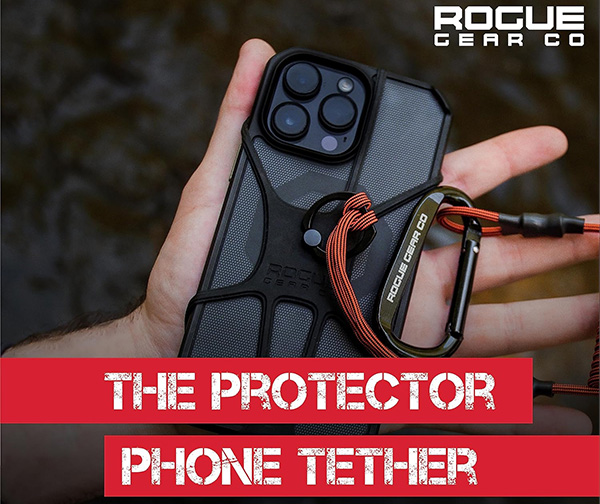
While some might view a phone tether as a niche accessory, the Protector represents a significant shift in Everyday Carry (EDC) security. Crafted by a company known for keeping expensive pliers and fishing nets from sinking into the abyss, this tether brings industrial-grade retention to the palm of your hand. In this exhaustive evaluation, we explore the physics of the silicone harness, the ergonomics of the 36-inch reach, and why this $22 investment is the ultimate insurance policy for your mobile device in 2026.
"The Protector isn't just a leash for your phone; it is a mechanical failsafe. It transforms your smartphone from a loose projectile into a secured component of your person, allowing you to focus on the drop, not your pocket."
1. The Origins : From Deep Sea Fishing to G-Force Protection
Rogue Gear Co. did not start in the consumer electronics sector. Their heritage is firmly planted in the maritime and fishing industry, where "dropping things" usually means losing them forever in the saltwater abyss. This background is critical to understanding the Protector’s build quality. When a company designs gear intended to hold up to the corrosive environment of the ocean and the thrashing of large game fish, a roller coaster is a relatively controlled environment by comparison.The transition from securing fishing gear to securing iPhones was a natural evolution of their business model. As smartphones replaced dedicated cameras and GPS units on boats, the need for a high-tension, weather-resistant tether became apparent. Rogue Gear recognized that "bag drops" at theme parks are a theft risk and that most "secure" zippered pockets on shorts are surprisingly prone to failure under extreme lateral $g$-forces.
2. Engineering the Harness : The Silicone Architecture
The heart of the Protector is its flexible silicone harness. While the main tether assembly is Made in the USA, the silicone component is sourced from specialized manufacturers in China to ensure a specific balance of tensile strength and elasticity that is difficult to achieve with domestic rubber formulations.- Universal Fitment : The harness is designed to wrap around the corners of nearly any smartphone, from a compact iPhone 13 Mini to the massive Samsung S24 Ultra. The "web" design stretches without tearing, creating a tension-based grip that becomes tighter as the phone moves.
- Vibration Dampening : Silicone is naturally shock-absorbent. On a rattling wooden coaster, the harness acts as a buffer, reducing the micro-vibrations transferred from the rider’s body to the phone’s sensitive internal optical image stabilization (OIS) sensors.
- The FaceID Tweak : During our testing, we noted that on certain bezel-less phones, a silicone strap could occasionally occlude the front-facing camera or infrared sensors used for Facial Recognition. However, the material is pliable; it can be shifted by a few millimeters to clear the sensor path without compromising the structural integrity of the grip.
3. The "Snap-Back" Mechanics : 3 Inches to 36 Inches
The functionality of a tether is defined by its reach-to-bulk ratio. A tether that is long enough to take a "selfie" at arm's length is usually so long that it tangles in your belt loops when not in use. Rogue Gear solved this with a high-memory coiled design.* The Resting State : At a retracted length of just 3 inches, the tether is virtually invisible. It sits tight against your hip, preventing the "pendulum effect" where a heavy phone swings and strikes the side of the ride vehicle or the rider next to you.
* The Extension : The coil extends smoothly to 36 inches. This provides ample "reach" to hold the phone up for photos, navigation, or scanning a digital ticket without feeling like you are fighting a high-tension bungee cord.
* The Carabiner : Unlike the flimsy plastic clips found on "budget" lanyards, the Protector utilizes a robust aluminum carabiner. It clips securely to a belt loop, a backpack D-ring, or a purse strap, ensuring that the anchor point is as strong as the tether itself.
Comparative Utility : Protector vs. Standard Phone Security
| Security Method | Drop Risk | Theft Risk | Ease of Access |
|---|---|---|---|
| Standard Pocket | High (Inversions) | Moderate | High |
| Amusement Park Bag Drop | Zero | Very High | Low (Wait Times) |
| Zippered Tech Pockets | Low | Low | Moderate |
| Rogue Gear Protector | Near Zero | Low (Tethered) | High |
4. Real-World Application : The "Giga-Coaster" Test
During our assessment at major parks like Cedar Point and Six Flags, the Protector was put through "Giga-Coaster" forces (drops over 300 feet and speeds exceeding 90 mph).* Observation : On high-intensity rides with aggressive "airtime" (negative $g$-force), the phone naturally wants to lift out of the pocket. The Protector remained taut, preventing the phone from rising more than an inch above the pocket line.
* Policy Compliance : It is critical to note that many "extreme" coasters (specifically those with metal detectors in the queue) have a strict no-phone policy. Even with a tether, park safety leads may require you to stow the device. However, for the 90% of rides where phones are permitted in "secured pockets," the Protector provides the secondary layer of safety that standard fabric pockets simply cannot offer.
5. Beyond the Park : Versatility for the Modern Adventurer
While the "Protector" excels at theme parks, its $22 value proposition extends to several other high-risk environments :1. Skiing/Snowboarding : Attempting to use a phone on a chairlift is a recipe for a 50-foot drop into deep powder. The Protector ensures that a dropped phone stays attached to your jacket cuff.
2. Kayaking/SUP : When paired with a waterproof case, the tether prevents your phone from becoming a permanent reef if you capsize.
3. Urban Travel : In areas prone to "snatch-and-grab" phone theft, a tethered phone is a significantly less attractive target for thieves on motorbikes, as the mechanical connection provides immediate resistance.
6. The Rogue Ecosystem : Guardian 55 and Beyond
Rogue Gear Co. is clearly doubling down on the "Retention Economy." The success of the Protector has paved the way for the Rogue Guardian 55, a heavy-duty utility leash designed for larger tools, rangefinders, and professional electronics. This commitment suggests that Rogue Gear is evolving into a premier name in Valuable Asset Retention. Whether you are securing a $500 pair of pliers or a $1,200 iPhone, the metallurgical and polymer standards remain consistent across their lineup.7. Value Analysis : Is $22 Too Much for a "String"?
In a world of $2.00 "wish-style" lanyards, $22.00 might initially seem steep. However, the cost of a screen replacement typically starts at $250, and the cost of a total device replacement can exceed $1,000.When you factor in the USA-based manufacturing, the high-grade aluminum carabiner, and the peace of mind that comes from a high-tension coil that won't lose its "snap," the ROI (Return on Investment) of the Rogue Gear Protector is realized the very first time you feel your phone slip, only to have it safely catch on your hip.
Final Verdict : The Enthusiast's Essential
The Rogue Gear Co. Protector Phone Tether is a rare product that solves a modern problem with old-world durability. It is simple, effective, and built to last significantly longer than the phone it is designed to protect.Pros :
* Industrial Security : Proven retention for high-$G$ environments.
* Compact Profile : 3-inch resting length prevents tangling.
* Universal Design : Pliable silicone harness works with almost any case/phone combination.
* Domestic Build : USA-assembled components ensure consistent quality.
Cons :
* Sensor Occlusion : Requires minor adjustment for FaceID/Selfie cameras.
* Pocket Bulk : The harness adds a few millimeters of thickness to the phone.
Final Thoughts : If you value your digital life and your sanity during your next vacation or outdoor excursion, the Protector is a mandatory upgrade. It is a discreet, rugged, and reliable way to ensure that your phone returns home in the same pocket it started in.
Comments 0
Leave a Comment