Before I have to wipe the drool off this review, it might be good to take a moment to describe what I feel is a hammer that everyone needs to see in person—and hopefully give a few swings, because the experience of holding and using the Powerstrike is fundamentally different from reading about it. The balance, the way the head drives nails, the way the grip settles into the palm, the curious and deeply satisfying hollow "thwock" of a strike—these are sensations that cannot be captured in a photograph or adequately conveyed in a specification table. But I will do my best to convey why this hammer is special, why it justifies a price that rivals premium titanium models, and why it might be the last framing hammer you ever need to buy.
The Sum of Its Parts: A Ten‑Piece Machine Designed for a Lifetime of Service
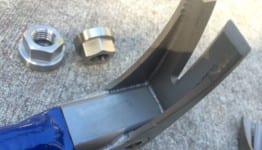
Take away any one of the parts of the Powerstrike and you lose the hammer. There is nothing wasted on this tool. The construction begins with the head, which is fabricated from 17‑4 stainless steel, a precipitation‑hardening alloy that combines high strength, excellent corrosion resistance, and good toughness. Powerstrike claims that the steel in its head is 60% stronger than titanium, but this is not a bold claim in the way it might initially sound. Most titanium hammers use alloys—typically 6Al‑4V, an aerospace‑grade material—to provide additional strength beyond what pure titanium can offer. The real competition is between 17‑4 stainless and 6Al‑4V titanium, and while both are premium materials with excellent properties, the stainless steel offers one significant advantage in a hammer head: density. Steel is denser than titanium, which means a steel head of the same physical dimensions packs more mass into the same space. More mass, concentrated in the head and delivered with the same swing speed, means more kinetic energy transferred to the nail on each strike. The result is a hammer that drives nails deeper per blow, with less effort from the user. The head is not a single casting or forging; it is welded together from roughly four separate components, each one shaped for its specific function. The claw is one piece, with the distinctive curved tines that grip nail heads for extraction. The striking face is another, a replaceable insert that threads into the front of the head and can be swapped out when it becomes worn or when the user wants to switch between a convex (milled) face for framing and a smooth (bullseye) face for finish work. The central body of the head, which houses the nail spotter and mates with the handle, is a third piece. And the nail spotter assembly, with its ingenious magnetic holder and its Allen‑style set screw that allows it to be rotated for top or bottom placement, is the fourth. Each of these components is machined to precise tolerances and finished with a level of care that is evident in the smooth contours, the crisp edges, and the flawless fit between the parts.
The handle is an entirely different kind of engineering achievement. It is a hollow, machine‑welded aluminum monocoque structure—"monocoque" being a term borrowed from aircraft design that means the strength of the structure lies in its outer shell, not in an internal frame. Think of an aircraft fuselage: a thin, curved skin that derives its strength from its shape, not from a heavy internal skeleton. The Powerstrike handle applies the same principle. The aluminum shell is shaped with gentle, organic curves that taper from the grip area to the head, and the wall thickness is precisely controlled to put material where it is needed for strength and to remove it where it is not needed to save weight. The result is a handle that is remarkably light for its size—the entire hammer weighs just 27.6 ounces on our scale, which is only a few ounces more than a 12‑ounce Estwing claw hammer—and that has a stiffness and a vibration‑damping quality that solid metal handles cannot match. The hollow interior acts as a resonant chamber, absorbing the high‑frequency vibrations that make solid‑steel hammers fatiguing to use over long periods. The handle is machined in such a way as to interlock with the stainless‑steel head, creating a structural connection that is far more secure than the simple press‑fit or epoxy bond used on most hammers. The head slides over the top of the handle, engaging a precisely machined interface, and it is held in place by a counterweight and a bolt‑through cap screw with a flange nut. The counterweight serves a dual purpose: it secures the head to the handle, and it balances the hammer by adding mass at the top of the handle, directly behind the striking face. This counterweight is one of the keys to the Powerstrike's exceptional balance, and I will discuss it in more detail later.
The Replaceable Face: A $25 Consumable That Extends the Hammer's Life Indefinitely
One of the most innovative features of the Powerstrike hammer is the replaceable striking face. The face is a separate component that threads into the front of the steel head. It is available in two configurations: a convex spring face (milled) for framing, where the textured surface grips the nail head and prevents the hammer from glancing off, and a bullseye face (smooth) for finish work, where a smooth, flat striking surface is needed to avoid marring the workpiece. The replaceable face addresses one of the most common failure modes of hammers: the gradual wear and deformation of the striking face. Over thousands of strikes, even the hardest steel face will eventually show signs of wear: the edges may mushroom, the milling may wear smooth, the face may develop a concave curve from repeated contact with nail heads. On a traditional hammer, this wear is permanent. The hammer still works, but its driving efficiency diminishes, and the user must compensate by swinging harder or by replacing the entire tool. On the Powerstrike, the worn face can simply be unscrewed and replaced with a new one. The replacement cost, at the time of this writing, is around $25—a fraction of the cost of a new premium hammer. This means the Powerstrike is not merely a tool; it is a platform. The aluminum handle, the stainless‑steel head body, the claw, and the nail spotter are designed to last a lifetime. The face, which absorbs the vast majority of the wear and tear, is a consumable that can be replaced as needed. Powerstrike has indicated that titanium faces may become available in the future, which would allow the user to further customize the hammer's driving characteristics by swapping between steel and titanium faces depending on the application. That kind of modular, user‑configurable design is virtually unheard of in the hammer market, and it speaks to a philosophy that views the tool as a long‑term investment rather than a disposable commodity.
The threaded attachment between the face and the head is robust and secure. The threads are coarse and precisely cut, allowing the face to be installed and removed with a standard wrench. There is no tendency for the face to loosen during use; once it is torqued down, it remains firmly in place through thousands of strikes. The interface between the face and the head body is a flat, machined surface that ensures full contact and efficient transfer of impact energy from the head to the nail. There is no slop, no wobble, no sense that the face is anything other than an integral part of the hammer. For the professional who swings a hammer every day, the replaceable face is not a gimmick. It is a practical, money‑saving feature that ensures the hammer will deliver consistent performance throughout its life, rather than gradually declining as the face wears.
The Nail Spotter: A Magnetic Marvel That Adapts to Your Preference
The nail spotter on the Powerstrike hammer is a small but brilliantly executed feature that makes one‑handed starting of nails significantly easier, particularly in overhead applications or in tight spaces where the user cannot reach the nail with their free hand. The spotter consists of a magnet embedded in a small steel housing that is mounted on the top of the head, just behind the striking face. To use it, the user places the head of a nail against the magnet, which holds the nail in position with the point facing outward, aligned with the striking face. The user can then position the nail against the workpiece and strike it with the hammer, driving the point into the wood. Once the nail is started, the user releases it from the magnet—a slight twist of the hammer is all that is required—and continues driving it with the face of the hammer as normal. The innovation on the Powerstrike is that the nail spotter can be rotated. A small Allen‑style set screw secures the spotter in position, and by loosening the screw, the spotter can be oriented for either top placement or bottom placement. Top placement—the default configuration, in which the spotter sits on the top of the head, directly above the striking face—is the conventional arrangement and is preferred by many users because it allows the nail to be positioned with a natural, overhand swing. Bottom placement rotates the spotter so that the nail is held against the underside of the steel head body, with the head itself serving as the backing point for driving the nail home. This is preferred by some carpenters because it gives a better view of the nail as it is being set into the wood, and because the steel head body provides a solid, non‑magnetic surface that drives the nail cleanly without the slight pull that a magnet can exert on the nail head. Both configurations work, and the ability to choose between them—and to change your mind later, without buying a different hammer—is a level of customization that is rare and welcome. The magnet itself is powerful enough to hold a 16d nail securely, even when the hammer is oriented vertically for overhead work. It does not let go until the user deliberately releases the nail. The spotter is positioned so that the nail aligns naturally with the center of the striking face, which means that the first strike—the one that sets the nail into the wood—is almost always dead‑center, with none of the glancing blows that can bend a nail or send it skittering across the floor.
In the Field: Swinging the Powerstrike Through Dimensional Lumber, Pressure‑Treated Stock, and Petrified Hundred‑Year‑Old Wood
As with any tool, knowing how it works and understanding the technology is great, but the real test comes when you put it in your hand and use it for the work it was designed to do. I wanted to drive home some nails with the Powerstrike—a lot of nails—to see what I thought of it after carrying it and using it all day. For starters, the hammer is light, given its size. At 27.6 ounces, it is only slightly heavier than a 12‑ounce Estwing claw hammer, which comes in around 22 ounces. That is a remarkable achievement for a full‑sized framing hammer with a steel head, and it is a direct result of the hollow aluminum monocoque handle. The weight savings are concentrated in the handle, which means that proportionally more of the hammer's total mass is located in the head, exactly where it is needed for driving power. The result is a hammer that swings with the speed and ease of a much lighter tool but hits with the authority of a heavier one. I took the Powerstrike and a box of 16d nails into some dimensional lumber, fastening together a couple of 2x4s in the way that framers have done for generations. This is my go‑to test to gauge the feel of any hammer: the rhythm of positioning the nail, setting it with a tap, and driving it home with two or three full swings. It is a test that reveals balance, vibration, grip comfort, and driving efficiency all at once, and it is a test that separates the hammers I enjoy using from the hammers I merely tolerate.
The Powerstrike excelled. I really like the balance on this hammer. I mean, I really like the balance. It is the first steel‑head hammer that I have actually come close to preferring over my titanium daily‑use hammer, and that is a statement I do not make lightly. I think the reason for the exceptional balance lies in the combination of the hollow aluminum handle, which removes weight from the grip end, and the counterweight that secures the head to the handle. That counterweight, positioned directly behind the striking face, shifts the center of mass forward, giving the hammer a head‑heavy balance that makes it want to fall into the nail. The result is that the Powerstrike seems to hit dead‑center every time, with no conscious effort on the part of the user. It may be the hollow aluminum handle, with its gentle curves that flared slightly at the butt end, providing just the right purchase for the pinky and ring finger to lever against the palm. It may be the design of the head, which seemed to drive nails further and harder than any other hammer in my arsenal. Nails that would require three solid strikes with my titanium hammer sank home in two with the Powerstrike, and the first strike—the set—felt more authoritative, more positive, less likely to glance off or bend the nail. After a full day of framing with the Powerstrike, my hand was less fatigued than it would have been with a solid‑steel hammer, and I had driven more nails in less time. That is the definition of a productivity improvement.
I showed this hammer to a few contractors who were working on the same job site, and their feedback was fairly unanimous. The design was very favorable—it looks like a manly hammer, they said, the kind of tool that you feel awesome using. The second corroborating piece of feedback was that the swing is very nice and smooth. This hammer has just perfect ergonomics, and it makes the task of hammering nails a lot easier than a traditional steel‑head model. The contractors particularly noted the vibration damping; after a dozen strikes with the Powerstrike, they would pick up their own hammers and immediately notice the increased sting in the handle. The hollow aluminum handle absorbs the high‑frequency shock that solid handles transmit directly to the hand, and the result is a hammer that can be swung all day without the tingling, numb sensation that many carpenters accept as an inevitable part of their trade. After driving a ridiculous number of nails into standard 2x4s, I turned to harder material: pressure‑treated lumber and layered plywood. Pressure‑treated wood is denser and more resinous than standard framing lumber, and it tends to grab nails more tightly, requiring more force to drive them fully. Layered plywood, particularly the thick, heavily glued variety used for engineered beams and headers, can be surprisingly resistant to nail penetration. I also sought out some hundred‑year‑old wood that feels petrified and acts that way to fasteners and blades alike. In all of these challenging materials, the Powerstrike performed exceptionally. The combination of the concentrated head mass and the efficient energy transfer from the rigid aluminum handle to the steel head meant that nails simply seemed to sink further in with each blow, even when the material was fighting back. The replaceable convex face provided excellent grip on the nail head, preventing the glancing blows that are more likely when driving into hard, irregular material. There is a scene in the second Karate Kid movie where Daniel LaRusso, after weeks of training, drives a nail into a 2x4 with a single strike. The Powerstrike did not quite achieve that level of cinematic perfection—no hammer can, outside of a Hollywood soundstage—but it came closer than any hammer I have used before. The driving power of this tool is genuinely impressive, and it is one of the primary reasons I would recommend it to a professional framer.
Ergonomics, Grip, and the Hollow‑Handle Advantage
The grip on the Powerstrike is an integral part of the aluminum handle, not a separate rubber sleeve that can slip, wear, or become sticky over time. The aluminum is machined with a subtle texture that provides traction without being abrasive, and the curves of the handle are shaped to fit the natural contours of the hand. The butt end flares slightly, which serves two purposes: it prevents the hand from slipping off the end of the handle during a powerful swing, and it provides a leverage point for the pinky and ring finger, allowing the user to generate more head speed with less wrist effort. The flare is not so pronounced that it interferes with the user's ability to choke up on the handle for close‑quarters work or for starting nails with the nail spotter. The overall length of the handle, while not explicitly specified in the manufacturer's literature, feels appropriate for a framing hammer—long enough to generate good head speed during a full swing, but not so long that it becomes unwieldy in tight spaces. The hollow construction of the handle contributes significantly to the hammer's comfort. When a solid steel or fiberglass handle strikes a nail, the impact generates a shock wave that travels through the handle and into the user's hand. That shock wave is composed of a broad spectrum of frequencies, from the low‑frequency "thud" of the head striking the nail to the high‑frequency "ring" of the steel components vibrating. The low frequencies are felt as a dull impact; the high frequencies are felt as a sharp sting. The hollow aluminum handle on the Powerstrike acts as a mechanical filter, absorbing the high frequencies and converting them into a small amount of heat that dissipates harmlessly into the air. The user feels the satisfying "thwock" of a solid strike, but not the accompanying sting. This is a similar principle to the way that a hollow titanium driver head in golf absorbs vibration and produces a more pleasing sound and feel at impact. It is not a gimmick; it is a legitimate application of vibration‑damping technology, and it makes the Powerstrike a more comfortable hammer to use for extended periods. For the professional who swings a hammer for hours every day, that comfort translates directly into reduced hand fatigue, improved control, and a lower risk of developing the cumulative vibration‑related injuries that can shorten a career.
Colors, Customization, and the Neon‑Pink Anti‑Theft Option
The Powerstrike hammer is available in eight different colors: gunmetal, navy, dark green, red, orange, neon green, neon yellow, and—for the user who really wants to make sure no one steals their hammer—neon pink. The color is applied to the aluminum handle via an anodizing process, which means it is not a surface coating that can chip or peel; it is an integral part of the metal itself, formed by electrochemically thickening the natural oxide layer on the aluminum and incorporating dye into the porous structure. The anodized finish is hard, durable, and resistant to the scuffs and scratches that are inevitable on a tool that sees daily use. The availability of multiple colors is more than a cosmetic feature. On a crowded job site, where multiple carpenters may be working in close proximity and their tools may become intermingled, a distinctive color makes it easy to identify your hammer at a glance. The bright, unconventional colors—neon green, neon yellow, neon pink—are particularly effective for this purpose. They also make the hammer easier to locate in a dimly lit tool bag or in the shadowed footwell of a work truck. The ability to choose a color that reflects your personality or your company branding is a small but appreciated touch, and it is consistent with the overall philosophy of the Powerstrike: a tool that is built to be used, but also to be owned with pride.
The Warranty and the Philosophy of Serviceability
Possibly the most impressive part of the Powerstrike hammer is its limited lifetime warranty. While Powerstrike is probably not going to replace your hammer if you leave it out in the rain to rust, or if you break it by attempting to pry an I‑beam with the claw—no manufacturer covers abuse—the warranty is still an impressive statement about how much they stand behind their materials and build quality. The warranty covers defects in materials and workmanship for the life of the tool, and it reflects the confidence that comes from building a hammer from high‑quality, individually replaceable components. Because every part of the Powerstrike can be removed and replaced, a damaged hammer does not necessarily mean a trip to the store for a new one. A worn face can be unscrewed and replaced for around $25. A damaged nail spotter can be swapped out. Even the handle, in the unlikely event that it is bent or cracked, can theoretically be replaced, though the cost and complexity of doing so may approach that of a new hammer. The point is that the Powerstrike was designed from the outset to be a serviceable tool, not a disposable one. In an industry where most hammers are simply discarded when they wear out or break, the Powerstrike represents a different, more sustainable approach: buy a quality tool once, maintain it as needed, and pass it down to the next generation. For the professional who views their tools as investments rather than expenses, that philosophy is deeply appealing.
Powerstrike Hammer Specifications
| Specification | Detail |
|---|---|
| Head Material | 17‑4 precipitation‑hardening stainless steel |
| Handle Material | Hollow machine‑welded aluminum monocoque |
| Weight (as tested) | 27.6 ounces |
| Face Options | Convex (milled) for framing; Bullseye (smooth) for finish work; Replaceable, threaded |
| Face Replacement Cost | ~$25 |
| Nail Spotter | Magnetic, rotatable for top or bottom placement |
| Claw Style | Curved rip claw |
| Available Colors | Gunmetal, Navy, Dark Green, Red, Orange, Neon Green, Neon Yellow, Neon Pink |
| Handle Finish | Anodized aluminum |
| Warranty | Limited Lifetime |
Who Should Buy the Powerstrike Hammer?
The Powerstrike is a premium framing hammer at a premium price, and it is not for everyone. It is for the professional framer who swings a hammer hundreds of times a day, five or six days a week, and who has learned, through hard experience, that the difference between a good hammer and a great one is measured in fatigue at the end of the day, in the number of nails driven per hour, and in the long‑term health of the elbow, wrist, and hand. It is for the carpenter who appreciates precision engineering, who takes satisfaction in using a tool that has been designed with obsessive attention to detail, and who is willing to pay a titanium‑hammer price for a steel‑head hammer because that hammer delivers titanium‑hammer performance with steel‑hammer driving power. It is for the contractor who equips a crew and who recognizes that a more efficient hammer can reduce labor costs over time, paying for itself many times over in productivity gains. It is also for the tool enthusiast, the collector, the person who simply loves well‑made things and who wants to experience what a hammer can be when an engineer refuses to accept that "good enough" is good enough. This is the first non‑titanium hammer that I would be willing to pay a titanium hammer price for. If you use a hammer daily for your job, then you should too. It is a tool that rewards the investment every time you swing it, and it is built to keep rewarding that investment for a lifetime.
Comments 0
Leave a Comment