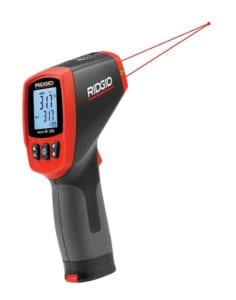
Infrared thermometers are one of those tools that, once you have used one, you find yourself reaching for it constantly. The ability to measure the temperature of a surface without touching it—from a safe distance, in a matter of seconds—is a capability that has applications in virtually every trade. The electrician uses it to check for hot spots on circuit breakers, loose connections, and overloaded conductors. The HVAC technician uses it to measure supply and return air temperatures, to check the performance of heat exchangers, and to verify that a compressor is operating within its specified temperature range. The automotive mechanic uses it to diagnose cooling system problems, to check for a misfiring cylinder by measuring exhaust manifold temperatures, and to verify that catalytic converters are functioning. The building inspector uses it to find missing insulation, to detect moisture intrusion by looking for cold spots, and to verify that radiant heating systems are operating correctly. The Ridgid Micro IR‑200 is an upgraded version of the company's previous IR thermometer, and it brings several improvements that make it more capable and more versatile than its predecessor. The temperature range has been extended to a maximum of 2,192 degrees Fahrenheit—more than 700 degrees hotter than the previous model. The distance‑to‑spot ratio has been increased from 20:1 to 30:1, allowing the user to measure smaller areas from a greater distance. Adjustable emissivity settings allow the user to compensate for the different surface finishes of various materials, improving accuracy on shiny, reflective, or otherwise non‑ideal surfaces. Dual Class II lasers project two dots that outline the measurement area, giving the user a clear visual indication of exactly what is being measured. And a tripod mount, audible and visual alarms, and a backlit display add convenience and versatility for professional applications. The core technology of an infrared thermometer is straightforward, but the details of its implementation determine how useful it actually is in the field. All objects emit infrared radiation as a function of their temperature, and an IR thermometer captures a portion of that radiation and converts it into a temperature reading. The two most critical factors that determine the accuracy and usefulness of that reading are the distance‑to‑spot ratio and the emissivity setting. The distance‑to‑spot ratio, often abbreviated as D:S, describes the relationship between the distance from the thermometer to the target and the diameter of the circular area that is being measured. A D:S ratio of 30:1 means that, from a distance of 30 inches, the thermometer is measuring the average temperature of a circle that is 1 inch in diameter. From 60 inches away, the measurement area is 2 inches in diameter. As the distance increases, the measurement area grows proportionally larger. If the measurement area becomes larger than the target—for example, if the thermometer is held too far from a small pipe or a narrow electrical connection—the reading will represent an average of the target and the surrounding background, which will be inaccurate. A higher D:S ratio allows the user to measure smaller targets from a greater distance, which is particularly important when measuring hot or dangerous objects where proximity is undesirable. The Micro IR‑200's 30:1 ratio is a significant improvement over the more common 12:1 or 20:1 ratios found on less expensive thermometers, and it makes the tool more useful for measuring small, hot components from a safe distance. Emissivity is a measure of how efficiently a surface emits infrared radiation. A perfect blackbody radiator has an emissivity of 1.00, and most organic materials, painted surfaces, and dull metals have emissivities in the range of 0.85 to 0.95. Shiny, polished metals, however, can have emissivities as low as 0.10, which means they reflect most of the infrared radiation that strikes them rather than emitting their own. If an IR thermometer calibrated for a high‑emissivity surface is pointed at a low‑emissivity surface, the reading will be inaccurate—typically lower than the true temperature. The ability to adjust the emissivity setting on the Micro IR‑200 allows the user to compensate for these differences, improving the accuracy of measurements on a wider range of materials. The setting can be adjusted from 0.10 to 1.00, covering virtually any surface that a professional is likely to encounter. The dual‑laser system is a practical feature that takes the guesswork out of aiming. Instead of a single laser dot in the center of the measurement area, the Micro IR‑200 projects two dots that represent the edges of the measurement circle. By bracketing the target between the two dots, the user can be confident that the thermometer is measuring what they intend to measure, not an adjacent surface or the background. This is particularly useful when measuring small objects, such as individual wires in a panel or specific components on a circuit board, where a slight misalignment could result in measuring the wrong object. The tripod mount is a feature that acknowledges that many temperature measurements are taken as part of a process that requires repeatability. A technician who is monitoring the temperature of a bearing over time, or an electrician who is checking a panel at regular intervals, can set up the IR‑200 on a tripod, aim it at the target, and take a series of measurements from the same position, ensuring consistency. The audible and visual high‑low alarms allow the user to set a temperature range, and the thermometer will alert them if the measured temperature falls outside that range. This is useful for quickly scanning a panel or a piece of equipment and identifying the hot spots that require further investigation, without having to look at the display for each measurement. The backlit display is a practical necessity for a tool that is often used in dimly lit areas—the back of a panel, the interior of a mechanical room, the shadowed underside of a vehicle. The display shows the current temperature, the maximum temperature captured during a measurement session, and the measurement units. The thermometer runs on a single 9‑volt battery, which is included, and it is backed by Ridgid's full lifetime warranty—a significant statement of confidence in the product's durability. The tool is built to the standards that professionals expect from Ridgid, with a rugged housing that can survive the drops and bumps of daily use.
Ridgid Micro IR‑200 Infrared Thermometer Specifications
| Specification | Detail |
|---|
| Temperature Range | ‑58°F to 2,192°F (‑50°C to 1,200°C) |
| Accuracy (‑58 to 68°F) | ±4.5°F |
| Accuracy (68°F to 2,192°F) | ±1.0% or ±1.8°F |
| Distance‑to‑Spot Ratio | 30:1 |
| Emissivity | Adjustable, 0.10–1.00 |
| Response Time | <150 milliseconds |
| Display | Backlit, current and MAX temperature |
| Power Source | 1 × 9V battery (included) |
| Weight | 0.5 lb |
| Warranty | Full Lifetime |
Conclusion: A Professional‑Grade Tool for the Portable Diagnostic Toolkit
The Ridgid Micro IR‑200 is not a tool that will replace a thermal imager for applications that require a detailed, spatial map of temperatures. But for the vast majority of temperature measurement tasks—spot‑checking a component, scanning a panel for hot spots, verifying that a system is operating within its specifications—an IR thermometer is the right tool, and the Micro IR‑200 is one of the most capable IR thermometers in its class. The high maximum temperature of 2,192°F, the 30:1 distance‑to‑spot ratio, the adjustable emissivity, the dual‑laser targeting, and the tripod mount are features that are typically found on more expensive instruments. The Ridgid full lifetime warranty provides peace of mind, and the rugged construction ensures the tool will survive the rigors of professional use. For the electrician, the HVAC technician, the mechanic, the building inspector, or any professional who needs to measure temperature quickly, accurately, and safely from a distance, the Micro IR‑200 is an excellent investment.
Comments 0
Leave a Comment