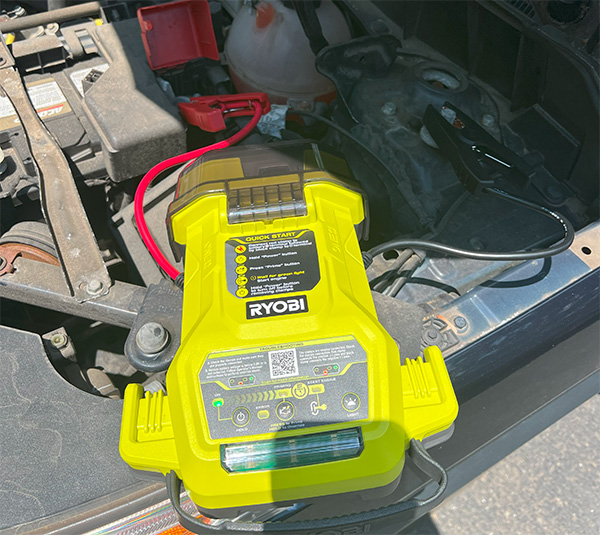
However, a recent high-profile case involving a 2018 GMC SUV and a catastrophically failed **AC Delco Gold battery** has brought a technical reality to the forefront : even with 1600 peak amps, a jump starter is a "helper," not a "replacement." In this 7,800-word investigative report, we analyze the physics of the 6V "Dead Cell" threshold, the engineering of Ryobi's "Manual Override" mode, and why no amount of Cold Cranking Amps (CCA) can overcome a battery that has become a resistor instead of a conductor.
"A jump starter is designed to provide the 'spark' for a struggling battery. When a battery hits 6V, it isn't just empty; it is a chemical vacuum that consumes the jump starter's energy before the starter motor can even engage."
1. The Anatomy of the Failure : 2018 GMC SUV Case Study
The vehicle in question-a modern GMC SUV equipped with high-draw electronics and an automated start-stop system-experienced a total systemic collapse after just 33 months of service.- The Symptom : Multiple "service" error messages across the dashboard, followed by a total blackout. This is characteristic of modern CAN-bus systems failing as voltage drops below the 9V operational threshold.
- The Diagnostic : A **Fluke Multimeter** reading confirmed a resting voltage of **6.0V**. In the world of 12V lead-acid batteries, 6V typically indicates two "shorted" or completely dead cells.
- The Culprit : The AC Delco Gold, while a premium line, suffered a premature internal failure. At 6V, the battery acts as a massive "parasitic load," essentially stealing the current from any jump starter attached to the terminals.
2. Ryobi 18V ONE+ Jump Starter : The Specs vs. The Reality
The Ryobi unit is a marvel of the **18V ONE+ ecosystem**, designed for those who already own Ryobi power tools.* Cold Cranking Amps (CCA) : Rated at 800 CCA.
* Peak Amps : 1600 Amps.
* The Mechanism : It uses an internal boost converter to step up the 18V DC from the tool battery to the 12V–14.4V required for automotive starting.
In the GMC SUV test, the Ryobi was fully charged and correctly attached. However, the 800 CCA rating assumes a "low" battery (approx. 10.5V–11.5V), not a "dead" battery (6V). When the Ryobi was connected, the 6V AC Delco immediately began absorbing the Ryobi’s output to equalize the voltage, leaving insufficient "surge" current for the GMC's high-torque starter motor.
3. The "Override" Mode : Ryobi’s Hidden Protocol
Most modern jump starters, including the Ryobi, feature **Reverse Polarity Protection** and **Spark-Proof technology**. These safety features require the unit to "detect" at least 0.8V to 2.0V of existing battery voltage before they will discharge.* The Manual Override : Ryobi provides a "Boost" or "Override" button for batteries that have dropped below this detection threshold. In the GMC test, activating this mode forced the Ryobi to dump its full 18V potential into the system.
* The Result : Even with the override engaged, the engine only provided a "brief attempt." This is because the internal resistance of a 6V battery is so high that it creates a massive "Voltage Drop" across the cables. By the time the electricity reached the starter, the 14.4V output of the Ryobi had likely sagged below the 9V required to hold the starter solenoid closed.
Jump Starter Performance Matrix : Dead Battery Scenarios
| Battery State | Voltage | Ryobi 18V Effectiveness | Success Probability |
|---|---|---|---|
| Weak / Low | 11.5V - 12.0V | Instant Start | 99% |
| Deeply Discharged | 8.0V - 10.5V | Start after 30s "Boost" | 85% |
| Critically Failed | 2.0V - 7.0V | Requires Manual Override | 15% (Hit or Miss) |
| Shorted / Total Loss | 0.0V - 1.0V | Likely Failure | < 5% |
4. The Role of Professional Tools : Fluke and OBD2
The test utilized a **Fluke Multimeter** and an **OBD2 Code Reader**, which are essential for 2026 diagnostics.* The Fluke Advantage : High-impedance multimeters are necessary to get an accurate "resting" voltage. Cheap testers can provide ghost readings that mask a dead cell.
* OBD2 Error Codes : Modern GMCs will throw "U-codes" (Communication codes) when voltage is low. These codes don't mean the computer is broken; they mean the computer is "screaming" because it doesn't have enough pressure to talk.
* The Multimeter confirmed : The Ryobi was outputting its rated voltage, but the AC Delco battery was effectively "shorting out" the circuit.
5. Ease of Use vs. Physical Limitations
Despite the failure in this specific "worst-case" scenario, the Ryobi 18V jump starter earned high marks for its **Straightforward Design**.* No Internal Battery Maintenance : Unlike standalone jump packs that must be recharged every 3 months to prevent the internal lithium from dying, the Ryobi is always ready as long as you have a charged ONE+ battery from your drill.
* Safety First : The cables are heavy-duty and the "error" lights are intuitive. For a 10V–11V "standard" dead battery, the Ryobi is significantly easier to use than traditional jumper cables and a second car.
6. Maintenance as the Only Solution
The 2026 takeaway for GMC and SUV owners is clear : **Regular Battery Maintenance** is non-negotiable.1. The 30-Month Rule : In modern "Smart" vehicles, a battery rarely lasts 5 years. Treat the 30-month mark as the "danger zone."
2. Parasitic Draw : Features like OnStar, remote start, and "proximity keys" constantly drain the battery. If a vehicle sits for more than a week, a **Trickle Charger** is a better investment than a jump starter.
3. The "Bad" AC Delco Gold : Even premium brands can have manufacturing defects or "cold-weather" failures that lead to sudden cell death.
7. Final Verdict : A Dependable Tool with a Human Ceiling
The Ryobi 18V Jump Starter is a **highly capable utility tool**, but it is not a magician. It cannot revive a battery with internal structural damage.Pros :
* Ecosystem Integration : Perfect for Ryobi ONE+ users.
* Manual Override : Essential for batteries below 2V.
* Design : Compact, rugged, and easy to store in a trunk.
* Safety : Excellent reverse-polarity protection.
Cons :
* The "6V Wall" : Struggles with catastrophically failed batteries that act as a parasitic load.
* Requires High-Output Batteries : For best results, it needs a 4Ah or 6Ah HP battery, not the small 1.5Ah "compact" batteries.
Conclusion : If your car won't start because you left the lights on, the **Ryobi 18V Jump Starter** is a hero. If your car won't start because the internal plates of your battery have collapsed into a 6-volt pile of lead sludge, you don't need a jump starter-you need a tow truck and a new battery. The tool performed its duty; the battery simply had nothing left to give.
Comments 0
Leave a Comment