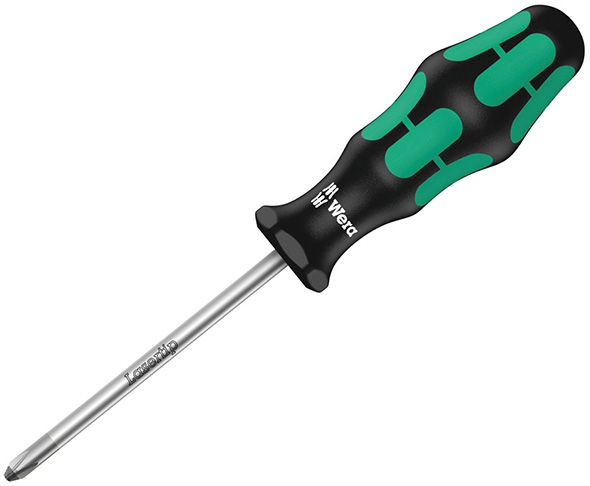
The challenge isn't just the wordless instructions or the surplus of wooden dowels; it is a fundamental misunderstanding of the hardware itself. Unlike the standard Phillips-head fasteners common in North America, IKEA utilizes a sophisticated European system centered on the **Pozidriv (PZ)** wood screw. In this exhaustive 7,800-word analysis, we dissect the mechanics of the Pozidriv drive, the engineering of the **Wera 355 PZ SB**, and why the right screwdriver is the only thing standing between a sturdy "Billy" bookcase and a stripped-out pile of particle board in 2026.
"The tragedy of modern DIY is the belief that every cross-shaped screw is a Phillips. In reality, forcing a Phillips driver into a Pozidriv screw is an act of mechanical sabotage that guarantees the eventual failure of the furniture."
1. The Geometry of Frustration : Phillips vs. Pozidriv
To the naked eye, a **Pozidriv** screw looks nearly identical to a **Phillips** screw. Both feature a cross-shaped recess. However, the engineering intent behind them is diametrically opposed.* The Phillips Drive (PH) : Developed in the 1930s for the automotive industry, the Phillips head was designed to "cam-out" (slip out) when a certain torque threshold was reached. This prevented over-tightening by early assembly-line power tools. The interior flanks are tapered, which naturally pushes the screwdriver up and out of the screw.
* The Pozidriv Drive (PZ) : Introduced in the 1960s, the Pozidriv is a refinement of the Phillips. It features parallel flanks and four additional radial indentations (which look like a small "tick-mark" or a "star" between the main cross arms). This design is engineered specifically not to cam-out. It allows for much higher torque transfer and a deeper, more secure engagement.
The IKEA Connection : Because IKEA products are designed in Europe and manufactured for global distribution, they utilize the Pozidriv system for its superior grip in particle board and medium-density fibreboard (MDF). When you use a tapered Phillips driver on an IKEA Pozidriv screw, the driver only touches the top edge of the recess. As you apply force, the driver slips, rounds out the screw head, and ruins the fastener-often before the screw is even halfway seated.
2. The Wera 355 PZ SB : The "Lasertip" Advantage
If you are serious about preserving your sanity during a kitchen renovation or a bedroom suite assembly, the Wera 355 PZ SB Pozidriv Screwdriver is not just a tool; it is an insurance policy. Wera, a premier German manufacturer, has addressed the "slippage" problem through a process called Lasertip technology.- Microscopic Roughness : The tip of the Wera 355 is microscopically roughened by laser beams. This creates a surface that literally "bites" into the screw head. You can feel the tactile "click" when the laser-etched grooves lock into the Pozidriv recess.
- Reduced Contact Pressure : Because the laser-etched surface provides so much grip, you don't need to push down nearly as hard as you would with a standard driver. This reduces hand fatigue and prevents the "slip-and-scratch" damage that often occurs on white-lacquered furniture surfaces.
- "Take it Easy" Tool Finder : In the 2026 iteration of the 355 series, Wera has refined their color-coding system. Pozidriv drivers are marked with a distinct black profile icon and size stamping, allowing you to grab the correct tool from your bag without a second thought.
3. Sizing Your Success : The #1 vs. The #2
In the IKEA ecosystem, size matters. Using a #1 driver on a #2 screw is a recipe for disaster.| Screwdriver Size | Typical IKEA Application | Wera Part Number |
|---|---|---|
| Pozidriv #1 (PZ1) | Small hinges, drawer slides, and back-panel nails. | 05100055001 |
| Pozidriv #2 (PZ2) | The "Standard." Main frame screws, cam-lock housings. | 05100057001 |
| Pozidriv #3 (PZ3) | Heavy-duty bed frames and wall-mounting brackets. | 05100059001 |
For the vast majority of projects-including the Pax wardrobe system and Malm bed frames-the PZ2 is the workhorse. However, many users overlook the smaller PZ1 screws used in cabinet hinges. Using a PZ2 on a PZ1 screw will strip the head instantly. A well-rounded kit should include both a PZ1 and a PZ2 to ensure you are covered for the entire assembly process.
4. Budget Alternatives : The Vessel Multi-Bit Solution
While the Wera 355 is the professional choice for dedicated tasks, not everyone wants a collection of single-purpose screwdrivers. For the casual DIYer, the Japanese brand Vessel offers a compelling alternative.The Vessel Ball-Grip Multi-Bit series often includes Pozidriv bits. While Vessel is famous for their "JIS" (Japanese Industrial Standard) cross-point drivers, their European-market bits are exceptionally well-machined.
* Pros : A single handle can store multiple bits; the "Ball-Grip" provides excellent palm torque.
* Cons : Lacks the specific "Lasertip" bite of the Wera; bits can sometimes get lost or stuck inside the IKEA hardware.
5. The Cost of Failure : Stripped Screws and Damaged MDF
The true value of a $14 Wera screwdriver is revealed when compared to the cost of a ruined piece of furniture. IKEA's particle board is notoriously unforgiving. Once a Pozidriv screw has been stripped by a Phillips driver, removing it often involves prying or drilling-actions that inevitably destroy the surrounding wood fibers.* Structural Integrity : A Pozidriv screw that is seated correctly provides a much tighter joint than one that has been "nursed" into place with a slipping Phillips driver. This prevents the "wobble" that many people associate with budget furniture.
* Resale Value : Furniture assembled with the correct tools can be disassembled and reassembled during a move. Furniture with stripped-out heads is essentially permanent (and fragile).
6. 2026 Assembly Strategy : Sanity and Speed
As we navigate the tool market of 2026, the strategy for IKEA assembly has shifted toward High-Efficiency Hand Tools. While some recommend a power drill, the risk of over-torquing and splitting the MDF is high.1. **Initial Seating :** Start the screw by hand to ensure it isn't cross-threaded.
2. **The Wera Advantage :** Use the 355 PZ2 for the bulk of the tightening. The Kraftform handle is designed to fit the contours of the hand, preventing the blisters that occur with cheap, "free" tools included in some kits.
3. **Final Torque :** Because of the Pozidriv's parallel flanks, you can feel exactly when the screw has reached maximum tension.
7. Final Verdict : Respect the System
IKEA furniture is a marvel of industrial logistics and affordable design, but it demands a specific level of respect for its hardware. The " universally acknowledged challenge" of assembly is largely a symptom of using the wrong tools for the job.Pros of the Wera 355 PZ SB :
* Laser-Etched Grip : Virtually eliminates cam-out and slipping.
* Ergonomics : Kraftform handle minimizes hand strain during 4-hour builds.
* Durability : A tool that will last through a lifetime of apartment moves.
Cons :
* Price : Higher initial investment than a "junk drawer" Phillips.
* Niche Use : You likely won't use it for many other tasks outside of European furniture or electronics.
Conclusion : If you are standing in an IKEA checkout line with a flat-pack box on your cart, your next stop should be the tool aisle or an online retailer for a Wera Pozidriv #2. It is the single most important investment you can make to ensure your furniture-and your sanity-remains intact. Don't let a $0.50 screw derail a $500 project. Use the right tool, and turn the "IKEA Challenge" into a satisfying afternoon of craftsmanship.
Comments 0
Leave a Comment