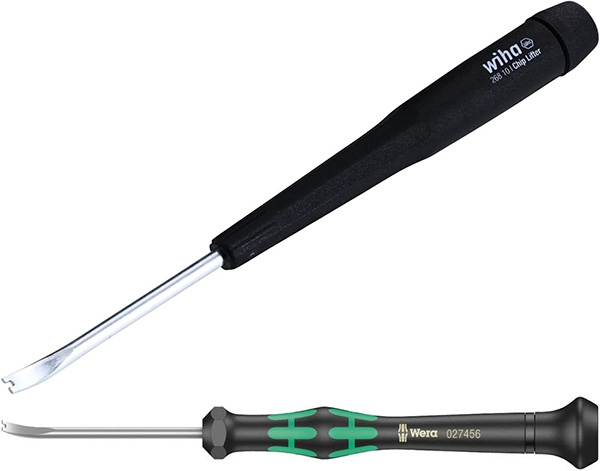
While often mistaken for a simple notched screwdriver, brands like Wiha and Wera have engineered these tools with metallurgical precision and ergonomic forethought. They are designed not just to move objects, but to do so with a controlled mechanical advantage that protects both the component and the traces on the printed circuit board (PCB). In this deep dive, we explore why this $10 investment is a non-negotiable addition to the modern workbench.
"A chip lifter is to an electronics technician what a scalpel is to a surgeon. It provides the leverage needed for extraction without the collateral damage inherent in improvised tools."
Anatomy of Excellence: The Wiha and Wera Advantage
When we examine the Wiha 26810 Precision Chip Lifter, we see a tool built for longevity. Constructed from CRM-72 tool steel-an exclusive alloy that is through-hardened and tempered-this lifter resists the "tip-curl" that plagues cheaper hardware store alternatives. The tip is precision-machined into a 3.5mm fork, specifically notched to straddle pins and fasteners. This ensures that when you apply upward pressure to an IC, the force is distributed evenly across the base of the chip, preventing the pins from bending or snapping.Conversely, the Wera 05027456001 (Kraftform Micro Series) offers a different ergonomic philosophy. Its handle features the "Kraftform Micro" zones:
- The Precision Zone: A slim neck for fine adjustments.
- The Power Zone: Integrated soft sections near the blade for high-torque transfer.
- The Fast-Turning Zone: A rotating cap that allows the technician to spin the tool rapidly while maintaining constant pressure.
Both tools are finished with anti-corrosion protection-often a chrome or black-point finish-to ensure that even in humid environments or after contact with flux and cleaning agents, the tool remains a reliable part of your kit for decades.
Case Study: The "Drawer Slide" Miracle
The versatility of a chip lifter extends far beyond the green silicon of a motherboard. Recently, a professional tool repairer encountered a frustrating setback: while relocating a high-capacity tool cabinet, a heavy-duty ball-bearing drawer slide was accidentally dislodged. The internal locking tab, made of thin spring steel, had become jammed in a position that prevented the drawer from re-seating.Standard screwdrivers were too thick to reach the tab, and needle-nose pliers risked marring the finish of the slide. By utilizing a Wiha chip lifter, the technician was able to use the forked tip to straddle the locking pin and apply the exact amount of vertical leverage needed to pop the tab back into its track. The repair took less than sixty seconds and left zero visible marks on the hardware. This real-world scenario highlights a fundamental truth: precision tools solve "impossible" mechanical problems through superior access.
Why Not Use a Screwdriver? The Risk of Improvised Extraction
It is a common sight on hobbyist forums: a user attempting to pry a DIP (Dual In-line Package) chip out of its socket using a flathead screwdriver. While this can work, it introduces three significant risks:- Fulcrum Damage: A flathead screwdriver usually requires prying against the edge of the socket or a nearby capacitor. The wide blade of a screwdriver can easily crush or crack these components.
- Uneven Lift: Prying from one side causes the chip to tilt. If the pins on the opposite side are still seated, they will bend at extreme angles, often leading to metal fatigue and breakage.
- Electrostatic Discharge (ESD): Professional chip lifters from Wera and Wiha often come in ESD-safe versions, featuring handles that dissipate static electricity. A standard household screwdriver is a lightning rod for static that can fry a CMOS chip in a heartbeat.
Comparison: Precision Chip Lifters vs. Improvised Tools
| Feature | Wiha/Wera Chip Lifter | Standard Flathead Screwdriver |
|---|---|---|
| Tip Geometry | Forked/Notched (Straddles pins) | Wedge-shaped (Slips easily) |
| Steel Grade | CRM-72 / High-Carbon (Hardened) | Mild Steel (Deforms under load) |
| Handle Type | Precision Rotating Cap | Fixed Standard Grip |
| ESD Protection | Available/Integrated | Non-existent |
| Safe Clearance | Designed for tight PCB density | Bulky; risks collateral damage |
The Electronics Ecosystem: Picks, Probes, and Spudgers
The chip lifter does not work in isolation. To build a truly professional electronics repair station, it should be paired with a suite of complementary instruments:* Spudgers: Typically made of nylon or carbon fiber, these are used for prying plastic casings (like those on smartphones) without scratching the finish.
* Probes and Picks: Used for wire guidance and clearing solder bridges between pins.
* The Chip Lifter: The "heavy lifter" of the group, used when mechanical leverage is required to overcome the friction of a socket or the tension of a spring clip.
When combined, these tools allow a technician to navigate the "urban sprawl" of a modern circuit board with total confidence. Whether you are extracting a BIOS chip for flashing or positioning a tiny SMD (Surface Mount Device) resistor for soldering, the forked tip of the lifter provides a "cradle" that standard tweezers simply cannot match.
A Smart Investment in Longevity
In the professional world, "cheap" tools are often the most expensive because they destroy the work they are meant to fix. A ruined $200 motherboard because of a $1 screwdriver is a mathematical failure. For approximately $10 to $15, a chip lifter from a reputable brand like Wiha or Wera is an insurance policy for your projects.The ergonomic handles reduce hand fatigue during long desoldering sessions, and the precision-machined tips ensure that your work looks as professional as the tools you use. As devices get smaller and components become more densely packed, the demand for high-leverage, low-profile tools will only increase.
The Final Verdict: If your work involves even a single integrated circuit or a delicate mechanical latch, the chip lifter is a mandatory upgrade. It is a testament to the fact that in the world of engineering, the right tool doesn't just make the job faster-it makes the "impossible" possible.
Comments 0
Leave a Comment