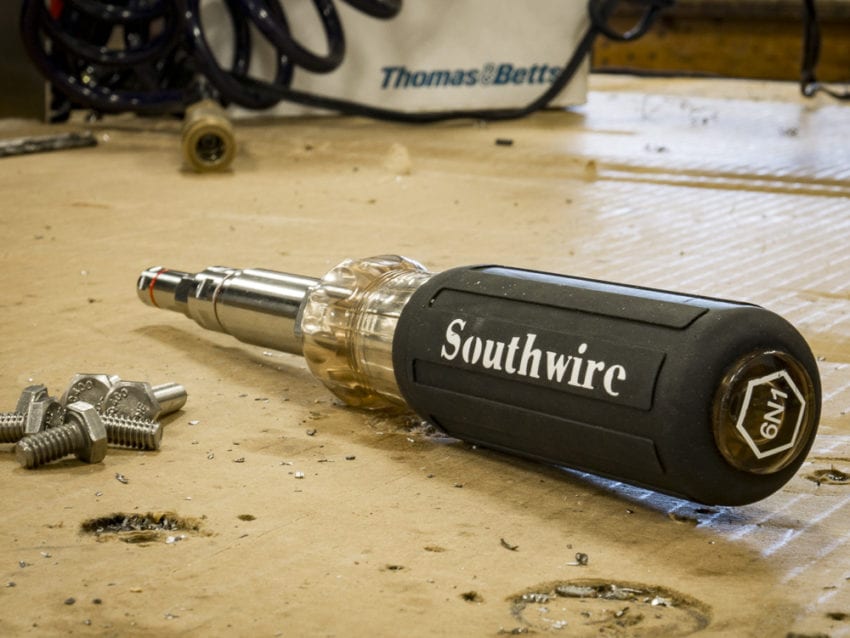
The Grip: A Direct Competitor to Klein's Cushion Grip—and Arguably Better
The handle of the Southwire 6‑in‑1 Heavy Duty Nut Driver is the first thing you will notice when you pick up the tool, and it is likely to be the feature that sways you toward Southwire or toward a competitor like Klein. Southwire has contoured the grip with a series of broad, deeply molded ridges that provide an exceptional interface between palm and tool. The rubber overmold is thick, slightly tacky to the touch, and generously applied across the full length of the handle. The ridges are not merely decorative; they create natural channels for the fingers, distributing pressure across a broader area of the palm and reducing hot spots during high‑torque fastening. When you are wrenching down on a stubborn panel nut or breaking loose a corroded bolt on an outdoor junction box, the Southwire grip communicates torque to the fastener without communicating pain to the user. Compared to Klein's cushion grip—the industry standard that I have praised in other reviews for its comfort and durability—the Southwire grip feels slightly more substantial in hand. It is wider, with a more pronounced texture, and for users with larger hands, it provides a more commanding hold. This is not to say that one grip is objectively better than the other, because grip preference is deeply subjective. Some electricians prefer the slimmer, denser feel of the Klein cushion grip, which prioritizes sensitivity and control. Others—and I count myself among them—prefer the chunkier, more aggressive grip of the Southwire, which prioritizes torque transfer and all‑day comfort. Both are professional‑grade, both resist oils and chemicals, and both will last for years of daily use. The difference is a matter of personal preference, and it is worth handling both tools in a store before making a decision.
The Nesting Mechanism: Secure, Smooth, and Heavy‑Duty
The Southwire 6‑in‑1 uses a nesting design similar to its competitors: the largest driver—the 9/16‑inch—is permanently mounted in the handle, and the smaller sizes nest inside it in descending order. The 7/16‑inch nests inside the 9/16‑inch, the 3/8‑inch inside the 7/16‑inch, the 5/16‑inch inside the 3/8‑inch, the 1/4‑inch inside the 5/16‑inch, and the 3/16‑inch inside the 1/4‑inch. The shafts are secured during transport by ball‑bearing detents that hold them snugly in place, preventing the maddening rattle of loose metal that plagues cheap multi‑drivers. To access a size, you pull the nested assembly apart, extract the desired shaft, and insert it into the handle. The connection between shaft and handle is solid, with no perceptible play or wobble. When a size is locked into the handle, it behaves exactly like a dedicated, fixed‑shaft nut driver.
The switching process is smooth—not too tight, not too loose. Some multi‑drivers require a surprising amount of force to separate the nested shafts, and others are so loose that the shafts fall apart at the slightest provocation. The Southwire strikes a comfortable middle ground. The shafts separate with a firm tug, and they slide back together with a satisfying click. The mechanism is not spring‑loaded like some quick‑change systems, but it does not need to be. The ball‑bearing detent provides sufficient retention, and the simplicity of the design means there is nothing to break, wear out, or jam. This is an important consideration for a tool that will be used daily, often in dusty, gritty, or wet environments. A complex mechanism is a liability on a jobsite; a simple, robust mechanism is an asset. The Southwire 6‑in‑1 falls firmly into the latter category.
The Hex Bolster: Wrench‑Assisted Torque, Southwire's Way
Each shaft on the Southwire 6‑in‑1 Heavy Duty Nut Driver features a hexagonal bolster positioned just above the handle. This bolster is designed to accept a wrench or an adjustable pliers, providing a mechanical advantage when a fastener is seized, corroded, or grossly overtightened. The hex shape is precisely machined, with clean, flat sides that provide a secure purchase for a wrench jaw. Applying a wrench to the bolster effectively multiplies the torque you can apply to the fastener, giving you the breakaway force needed to loosen a nut that has been in place since the Reagan administration without stripping the fastener or damaging the tool. This is a feature that has been standard on premium nut drivers for years, and Southwire has implemented it well. The bolster is positioned close enough to the handle that the wrench does not interfere with your grip, and it is long enough to accommodate the full width of a standard combination wrench jaw.
The wrench‑assist feature is not something you will use on every fastener—most nuts and bolts, especially on well‑maintained equipment, require only the torque that your hand can provide. But when you need it, you need it badly. The alternative—gripping the round shaft of a nut driver with a pair of pliers and hoping for the best—is a recipe for mangled shafts, slipped tools, and skinned knuckles. The hex bolster is the proper way to apply additional torque, and it is a non‑negotiable feature on any nut driver that claims to be professional‑grade. The Southwire 6‑in‑1 includes it on every shaft, as it should.
The Color‑Coding System: Quick Identification Without Reading Glasses
Southwire finishes each shaft with a distinct color band: blue for 3/16‑inch, green for 1/4‑inch, red for 5/16‑inch, yellow for 3/8‑inch, orange for 7/16‑inch, and black for 9/16‑inch. This color‑coding is the primary method by which you will identify the correct shaft, and for good reason: it works instantly, in any lighting, and from any angle. After a few days of use, you will know without thinking that the green shaft is the 1/4‑inch, and you will reach for it with the same unconscious confidence that a pianist reaches for the correct key. The colors are bright and durable, retaining their visibility through extended use and exposure to jobsite grime. They are also consistent with the color‑coding used by other manufacturers, which reduces confusion when you are mixing Southwire tools with Klein or Milwaukee tools in the same bag. The size of each driver is also etched into the shaft near the bolster, but the etchings are small—too small, in my opinion, and a point of criticism I will address shortly. For most users, the color‑coding will be the go‑to identification method, and the etchings will be a secondary reference for the moments when you want to be absolutely certain you have the right size.
The Size Etchings: Small, Hard to Read, and the Tool's Biggest Flaw
If the Southwire 6‑in‑1 Heavy Duty Nut Driver has a weakness, it is the size markings. The size of each driver—3/16, 1/4, and so on—is etched into the shaft near the bolster, but the numerals are small. Frustratingly small. If you have excellent eyesight and you are working in bright, direct light, you can read them without difficulty. If you are over the age of forty, your close‑up vision is not what it used to be, and you are working in the dim recesses of a mechanical room or an attic, those etchings become effectively invisible. You will squint. You will tilt the shaft toward the light. You will eventually give up and rely entirely on the color‑coding, which, as I have noted, is excellent—but it would be nice to have a secondary confirmation that does not require twenty‑twenty vision. Klein addresses this with larger, more boldly stamped markings that are significantly easier to read. Milwaukee uses a combination of laser etching and color‑coding that also provides better legibility. Southwire could improve the 6‑in‑1 dramatically by increasing the size of the etchings, using a contrasting fill color to make the numerals pop, or both. This flaw is not a dealbreaker—the tool functions perfectly regardless of whether you can read the etchings—but it is an annoyance that could be eliminated with a minor manufacturing change. It is the kind of detail that separates a very good tool from a truly great one, and I hope Southwire addresses it in a future production run.
The 3/16‑Inch Conundrum: Why Is the Smallest Size Still Here?
One of the enduring mysteries of multi‑nut driver design is the stubborn persistence of the 3/16‑inch size. I have encountered this size on virtually every multi‑nut driver I have ever tested—Klein, Southwire, Milwaukee, and Ideal all include it—and yet, in conversations with electricians, plumbers, and maintenance professionals, I rarely meet anyone who uses it with any regularity. The 3/16‑inch hex is a very small fastener, typically found on delicate electronics, small appliance housings, and the kind of miniature hardware that is more likely to be encountered by a repair technician working on a computer than by an electrician pulling Romex or a plumber assembling black iron pipe. Its inclusion in a tool designed for building trades professionals is a puzzle. Meanwhile, the 11/32‑inch size—a critical size for the nuts that secure fluorescent light ballasts, one of the most common tasks a commercial electrician performs—is notably absent from the Southwire 6‑in‑1. It is also absent from the Klein 5‑in‑1, though Klein's 6‑in‑1 does include it. Why do manufacturers persist in including a size that sees so little use while omitting one that sees so much? There may be a design challenge involved: the 11/32‑inch is larger than the 3/16‑inch, and nesting it inside the handle while maintaining a compact overall size may be geometrically difficult. But the first manufacturer to crack that nut—literally and figuratively—and produce a multi‑driver that replaces the 3/16‑inch with an 11/32‑inch will earn the loyalty of every electrician who has ever balanced on a ladder, holding a ballast in one hand and fumbling for the right driver with the other. Until then, the 3/16‑inch remains a curious stowaway, occupying a slot that could be better served by a more essential size. The Southwire 6‑in‑1 is, in this respect, no different from its competitors. It is a limitation of the category, not a specific defect of the tool.
Weight, Heft, and the Feeling of Durability
The Southwire 6‑in‑1 Heavy Duty Nut Driver weighs approximately one pound—0.93 pounds, to be precise, based on our scale—which places it on the heavier side of the multi‑nut driver spectrum. For comparison, the Klein 5‑in‑1 is lighter, and the Milwaukee equivalent falls somewhere in between. This weight is not a liability; it is a deliberate choice that reflects the "heavy duty" designation in the product name. The Southwire shafts are made from chrome‑plated, heavy‑duty steel, with thicker walls than some competitors, and the handle is robustly constructed with a generous overmold. The result is a tool that feels substantial, durable, and capable of absorbing the abuse that a professional jobsite dishes out. When you hold the Southwire 6‑in‑1, you know you are holding a tool that will not bend, break, or strip under normal—or even moderately abnormal—use. The weight also contributes to the tool's balance. A well‑balanced nut driver, like a well‑balanced hammer, feels like an extension of the arm rather than a burden in the hand. The Southwire 6‑in‑1 balances slightly forward of the handle, which positions the weight over the fastener and improves control during driving. For overhead work, the weight can become fatiguing over extended periods—a pound does not sound like much until you have been holding it above your head for ten minutes straight—but for the vast majority of tasks, it provides a reassuring solidity that lighter tools lack. There is a tether hole at the end of the handle, a thoughtful safety feature for professionals working at height. Attach a lanyard, and if the tool slips from your hand, it will not become a projectile plummeting toward the ground or, worse, toward a person below. The tether hole is a small addition that costs the manufacturer almost nothing but adds significant safety value.
Performance in the Field: From Panel Work to Pipe Hangers
I tested the Southwire 6‑in‑1 Heavy Duty Nut Driver across a range of tasks that reflect the kinds of work an electrician, plumber, or HVAC installer performs daily. On electrical panels, the 5/16‑inch and 3/8‑inch sizes were the workhorses—they fit the screws on terminal blocks, the nuts on ground bars, and the fasteners that secure panel covers. The deep‑well design of the shafts, combined with the hollow core that accommodates the bolt extending beyond the nut, made it easy to engage fasteners that were recessed into the panel frame. The 1/4‑inch size handled the smaller screws on control boards and disconnect switches. On conduit hangers and pipe clamps, the 7/16‑inch and 9/16‑inch sizes were the most frequently used, and the wrench‑assist bolster came into play several times when dealing with corroded fasteners on outdoor equipment. On one occasion, I encountered a ballast replacement—the very task that highlights the absence of the 11/32‑inch size—and I was forced to retrieve a dedicated driver from my tool bag. The Southwire 6‑in‑1 handled everything else that day with ease. The shafts did not bend, the handle did not slip, and the color‑coding allowed me to switch sizes without looking away from my work. The tool performed exactly as expected, and after a week of daily use, it had earned a permanent place in my primary tool bag.
Comparison: Southwire 6‑in‑1 vs. Klein 5‑in‑1 vs. Klein 6‑in‑1
The most direct competitors to the Southwire 6‑in‑1 are the Klein 5‑in‑1 (model 32801) and the Klein 6‑in‑1 (model 32800). The Klein 5‑in‑1, which I have reviewed in detail elsewhere, covers 3/16, 1/4, 5/16, 3/8, and 9/16 inches—the same as the Southwire minus the 7/16‑inch. It is slightly lighter and more compact, and it retails for around $23. The Klein 6‑in‑1 adds the 7/16‑inch and 11/32‑inch while omitting the 3/16‑inch, making it the most practical selection for electricians. It retails for slightly more than the Southwire. Where does the Southwire fit in? It offers the 7/16‑inch that the Klein 5‑in‑1 lacks, but it does not offer the 11/32‑inch that the Klein 6‑in‑1 provides. In terms of build quality, the Southwire is at least as good as the Klein, and its grip, in my opinion, is superior. The price is competitive: at around $15 to $23 depending on the retailer, it undercuts the Klein 6‑in‑1 by a few dollars. If you rarely or never need the 11/32‑inch—and there are many electricians, particularly those working in residential and light commercial, who do not—the Southwire 6‑in‑1 is an excellent value. If you change ballasts regularly, the lack of the 11/32‑inch will be a frustration, and you will likely choose the Klein 6‑in‑1 instead. Both are excellent tools, and the choice between them comes down to your specific needs and your preference in grip design.
Southwire 6‑in‑1 Heavy Duty Nut Driver Specifications
| Specification | Detail |
|---|---|
| Item Number | ND6N1HD |
| Included Sizes | 3/16, 1/4, 5/16, 3/8, 7/16, 9/16 inches |
| Shaft Material | Chrome‑plated heavy‑duty steel |
| Handle | Comfort grip with rubber overmold |
| Special Features | Wrench‑assist hex bolsters, color‑coded shafts, hollow shafts for screw clearance, tether hole |
| Overall Length | 9.25 inches |
| Width | 1.4 inches |
| Depth | 1.4 inches |
| Weight | Approximately 1 pound |
| Price | $15.29 (varies by retailer) |
Conclusion: A Heavy‑Duty Competitor That Earns Its Place
The Southwire 6‑in‑1 Heavy Duty Nut Driver is not a perfect tool, but it is a very good one. Its grip is among the best in its class—comfortable, secure, and clearly designed for professionals who torque down fasteners all day long. Its nesting mechanism is smooth and reliable, with no tendency to loosen or jam. Its hex‑bolster wrench‑assist feature provides the mechanical advantage needed for stubborn fasteners. Its color‑coding makes size identification fast and intuitive. The size etchings are too small, the 3/16‑inch driver is of questionable utility, and the missing 11/32‑inch will frustrate ballast changers. But these are category‑level limitations rather than deal‑breaking flaws. For the electrician who does not change fluorescent ballasts, the HVAC installer who works primarily with sheet metal and ductwork fasteners, the plumber who assembles black iron pipe and copper fittings, or the general tradesperson who simply wants a reliable, space‑saving multi‑nut driver, the Southwire 6‑in‑1 is an easy recommendation. It consolidates six commonly used sizes into a single, robust tool that will save space in the bag, weight on the belt, and time in the workflow. At its street price, it represents genuine value—a professional‑grade tool at a price that does not require a purchase order. If the idea of replacing five or six individual nut drivers with one multi‑tool appeals to you, give the Southwire 6‑in‑1 Heavy Duty Nut Driver a shot. It may not be perfect, but it is very, very good.
Comments 0
Leave a Comment