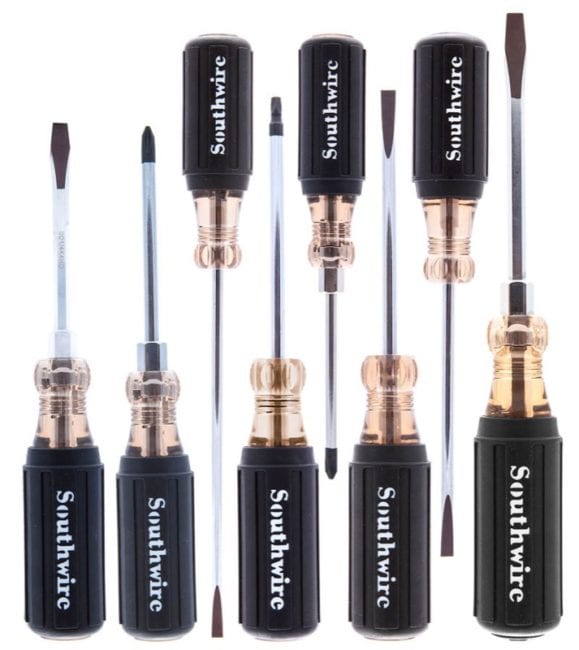
Keystone vs. Cabinet: The Two Faces of the Slotted Screwdriver
Before diving into the specific virtues of the Southwire set, it is worth pausing to clarify a distinction that many users—even experienced ones—may not consciously appreciate: the difference between a keystone slotted screwdriver and a cabinet slotted screwdriver. The terms refer not to the tip shape itself—both are flat, straight blades designed to engage a single slot in the fastener head—but to the profile of the blade as it transitions from the shaft to the tip. A keystone screwdriver features a blade that flares outward as it approaches the tip, widening into a shape that, viewed from above, resembles the keystone of an arch. This flared profile provides additional strength at the very end of the blade, where the forces are concentrated during high‑torque fastening. The keystone is the heavy‑duty flathead driver, the one you reach for when a screw is large, stubborn, or both. It is designed for torque—for the kind of forceful, palm‑centered driving that seats a large screw firmly into wood or metal. A cabinet screwdriver, by contrast, maintains a consistent blade width from the shaft to the tip, or tapers only slightly. It does not flare. This gives it a slimmer profile that can access deeply recessed screws in narrow channels—the screws that hold the faceplates on electrical panels, the screws inside junction boxes, the fine screws on delicate equipment. Cabinet drivers are designed for precision, for access, and for the moderate torque that smaller fasteners require.
The Southwire SDSET8 includes two keystone slotted drivers: a 1/4‑inch by 4‑inch (model SD1/4K4HD) and a 5/16‑inch by 6‑inch (model SD5/16K6HD). These are the heavy hitters. The 5/16‑inch keystone, in particular, is a substantial tool—the kind of screwdriver that feels like it could double as a chisel in a pinch, though Southwire would never recommend that use. It is designed for the large slotted screws found on lugs in electrical panels, on heavy‑duty switches, on industrial equipment. The cabinet‑tip drivers included are a 3/16‑inch by 4‑inch (model SD3/16C4), a 3/16‑inch by 6‑inch (model SD3/16C6), and a 1/4‑inch by 4‑inch (model SD1/4C4). These are the precision tools—the ones you reach for when the screw is small, the access is tight, and the torque requirement is modest. The 3/16‑inch cabinet driver is the specialist for the tiny screws on switch plates, on delicate electronic components, on the terminals of a thermostat. The 1/4‑inch cabinet driver bridges the gap between precision and torque, handling the medium slotted screws that are ubiquitous in electrical work. By including both keystone and cabinet drivers in the most commonly used sizes, the Southwire set ensures that the user always has the right tool for the slotted fastener at hand—not a compromise, not a driver that is too thick for the access or too weak for the torque, but the correct tool, purpose‑built for the task.
The Two #2 Phillips Drivers: Why One Is Not Enough
If the slotted screw is the traditional standby of electrical fasteners, the Phillips #2 is the modern workhorse. It drives the screws on panel covers, on conduit clamps, on junction boxes, on terminal blocks, on switches, on receptacles, on virtually every component of a modern electrical system that is not held together by hex heads or specialty fasteners. An electrician will reach for a #2 Phillips dozens of times a day. It is the screwdriver that spends the most time in the hand, and it is the screwdriver that is most likely to be abused—asked to drive a screw that is slightly too tight, twisted against a stubborn thread, used as a light prying tool to pop open a stuck panel cover. The Southwire SDSET8 includes not one but two #2 Phillips drivers: a 4‑inch shaft (model SD2P4HD) and a shorter, more compact version designed for close‑quarters work. The inclusion of two drivers in the same tip size is not a redundancy; it is a recognition of the reality that a professional needs different reach for different situations. The 4‑inch driver provides the leverage and the reach needed for panel screws and for fasteners that are recessed or surrounded by obstructions. The shorter driver tucks into tight spaces—inside a junction box, between a conduit and a wall, behind a piece of equipment—where a longer shaft would be impossible to maneuver. The Phillips #2 tips are machined with the same black phosphate coating as the slotted tips, and they are profiled to engage the screw head fully, reducing the tendency to cam out under torque. The Phillips drive is, by design, prone to cam‑out—the bit is meant to slip out of the screw head when the torque exceeds a certain threshold, a deliberate feature that was introduced in the 1930s to prevent over‑tightening on automobile assembly lines. But a well‑profiled Phillips tip, made from quality steel and properly heat‑treated, will resist cam‑out far longer than a poorly‑made tip, allowing the user to apply the necessary torque to seat the screw firmly before the slip mechanism engages. The Southwire tips, based on our testing, fall into the well‑profiled category. They grip the screw head positively, and they require a deliberate, forceful twist to cam out—not the frustrating, premature slip that plagues budget screwdrivers.
Black Phosphate Tips: Friction, Corrosion Resistance, and the Anti‑Slip Advantage
Each driver in the Southwire SDSET8 is finished at the tip with a black phosphate coating. This is a conversion treatment that chemically alters the surface of the steel, creating a microscopically textured, dark gray to black finish that serves two primary purposes. First, it provides a slight increase in friction between the tip and the fastener. The microscopic texture of the phosphate coating acts like a very fine sandpaper, gripping the walls of the screw recess and reducing the tendency for the tip to slip or cam out. This is particularly valuable on slotted screws, where the driver has only two points of contact with the fastener and is inherently prone to slipping laterally out of the slot. A phosphate‑coated tip, combined with a properly hollow‑ground profile that fits the slot snugly, can make the difference between a screw that drives smoothly and a screw that frustrates. Second, the phosphate coating provides a measure of corrosion resistance. The treatment fills the microscopic pores in the steel surface with a corrosion‑inhibiting layer, reducing the rate at which rust can form. For a tool that lives in a tool bag, that is exposed to humidity, sweat, and the occasional splash of water, this corrosion resistance extends the useful life of the driver and ensures that the tip remains sharp and properly profiled for years. The black phosphate also has an aesthetic function: it darkens the tip, providing a visual contrast that can help the user align the driver with the screw head in low‑light conditions. The black tip against the silver or brass screw head is easier to see than a bright, reflective tip would be. It is a small thing, but in the dim recesses of an electrical panel or the shadowed interior of a junction box, small things matter.
The Hexagonal Bolster: When Your Hand Is Not Enough
Positioned on the shaft of each driver in the Southwire SDSET8, just above the handle, is a hexagonal bolster. This is a section of the shaft that has been machined into a hex shape—six flat sides, each precisely ground to accept a wrench. The purpose of the bolster is to provide a mechanical advantage when the torque required to turn a screw exceeds what the user's hand can comfortably deliver. An electrician encounters such screws regularly: a panel cover screw that has been over‑tightened by the installer, a terminal screw that has corroded slightly and refuses to break free, a conduit clamp screw that has been painted over and now acts as if it were welded in place. In these moments, the user can place a wrench or an adjustable pliers on the hexagonal bolster and apply significantly more torque than is possible with the handle alone. The wrench multiplies the force of the hand through simple leverage, and the hex shape prevents the wrench from slipping, channeling all of the applied force into turning the screw. This is a feature that was once exclusive to premium, professional‑grade screwdrivers, but it has become increasingly common on mid‑range tools as well. Southwire's inclusion of the hex bolster on every driver in the SDSET8 signals the company's intent to compete at the professional level. The bolster is positioned close enough to the handle that the wrench does not interfere with the user's grip, and it is long enough to accommodate the full width of a standard combination wrench jaw. The hex flats are precisely machined, with no rounded corners or uneven surfaces that would cause the wrench to slip under load. For the professional who encounters a stubborn screw and does not want to risk damaging the handle or the shaft by clamping a wrench onto the round portion of the driver—a practice that every manufacturer officially discourages but that every professional has resorted to at some point—the hex bolster is the proper, designed‑for‑the‑purpose solution.
The Cushion Grip: All‑Day Comfort and the Anatomy of a Good Handle
The handles of the Southwire SDSET8 drivers are covered in a thick, rubbery overmold that Southwire describes as a cushioned grip. The grip is contoured with a series of broad, shallow flutes that run longitudinally from the butt of the handle to the bolster. These flutes create a comfortable, ergonomic shape that fits the natural curve of the palm. The rubber material itself is dense enough to transmit the tactile feedback of the screw seating—the subtle increase in resistance that tells the user to stop tightening—but soft enough to absorb the vibration and pressure that, over the course of a day, can lead to hand fatigue and blistering. The diameter of the handle varies slightly among the drivers in the set, with the larger drivers (the 5/16‑inch keystone, for example) having thicker handles that provide a more commanding grip, and the smaller drivers having proportionally smaller handles that are optimized for fingertip control. This is a deliberate design choice that reflects an understanding of how different sizes of screwdriver are used. A large keystone driver is used primarily for high‑torque applications; the user wraps their entire hand around the handle and applies force through the palm. A thick, palm‑filling handle is ideal for this grip. A small cabinet driver is used primarily for precision work; the user grips the handle with the fingertips, rotating it with a delicate, controlled motion. A thinner handle, which allows the fingertips to wrap further around the circumference and provides finer control, is better suited to this task. The rubber overmold on the Southwire handles resists the oils, solvents, and general grime that accumulate on a working professional's hands over the course of a day. It can be wiped clean with a rag, and it will not become sticky or degrade from contact with common jobsite chemicals. The butt of each handle is marked with the tip type and size, printed in white on the dark rubber, providing an easy visual reference when the drivers are stored handle‑up in a tool pouch. The printing is durable but not indestructible; after extended use and repeated wiping, it may begin to fade, but the user will typically have memorized the sizes by that point. The colors of the handles are Southwire's signature black with red accents, a color scheme that is consistent with the rest of the Southwire hand‑tool line and that provides a professional, cohesive look.
The Square Drive: A Nod to the Robertson Standard
The Southwire SDSET8 includes a single #2 square‑drive screwdriver (model SDQ2P4). Square drive, known more commonly by its inventor's name as Robertson, is a screw drive system in which the fastener head has a square recess and the driver has a corresponding square tip. It was invented in Canada in the early twentieth century and has since become the dominant standard in Canadian construction and a significant presence in the United States, particularly in electrical work. Square‑drive screws are found on many electrical boxes, on certain commercial fixtures, on HVAC equipment, and on a growing number of consumer products. The advantages of square drive are several: the tapered square recess grips the driver tip firmly, holding the screw on the driver without the need for magnetic assistance, and the geometry of the square engagement is inherently resistant to cam‑out—the driver cannot slip out of the recess in the way that a Phillips driver slips out of a Phillips head. This means square‑drive screws can be driven with one hand, at awkward angles, and with high torque, without the frustration of the driver slipping and damaging the screw head or the surrounding material. For the electrician who works on square‑drive boxes and fixtures, a dedicated square‑drive screwdriver is essential. The Southwire #2 square driver features the same cushioned grip, hexagonal bolster, and black phosphate tip as the rest of the set. The square tip is precisely ground to the correct dimensions, fitting snugly into a standard #2 square recess with no play. The tip holds the screw securely, even when the driver is held horizontally or inverted—a property that is particularly valuable when working overhead or in tight spaces where a dropped screw would be difficult or dangerous to retrieve.
Field Testing: From Outlet Replacement to 200‑Amp Service Panels
I used the Southwire SDSET8 in a variety of real‑world electrical applications over the course of several weeks. The tasks ranged from the mundane—replacing a dozen standard outlets and switches in a residential remodel—to the more demanding—installing new breakers into a 200‑amp service panel, securing the lugs, and attaching the panel cover. Throughout this testing, the Southwire drivers performed admirably. For outlet and switch replacement, the #2 Phillips drivers were the workhorses, driving the terminal screws that hold the wire in place and the mounting screws that secure the device to the box. The cushion grip provided a comfortable, secure hold, even when my hands were damp with sweat from working in a Florida attic. The hex bolster came into play several times when dealing with panel screws that had been over‑tightened by the original installer. A quick grab of an adjustable wrench on the bolster, a firm twist, and the screw broke free. The black phosphate tips showed no signs of wear or corrosion after several weeks of use, though the white lettering on the handle butts had begun to show slight signs of fading—a cosmetic issue that does not affect function. The slotted drivers, particularly the 5/16‑inch keystone, were used to tighten the large lugs in the service panel. The wide, flared blade engaged the lug slots positively, and the thick handle provided the leverage needed to torque the lugs to the point where the wire was securely clamped. The 3/16‑inch cabinet driver proved its worth on a few delicate tasks—tightening the tiny screws on a thermostat sub‑base, securing the terminals on a low‑voltage transformer.
Southwire 8‑piece Screwdriver Set SDSET8 Specifications
| Tip Type | Size | Shaft Length | Model Number |
|---|---|---|---|
| Slotted (Cabinet) | 3/16″ | 4″ | SD3/16C4 |
| Slotted (Cabinet) | 3/16″ | 6″ | SD3/16C6 |
| Slotted (Cabinet) | 1/4″ | 4″ | SD1/4C4 |
| Slotted (Keystone) | 1/4″ | 4″ | SD1/4K4HD |
| Slotted (Keystone) | 5/16″ | 6″ | SD5/16K6HD |
| Phillips | #1 | 3″ | SD1P3 |
| Phillips | #2 | 4″ | SD2P4HD |
| Square Drive | #2 | 4″ | SDQ2P4 |
| Common Features: Cushion grip handles, hexagonal bolster for wrench assist, black phosphate tips, chrome‑plated stainless steel shafts, tip identification on handle butt. | |||
Conclusion: The Foundation of a Professional Tool Kit
The Southwire 8‑Piece Screwdriver Set SDSET8 is not the flashiest tool you will ever buy, but it may be one of the most used. It covers the essential tip types and sizes that an electrician, a maintenance professional, or a serious DIYer encounters day in and day out. The inclusion of both keystone and cabinet slotted drivers ensures that the user has the right tool for both the high‑torque and the precision‑access scenarios. The dual #2 Phillips drivers provide the reach and versatility needed for the most common electrical fastener. The square‑drive driver covers the Robertson standard that is increasingly important in modern electrical work. The cushion grip, the hex bolster, and the black phosphate tips are not merely marketing features; they are practical, functional elements that make the drivers more comfortable to use, more capable when confronted with stubborn fasteners, and more durable over the long term. Southwire backs the set with a limited lifetime warranty, a promise that the tools will be free from defects in materials and workmanship for the life of the owner. For the professional who is building a tool kit or replacing worn‑out drivers, the SDSET8 is a solid foundation. It will not be the last screwdriver set you ever buy—no single set is—but it will be the set that you reach for most often, the one that lives in the top tray of your tool bag, the one whose handles become familiar through thousands of daily interactions. And for the price, it represents a value that is difficult to match from competing brands at this quality level. It is a working set, built for working hands, and it does its job with the quiet competence that defines all good tools.
Comments 0
Leave a Comment