The Magnet That Started It All : Rare‑Earth Tech Inside a Humbled Stud Finder
To understand the StudPop Level, you have to appreciate the StudPop itself. The original is a palm‑sized disc with a rare‑earth magnet so potent it snaps onto a hidden screw through half an inch of drywall with an audible click. There are no batteries to drain, no calibration routines to fumble through, no false positives from electrical wiring or metal pipes (it only sticks to ferrous metal, and you’re looking for the steel in fasteners, not the pipes themselves if you use good judgment). The StudPop works by feel and sound : you sweep it slowly across the wall, feel the magnetic tug, and when it abruptly locks onto a screw head, you’ve found your stud. It’s a tactile, almost game‑like experience that invites a satisfying rhythm—sweep, pause, mark, sweep, pause, mark. It’s so simple that your grandfather would recognize the technique instantly, even if the magnet strength would make his jaw drop.
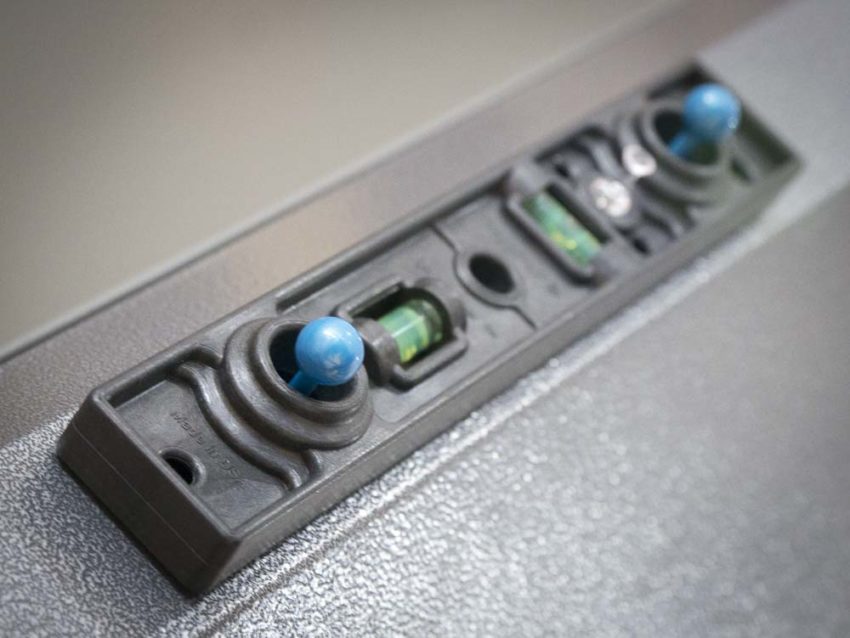
The StudPop Level takes two of these rare‑earth magnets and houses them inside the left and right ends of a 9‑inch ABS plastic spirit level. This duplicates the magnet count, doubling the coverage area as you scan a wall, and gives the tool a second life as a rough layout instrument. The level is exactly 9 inches long, which matches the nominal width of a 2×4 stud (actually 3.5 inches, but the 9‑inch length bridges across a stud cavity and tells you where the stud edges likely lie). Two vials—one horizontal, one plumb—are set into the orange ABS body, surrounded by white backing for contrast. A spring‑loaded grip pin on the backside allows you to press the level into the wall, pin it in place, and let go. It’s conceptually brilliant : find the stud, mark your level line, and pin the level there so you can grab a pencil, a fastener, or a bracket without the tool falling to the floor. And because it costs $15 (often less on Amazon), it’s an impulse‑buy accessory that doesn’t require a pro‑level budget.
Key Features of the StudPop On the Level
- Dual StudPop Magnets: Two rare‑earth neodymium magnets, one at each end, scan for drywall screws or nails behind sheetrock, plaster, tile, and wood lath. No batteries. No calibration. No false positives from live electrical wires (magnets ignore copper).
- 9‑Inch ABS Spirit Level: A plastic body with horizontal and plumb vials. The 9‑inch length matches a 2×4 stud’s nominal width, helping you visualize the stud edges when the level is centered on a screw.
- Grip Pin: A small, spring‑loaded steel pin on the back presses into the wall surface, holding the level in place while you work. Leaves a tiny pinhole, easily patched or ignored.
- Works on Multiple Materials: Because the magnets seek ferrous fasteners, they can penetrate non‑ferrous finishes—drywall, plaster, ceramic tile, wood lath, even stucco—as long as there’s a steel screw or nail close to the surface.
- No Electronics: No batteries, no sensor degradation, no ghost readings from moisture or temperature. Just physics.
- Lightweight and Compact: 9 inches long, weighs next to nothing, slips into a tool bag or a kitchen drawer without consuming space.
Design and Build : ABS Plastic That’s Tough Enough for the Job—But Not a Precision Instrument
The moment you pick up the StudPop Level, you’ll notice it’s not trying to compete with a machined aluminum Stabila. The body is molded ABS—a rugged, impact‑resistant polymer that can survive drops onto concrete, kicks across a subfloor, and the occasional unintentional hammer strike. It’s the same material used for power tool housings and automotive trim; it takes a beating without cracking. The orange color makes it highly visible against drywall, wood, and piles of tools, and the white backing behind the vials provides decent contrast. The two StudPop magnets protrude slightly from the back face, ensuring they’re the only points of contact with the wall. This prevents the level from scratching paint or marring wallpaper, because the plastic body floats a millimeter above the surface.
However, the ABS construction also signals that this level is a rough‑layout tool, not a precision instrument. The vials are simple, un‑magnified, and glued into the plastic frame. The stated accuracy is not published—and that’s intentional. Kapro, Empire, and Stabila can guarantee 0.0005 inches per inch because their frames are rigid aluminum, their vials are individually calibrated and locked, and their milling is precise. The StudPop Level’s plastic body can flex slightly under pressure, and the vials are likely set to a tolerance of a few millimeters per meter—fine for hanging a picture, not fine for setting a cabinet run. As a level, it’s a step above the bubble in a pack of shelf brackets and a step below a $10 torpedo. Use it for preliminary marks, for rough alignment, for finding vertical and horizontal references before you break out the real level. Don’t expect it to replace your 24‑inch box beam.
The dual StudPop magnets are the real stars, and they live up to the rare‑earth billing. Sweep the level across a wall covered in 5/8‑inch drywall, and the magnets will find a screw and latch on with a solid, satisfying click. The magnetic pull is strong enough that you can let go of the level and it hangs vertically or horizontally without falling. That’s a huge upgrade from the old ceramic‑magnet stud finders that would hold only if the screw was exactly centered and the wall was perfectly smooth. The rare‑earth magnets grab from a wider distance and hang on through minor vibrations. And because there are two magnets spaced 9 inches apart, you can sometimes catch two screws in one pass, confirming the stud direction and giving you even more confidence.
The Grip Pin : Genius Idea, Tiny Hole, Noticeable Limitation
The StudPop Level includes a small, sharp steel pin on a spring mechanism in the center of the back face. Press the level against the wall and the pin retracts; when you want to leave the level in place, you press firmly and the pin sinks into the drywall or plaster, holding the level exactly where you found the stud. It’s a clever answer to the question “How do I mark this spot when I’m working alone?” You don’t need a helper, you don’t need painter’s tape, you just press the pin home and the level hangs there. The hole it leaves is about the diameter of a sewing needle and can be filled with a dab of spackle in seconds. If you’re mounting something that will cover the area anyway—a bracket, a painting, a grab bar—the pinhole is a complete non‑issue.
There is a subtle limitation, though. The grip pin only holds the level when there’s a stud directly behind the center of the tool, or very close to it. If you’ve found a screw near the left magnet, the center of the level may be over empty drywall cavity, and the pin will have nothing to bite into—it will simply pop back out, and the level will fall. The original standalone StudPop, being a single disc, could grip a screw on its own and stay put without a pin, because its entire body is the magnet. The StudPop Level is heavier (two magnets plus the plastic body) and can’t rely on magnet friction alone to hold against gravity on a vertical wall, so the pin is necessary, but less reliable if the screw isn’t near center. In practice, you’ll find a screw, slide the level until the magnet clicks, then gently press the pin in; if it bites, great. If not, you’ll hold the level with one hand while marking with the other, which is no worse than using any other stud finder. Just don’t expect the pin to work every single time.
Using the StudPop On the Level : A Game of Hide‑and‑Seek with Hidden Screws
We put the StudPop Level through its paces on several projects—hanging shelves in a kitchen with 1/2‑inch drywall, mounting a grab bar in a tiled bathroom, and building a pallet wood accent wall for our video set. The experience was a mix of nostalgic fun and modern frustration, depending on the task.
On the drywall shelf project, the StudPop Level performed exactly as advertised. I swept it horizontally at the desired height, felt the magnets click onto screw heads, and made pencil marks. The 9‑inch length gave me a visual reference for the stud width, and I could quickly see that my marks were roughly centered on 16‑inch spacing. Drilling into those marks hit solid wood every time. The level’s vials helped me keep the shelf brackets aligned before I drove the screws. Total time from unboxing to finished shelf : under 20 minutes, with zero batteries and zero false positives. I enjoyed the process—the tactile feedback of the magnets snapping onto fasteners is oddly satisfying, like popping bubble wrap.
In the tiled bathroom, the StudPop Level faced a tougher test. Ceramic tile and cement board add thickness and density that can reduce a magnet’s effective range. The rare‑earth magnets still found screws, but it took slower, more deliberate passes, and the clicking sensation was less pronounced. I had to sweep each area multiple times, marking every candidate spot before cross‑referencing with a level to ensure they aligned vertically (indicating a stud). The process worked, but it was slower than using my Franklin ProSensor T6, which instantly displays the entire stud width and depth in real‑time. If I were doing this daily for a living, I’d reach for the electronic finder every time. But for a one‑off DIY grab bar install where I didn’t want to buy a $50 sensor, the StudPop Level got the job done at a fraction of the cost.
The pallet wall project was where the StudPop Level met its match. Clint, one of our team members, was attaching reclaimed pallet boards to a stud wall covered in 3/4‑inch rough‑sawn wood. The irregular gaps, varying board thicknesses, and hidden nail heads from the pallet wood itself created a nightmare of false magnetic signals. The StudPop magnets kept sticking to old pallet nails, not the drywall screws underneath. An electronic stud finder with a depth‑detection mode would have ignored the surface nails and focused on the studs behind. After an hour of frustration, Clint swapped the StudPop Level for his Ryobi Whole Stud Finder and finished the job in half the time. His reaction sums up the magnetic finder’s eternal tradeoff : “I gave the StudPop Level an honest shot, but knowing I had electronic options available sent it home halfway through the project.”
Stud Width Awareness : The 9‑Inch Span Is Clever, Not Magic
The StudPop Level’s 9‑inch length was chosen to match the width of a standard 2×4 stud (3.5 inches) plus some margin on either side. The idea is that when you find a screw and center the level over it, the ends of the level roughly correspond to the stud’s edges, giving you a target area for drilling. This works beautifully if the screw is exactly in the center of the stud—but drywall screws are rarely perfectly centered. Framers drive screws quickly, often at a slight angle, and they can land anywhere within the stud’s width. If the screw is near the stud’s left edge, centering the level over it will put the level’s ends mostly over air on the right side, and you’ll be drilling into the void.
The correct technique is not to use the level as a literal stud‑edge indicator, but as a visual guide combined with common sense. Once you’ve located a screw, mark it. Then slide the level so the screw mark is somewhere inside the 9‑inch span, and use the vials to draw a level line. Drill along that line, but stay within the 3.5‑inch zone you know the stud occupies. The level’s width is a helpful reminder of where the stud could be, not a guarantee. If you’re uncertain, find multiple screws along the same vertical line to confirm the stud’s exact path. The StudPop Level’s dual magnets are great for this, because you can often catch two screws on the same stud (one near each magnet) and connect them mentally into a vertical plumb line.
The Noise Factor : Double the Magnets, Double the Chatter
One thing the original StudPop review notes and the StudPop Level amplifies : noise. When you glide a single magnet across a wall, it slides relatively quietly until it clicks onto a screw. Two magnets, spaced 9 inches apart, create twice the scraping and clicking sounds. The plastic body also acts as a resonator, rattling slightly as the magnets move over texture. On a smooth wall, it’s a soft whoosh‑click. On a textured orange‑peel or knockdown finish, it’s a more pronounced scratch‑scratch‑snap. It’s not loud enough to disturb a sleeping baby, but it’s noticeable enough that using the StudPop Level in a quiet house while the family sleeps might earn you a groggy glare. An electronic stud finder, by contrast, is virtually silent until it beeps. This is a matter of personal tolerance; some find the auditory feedback reassuring, others find it grating. Consider your working environment.
Specifications at a Glance
| Specification | Detail |
|---|---|
| Model | StudPop On the Level (StudPop Level) |
| Magnet Type | Dual rare‑earth neodymium StudPops |
| Level Length | 9 inches (matches 2×4 stud width) |
| Level Vials | Horizontal and plumb, dual‑line |
| Body Material | ABS plastic |
| Grip Pin | Spring‑loaded steel pin, leaves pinhole |
| Compatible Surfaces | Drywall (sheetrock), plaster, tile, wood lath, stucco (non‑ferrous) |
| Batteries Required | None |
| Weight | Under 4 ounces |
| Price | $15 – $20 (varies; available on Amazon) |
StudPop Level vs. Electronic Stud Finders : The Eternal Debate, Resolved
The choice between magnetic and electronic stud finders isn’t about which one is better—it’s about which one is appropriate for your wall type, your project scale, and your patience. Here’s a comparison to help you decide.
| Criterion | StudPop Level (Magnetic) | Electronic Stud Finder (e.g., Franklin ProSensor T6) |
|---|---|---|
| Detection Method | Rare‑earth magnet locates ferrous fasteners | Multi‑sensor detects dielectric density change of stud behind drywall |
| False Positives | Low on simple walls; high if stray nails/screws present | Low to moderate; can misinterpret pipes, wires, or moisture |
| Batteries | None | Typically 9V or AAA |
| Calibration | Never needed | Often required; sensitive to start position |
| Works Through | Drywall, plaster, tile, lath—any non‑ferrous material within magnetic range | Drywall up to 1.5″, some models through thin tile or plaster |
| Stud Width Display | No; only finds screw locations | Yes; many models display whole stud edge‑to‑edge |
| Speed | Moderate; requires sweeping and searching | Fast; instant readout with multiple LEDs |
| Price | $15 | $50 – $70 |
| Includes Level | Yes, 9‑inch spirit level (basic accuracy) | No; separate level required |
As the table shows, the StudPop Level excels in simplicity, cost, and the ability to function through materials that confuse electronic sensors. It’s the tool to keep in a kitchen junk drawer or a tool bag for those “I need to hang something now” moments. The electronic finder is the specialist for large projects, walls with complicated substructures, or when you need to know the stud’s exact center for heavy‑duty mounting. Many Pros carry both : a magnetic finder for quick checks and a high‑end electronic sensor for serious layout. The StudPop Level, with its added level functionality, makes a compelling case for being the magnetic finder of choice.
Who Should Buy the StudPop On the Level?
The target audience for the StudPop Level is broad, but it skews toward DIYers, apartment dwellers, and professionals who want a backup that never needs batteries. If any of the following sound like you, the StudPop Level deserves a spot in your toolkit.
- DIY Homeowners: You hang shelves, curtain rods, and wall art. You need a reliable, foolproof way to find studs without learning a calibration ritual. The StudPop Level is intuitive, inexpensive, and doesn’t require you to read a manual. The level vials help you keep things straight without a separate tool.
- Renters: You can’t afford to dent walls or leave large holes, but you still want to mount things securely. The StudPop Level leaves only tiny pinholes (from the grip pin) that are easily hidden or filled. It’s also cheap enough that you won’t weep if you lose it during a move.
- Professionals as a Backup: Electricians, plumbers, and general contractors often encounter dead battery situations on their electronic finders mid‑job. A StudPop Level in the glove box or bottom of the tool bag acts as a bulletproof backup that will never let them down. It’s also superior for scanning walls with metal lath or thick plaster, where electronic sensors struggle.
- Tile and Plaster Specialists: Because the magnets work through ceramic and thick plaster, the StudPop Level is one of the few stud finders that can reliably locate fasteners behind these challenging materials. Tile installers and bathroom remodelers will appreciate this capability.
Who Should Pass and Stick with Electronic Detection
- Production Framers and Drywallers: If you’re locating studs all day, every day, the speed and visual feedback of an electronic whole‑stud finder will save you hours over a week. The StudPop Level’s slower, more methodical search is fine for occasional use, but it becomes tedious on an assembly‑line schedule.
- Commercial and Industrial Trades: Walls with multiple layers of drywall, fire‑rated assemblies, sound isolation clips, and hidden metal channels can confuse a magnetic finder. Electronic sensors with deep‑scan modes or ultrasonic capabilities are better suited to these complex wall structures.
- Anyone Working on Walls with Embedded Metal Mesh: If a wall has metal lath or mesh, the StudPop magnets will stick everywhere and tell you nothing useful. Electronic finders can sometimes ignore the mesh and locate the studs underneath, but magnetic finders are essentially useless in this scenario.
- Perfectionists Who Need Stud Edge Precision: If you must know exactly where the stud edges are—for seismic brackets, heavy cabinetry, or ledger boards—an electronic finder with edge‑detection LEDs is the correct tool. The StudPop Level gets you close, but you’ll still need to confirm with a pilot drill or multiple screw marks.
Editor’s Note : Our Top Stud Finder Picks
For those who want to explore the full landscape of stud finders, from magnetic to electronic to radar‑based, we recommend checking out our comprehensive best stud finder article. It breaks down our top picks across categories, including the Franklin ProSensor T6 for whole‑stud detection, the Ryobi Whole Stud Finder for budget‑friendly electronic performance, and the StudPop family for the best magnetic options. The StudPop On the Level earns its place in that lineup as the best magnetic stud finder with an integrated level—a unique niche that no other finder occupies at this price.
Real‑World Testing Verdict : A Tool That Wins on Simplicity, Not Speed
After weeks of daily use, the StudPop Level has earned a permanent spot in my kitchen drawer—not my primary tool bag, because I rely on faster electronic sensors for most professional work, but in that drawer where I keep the household tools I reach for on a Saturday morning when a picture frame needs hanging. It has never failed to find a stud in standard drywall. It has never needed a battery. It has never beeped erratically over a metal junction box and sent me drilling into a live wire (because magnets ignore copper). Its level, while not pro‑grade, has kept my shelf brackets from sloping visibly. And its grip pin, when it bites, has given me that third‑hand convenience that makes solo work feel like a two‑person job.
The StudPop On the Level is not the most advanced stud finder on the market. It is not the fastest, nor the most feature‑rich. But it might be the most honest. It doesn’t pretend to see inside walls; it feels its way there with the unerring attraction of a rare‑earth magnet to a screw. It doesn’t promise sub‑millimeter accuracy; it gives you a bubble that gets you close and then gets out of the way. And it does all of this for roughly the price of a large pizza with toppings. For DIYers, renters, and budget‑conscious Pros who want a magnetic stud finder that also tells them which way is up, the StudPop Level is a tough deal to beat.
You can pick up the StudPop On the Level on Amazon for around $15. At that price, you can buy one for every floor of the house and still spend less than a single professional electronic finder. If nothing else, it’s a satisfying little tool that will make you smile the first time it clicks onto a hidden screw and refuses to let go. And in an era of over‑complicated gadgets, that tactile joy is worth something all by itself.
Comments 0
Leave a Comment